Estimate photo footprint polygons from centroids and scale
Source:R/fly_footprint.R
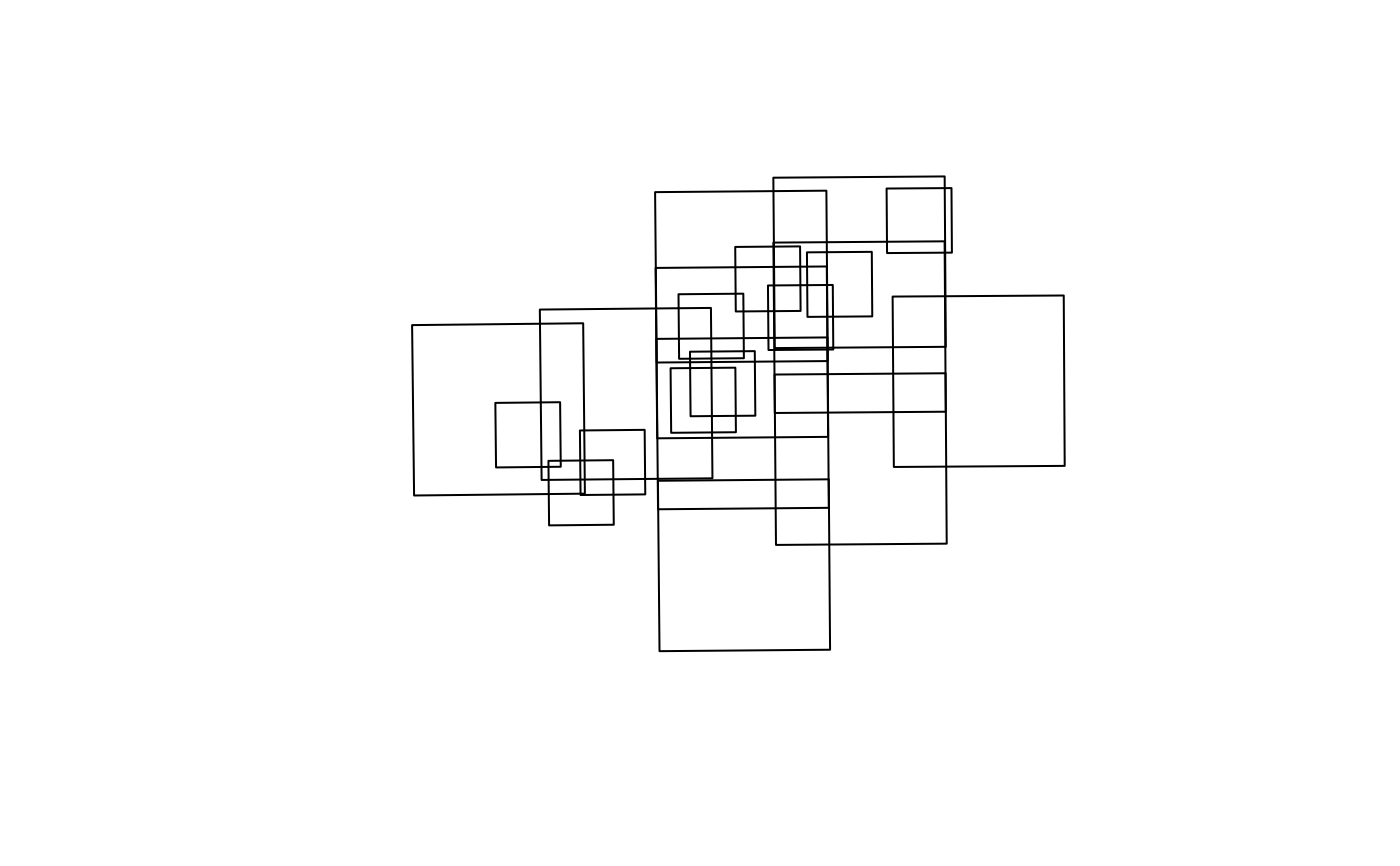
fly_footprint.RdCreates rectangular polygons representing the estimated ground coverage of each airphoto, based on film negative dimensions and the reported scale.
Details
Ground coverage is computed as negative_size * scale_number * 0.0254 metres
per side. Rectangles are constructed in BC Albers (EPSG:3005) for accurate
metric distances, then transformed back to the input CRS.
The scale denominator is parsed from the scale column string (e.g.
"1:12000" becomes 12000).
9x9 assumption: the default negative_size = 9 (inches) reflects the
standard 228 mm format used by BC aerial survey cameras (e.g. Wild RC-10,
Zeiss RMK). The BC Air Photo Database records camera focal length per roll
(Type 02 field 3.2.2) but this is not available in the simplified centroid
data from the catalogue. If working with non-standard format photography,
override negative_size accordingly.
Flat-terrain assumption: footprints are estimated assuming flat ground
beneath the aircraft. In reality terrain slope changes the actual ground
coverage — downhill slopes increase the true footprint (ground falls away
from the camera), while uphill slopes reduce it. In steep terrain typical
of BC valleys, true footprints may differ meaningfully from these estimates.
Coverage and overlap calculations downstream (e.g. fly_coverage(),
fly_overlap()) inherit this limitation.
Examples
centroids <- sf::st_read(system.file("testdata/photo_centroids.gpkg", package = "fly"))
#> Reading layer `photo_centroids' from data source
#>   `/home/runner/work/_temp/Library/fly/testdata/photo_centroids.gpkg'
#>   using driver `GPKG'
#> Simple feature collection with 20 features and 9 fields
#> Geometry type: POINT
#> Dimension:     XY
#> Bounding box:  xmin: -126.7631 ymin: 54.34512 xmax: -126.449 ymax: 54.47635
#> Geodetic CRS:  WGS 84
footprints <- fly_footprint(centroids)
plot(sf::st_geometry(footprints))