
Land Cover Change Detection for Floodplains
Source:vignettes/land-cover-change.Rmd
land-cover-change.RmdThis vignette demonstrates the drift pipeline using a small floodplain reach on Neexdzii Kwa (Upper Bulkley River) in northern BC. We compare Esri IO LULC land cover across 2017, 2020, and 2023 to track vegetation and land use change in the riparian zone.
The AOI polygon was delineated using the flooded package, which identifies floodplain extents from DEMs and stream networks.
The example data ships with the package — no STAC queries or database connections needed.
Load Data
library(drift)
#>
#>  'It's feeling confident I'm going to go up with the music, but I'm down every day. It's the challenge of trying to be the best at your worst times.' - Offset
#>   source
library(terra)
#> terra 1.9.50
library(sf)
#> Linking to GEOS 3.12.1, GDAL 3.8.4, PROJ 9.4.0; sf_use_s2() is TRUE

# AOI polygon (floodplain delineated via flooded package)
aoi <- sf::st_read(
  system.file("extdata", "example_aoi.gpkg", package = "drift"),
  quiet = TRUE
)

# IO LULC rasters for 3 years
years <- c(2017, 2020, 2023)
rasters <- lapply(years, function(yr) {
  terra::rast(system.file("extdata", paste0("example_", yr, ".tif"),
                          package = "drift"))
})
names(rasters) <- years
Classify
Apply IO LULC class names and colors from the shipped class table.
classified <- dft_rast_classify(rasters, source = "io-lulc")

# Check factor levels
terra::levels(classified[["2020"]])[[1]]
#>   id class_name
#> 1  1      Water
#> 2  2      Trees
#> 3  5      Crops
#> 4  7 Built Area
#> 5  9   Snow/Ice
#> 6 11  Rangeland
Classified Rasters
The figure below shows the three classified time steps side by side.
stacked <- terra::rast(classified)
names(stacked) <- names(classified)
terra::plot(stacked, axes = FALSE, mar = c(1, 1, 2, 1))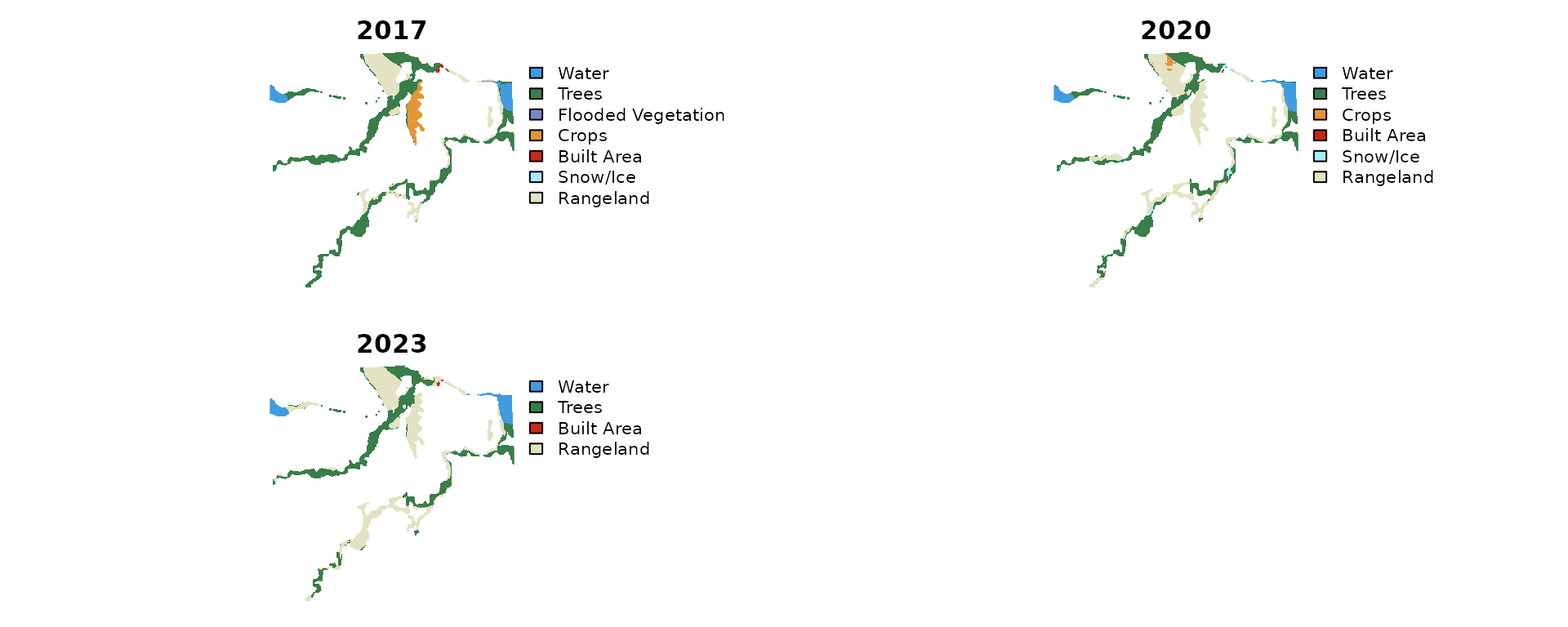
Classified land cover for the Neexdzii Kwa floodplain reach across three time steps.
Area Summary
The following table shows area by class for each year and the net change between 2017 and 2023, sorted by magnitude of change.
summary_tbl <- dft_rast_summarize(classified, source = "io-lulc", unit = "ha")
library(dplyr)
#>
#> Attaching package: 'dplyr'
#> The following objects are masked from 'package:terra':
#>
#>     intersect, union
#> The following objects are masked from 'package:stats':
#>
#>     filter, lag
#> The following objects are masked from 'package:base':
#>
#>     intersect, setdiff, setequal, union
library(tidyr)
#>
#> Attaching package: 'tidyr'
#> The following object is masked from 'package:terra':
#>
#>     extract

change <- summary_tbl |>
  dplyr::select(year, class_name, area) |>
  tidyr::pivot_wider(names_from = year, values_from = area, values_fill = list(area = 0)) |>
  dplyr::mutate(
    change = `2023` - `2017`,
    pct_change = round(change / `2017` * 100, 1)
  ) |>
  dplyr::arrange(dplyr::desc(abs(change)))

knitr::kable(change, digits = 2, caption = "Net land cover change 2017--2023 (ha), sorted by absolute change.")| class_name | 2017 | 2020 | 2023 | change | pct_change |
|---|---|---|---|---|---|
| Rangeland | 31.86 | 53.38 | 61.67 | 29.81 | 93.6 |
| Trees | 71.27 | 55.42 | 50.07 | -21.20 | -29.7 |
| Crops | 9.98 | 1.47 | 0.00 | -9.98 | -100.0 |
| Water | 9.41 | 10.89 | 11.11 | 1.70 | 18.1 |
| Built Area | 0.55 | 0.10 | 0.26 | -0.29 | -52.7 |
| Flooded Vegetation | 0.02 | 0.00 | 0.00 | -0.02 | -100.0 |
| Snow/Ice | 0.02 | 1.85 | 0.00 | -0.02 | -100.0 |
Vegetation Change
Trees and Rangeland show the clearest signal below — tree cover declining while rangeland expands.
library(ggplot2)

summary_tbl |>
  dplyr::filter(class_name %in% c("Trees", "Rangeland")) |>
  ggplot(aes(x = year, y = area, fill = year)) +
  geom_col() +
  facet_wrap(~class_name, scales = "free_y") +
  scale_fill_brewer(palette = "YlGnBu") +
  labs(y = "Area (ha)", x = NULL, fill = "Year",
       title = "Vegetation cover in Neexdzii Kwa floodplain") +
  theme_minimal()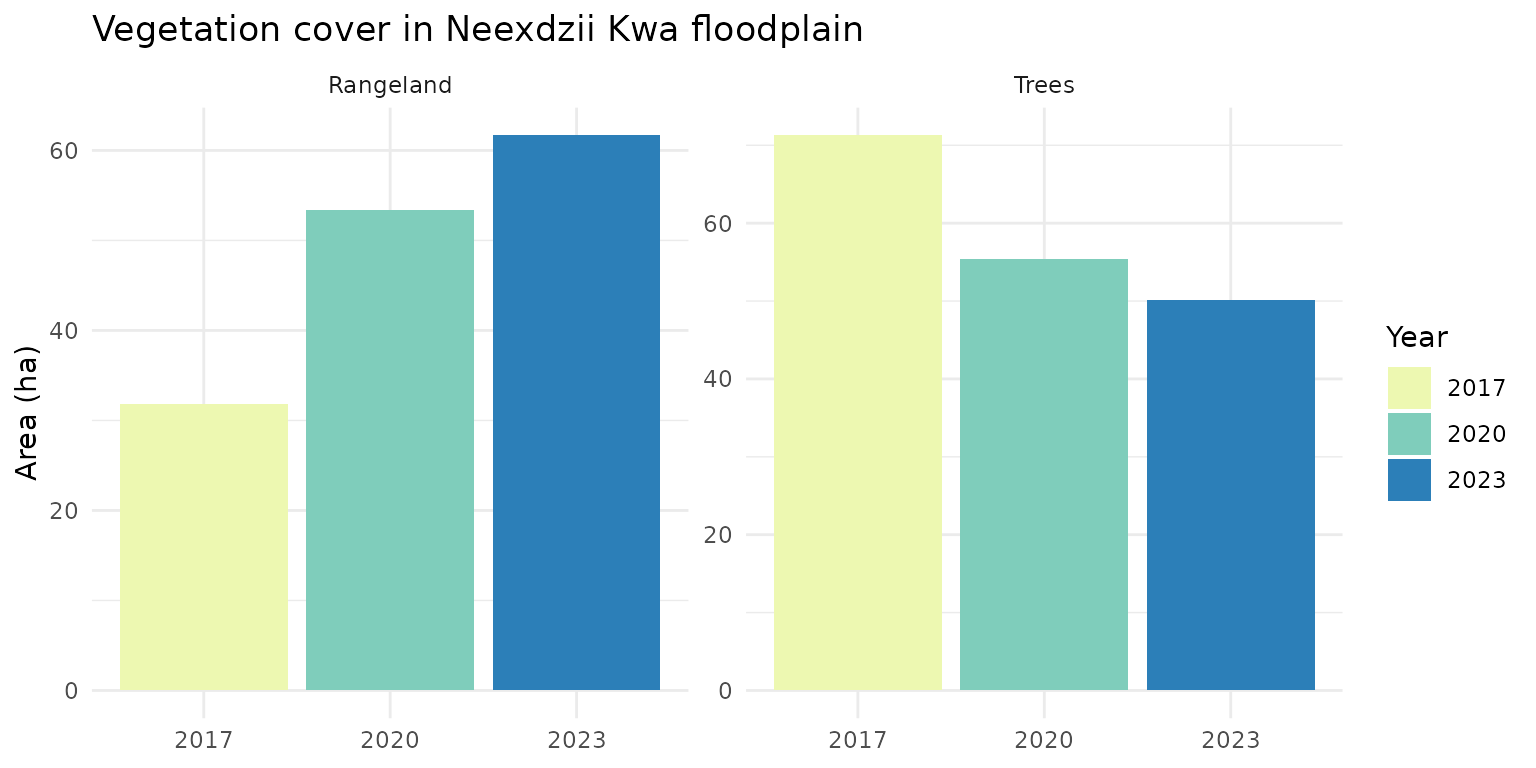
Dominant vegetation classes over time in the Neexdzii Kwa floodplain.
Transition Detection
dft_rast_transition() compares two rasters cell-by-cell
and returns a transition raster plus a summary table. The first table
below shows the area that remained in the same class (stable pixels),
while the second shows pixels that changed class. Only transitions
representing more than 1% of the total area are shown.
result <- dft_rast_transition(classified, from = "2017", to = "2023")

stable <- result$summary |>
  dplyr::filter(from_class == to_class) |>
  dplyr::filter(pct >= 1) |>
  dplyr::arrange(dplyr::desc(area))

changed <- result$summary |>
  dplyr::filter(from_class != to_class) |>
  dplyr::filter(pct >= 1) |>
  dplyr::arrange(dplyr::desc(area))
knitr::kable(stable, digits = 2,
caption = "Stable land cover 2017--2023 (only transitions >1% of total area shown).")| from_class | to_class | n_cells | area | pct |
|---|---|---|---|---|
| Trees | Trees | 4918 | 49.18 | 39.95 |
| Rangeland | Rangeland | 3026 | 30.26 | 24.58 |
| Water | Water | 938 | 9.38 | 7.62 |
knitr::kable(changed, digits = 2,
caption = "Land cover transitions 2017--2023 (only transitions >1% of total area shown).")| from_class | to_class | n_cells | area | pct |
|---|---|---|---|---|
| Trees | Rangeland | 2111 | 21.11 | 17.15 |
| Crops | Rangeland | 998 | 9.98 | 8.11 |
Grouping Classes for Domain-Specific Analysis
Fine-grained LULC classes can be grouped into categories relevant to a specific analysis. Here we demonstrate grouping Crops, Rangeland, and Bare Ground as “Agriculture” — at 10 m resolution these classes can represent different phases of the same land use depending on satellite overpass timing.
The table below shows the area of Trees in 2017 that transitioned to agriculture-related classes by 2023.
ag_classes <- c("Crops", "Rangeland", "Bare Ground")

# All transitions from Trees to get total Trees-origin pixel count
all_from_trees <- dft_rast_transition(classified, from = "2017", to = "2023",
                                       from_class = "Trees")
total_tree_cells <- sum(all_from_trees$summary$n_cells)

# Filter to agriculture classes
tree_loss <- dft_rast_transition(classified, from = "2017", to = "2023",
                                  from_class = "Trees",
                                  to_class = ag_classes)

# Relabel as Agriculture and compute pct of all Trees-origin pixels
tree_loss_tbl <- tree_loss$summary |>
  dplyr::mutate(to_class = "Agriculture") |>
  dplyr::group_by(from_class, to_class) |>
  dplyr::summarize(n_cells = sum(n_cells), area = sum(area), .groups = "drop") |>
  dplyr::mutate(pct_of_trees = round(n_cells / total_tree_cells * 100, 2))

knitr::kable(tree_loss_tbl, digits = 2,
caption = "Tree loss to agriculture (Crops + Rangeland + Bare Ground) 2017--2023. Percent is of all pixels classified as Trees in 2017.")| from_class | to_class | n_cells | area | pct_of_trees |
|---|---|---|---|---|
| Trees | Agriculture | 2111 | 21.11 | 29.62 |
Transition Raster
The figure below maps pixels that changed class between 2017 and 2023. Only transitions representing more than 1% of the total area are shown; minor transitions are masked. The AOI outline is shown in red.
trans_vals <- terra::values(result$raster)[, 1]
lvls <- terra::cats(result$raster)[[1]]

# Get codes for transitions >= 1% (excluding stable)
sig_labels <- changed$from_class  # already filtered to >1% and from != to
sig_transitions <- paste0(changed$from_class, " -> ", changed$to_class)
sig_codes <- lvls$id[lvls$transition %in% sig_transitions]

# Mask everything except significant transitions
change_vals <- rep(NA_integer_, length(trans_vals))
change_vals[trans_vals %in% sig_codes] <- trans_vals[trans_vals %in% sig_codes]
r_change <- terra::rast(result$raster)
terra::values(r_change) <- change_vals

# Keep only significant factor levels
change_lvls <- lvls[lvls$id %in% sig_codes, , drop = FALSE]
terra::set.cats(r_change, layer = 1, value = change_lvls)

terra::plot(r_change, main = "Land cover transitions 2017\u20132023",
            axes = FALSE, mar = c(1, 1, 2, 6))
plot(sf::st_geometry(sf::st_transform(aoi, terra::crs(r_change))),
     add = TRUE, border = "red", lwd = 2)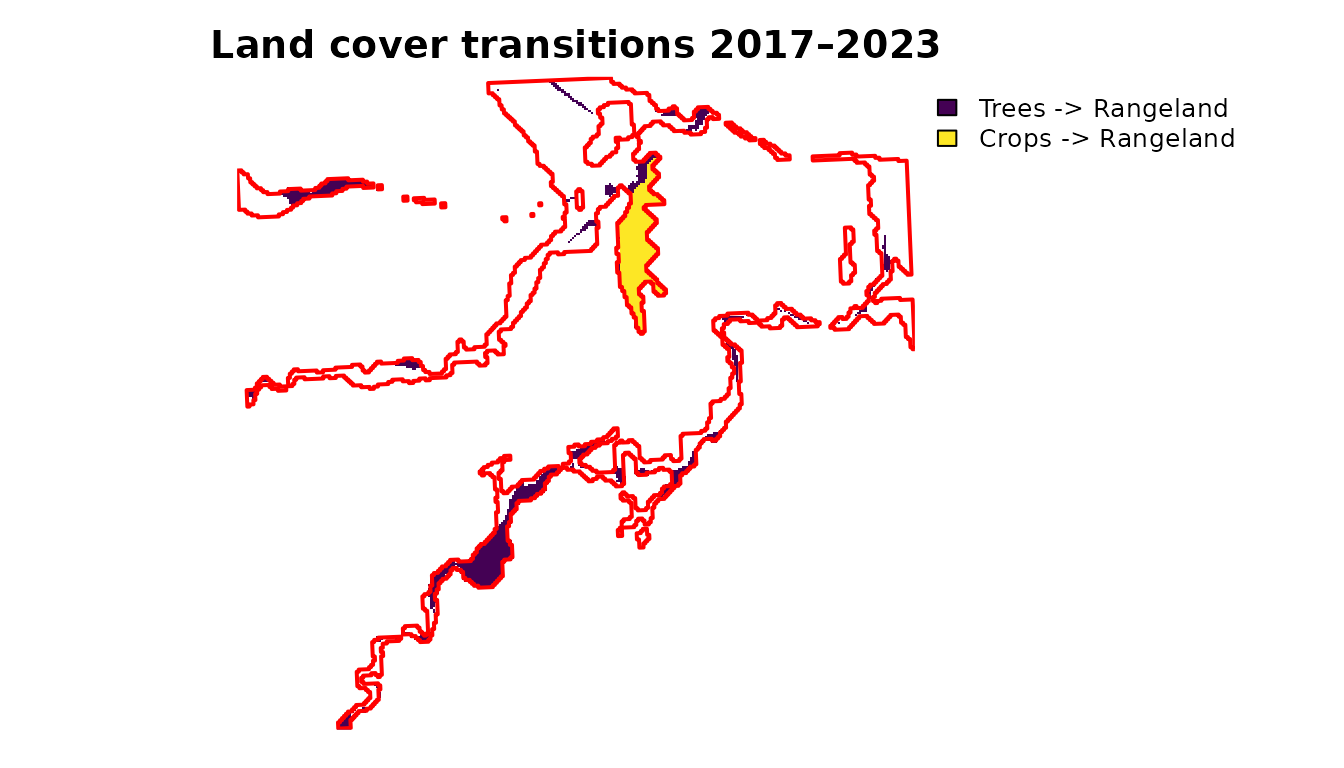
Spatial distribution of land cover transitions 2017–2023 (only transitions >1% of total area shown).
Filtering Classification Noise
At 10 m resolution, many detected transitions are single-pixel or
small-cluster noise from field-forest edge effects, seasonal canopy
variation, or sensor timing differences. The patch_area_min
parameter removes connected patches of changed pixels smaller than a
threshold (in m²) before computing the summary.
patch_min <- 5000
n_pixels <- patch_min / prod(terra::res(classified[[1]]))

result_filtered <- dft_rast_transition(classified, from = "2017", to = "2023",
                                       patch_area_min = patch_min)

changed_filtered <- result_filtered$summary |>
  dplyr::filter(from_class != to_class) |>
  dplyr::filter(pct >= 1) |>
  dplyr::arrange(dplyr::desc(area))

# Comparison table: unfiltered vs filtered
comparison <- changed |>
  dplyr::select(from_class, to_class, n_cells, area) |>
  dplyr::left_join(
    changed_filtered |>
      dplyr::select(from_class, to_class,
                    n_cells_filtered = n_cells, area_filtered = area),
    by = c("from_class", "to_class")
  ) |>
  dplyr::mutate(
    dplyr::across(c(n_cells_filtered, area_filtered), ~tidyr::replace_na(.x, 0)),
    cells_removed = n_cells - n_cells_filtered,
    area_removed = area - area_filtered
  )
Filtering at 5,000 m² (50 pixels at 10 m resolution) removed 481 pixels (4.81 ha) of small isolated changes. The table below compares unfiltered and filtered results.
knitr::kable(comparison, digits = 2, col.names = c(
  "From", "To", "Cells", "Area (ha)", "Cells (filtered)",
  "Area (filtered)", "Cells removed", "Area removed"
), caption = paste0(
  "Land cover transitions 2017--2023: unfiltered vs filtered (min patch area ",
format(patch_min, big.mark = ","), " m\u00b2)."))| From | To | Cells | Area (ha) | Cells (filtered) | Area (filtered) | Cells removed | Area removed |
|---|---|---|---|---|---|---|---|
| Trees | Rangeland | 2111 | 21.11 | 1632 | 16.32 | 479 | 4.79 |
| Crops | Rangeland | 998 | 9.98 | 996 | 9.96 | 2 | 0.02 |
The figure below shows three views: unfiltered transitions, what the
filter removed ($removed), and the filtered result. The
$removed raster is returned directly by
dft_rast_transition() when patch_area_min is
set.
aoi_proj <- sf::st_geometry(sf::st_transform(aoi, terra::crs(r_change)))

par(mfrow = c(1, 3))
terra::plot(r_change, main = "Unfiltered", axes = FALSE, mar = c(1, 1, 2, 6))
plot(aoi_proj, add = TRUE, border = "red", lwd = 2)
terra::plot(result_filtered$removed, main = "Removed patches", axes = FALSE,
            mar = c(1, 1, 2, 6))
plot(aoi_proj, add = TRUE, border = "red", lwd = 2)
terra::plot(result_filtered$raster, main = paste0("Filtered (min ",
            format(patch_min, big.mark = ","), " m\u00b2)"),
            axes = FALSE, mar = c(1, 1, 2, 6))
plot(aoi_proj, add = TRUE, border = "red", lwd = 2)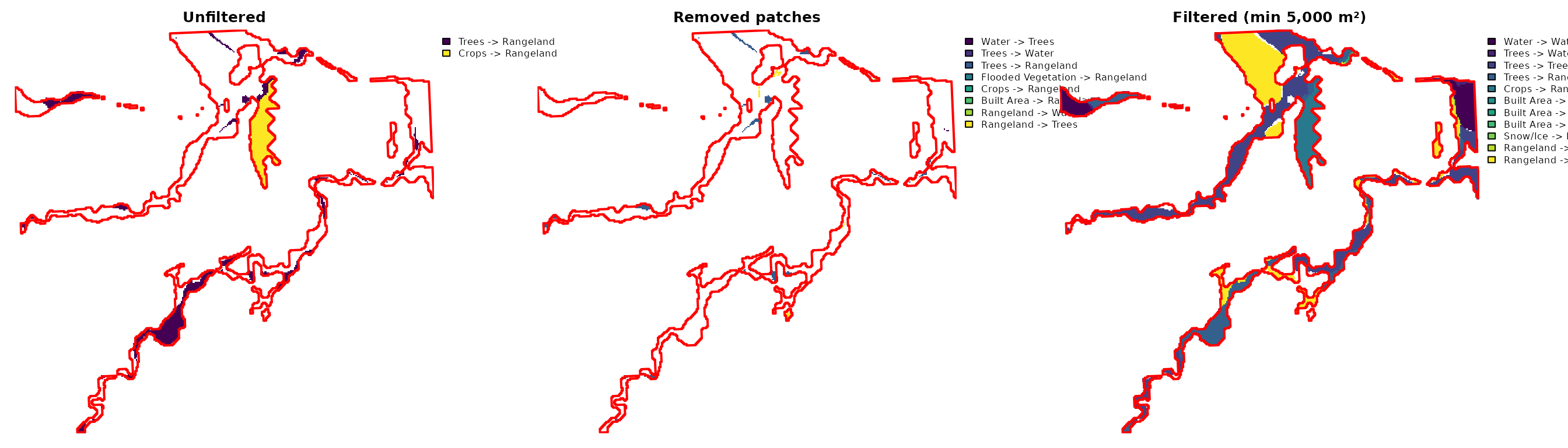
Transition raster before and after minimum patch area filtering (5,000 m²). Centre panel shows removed patches.
Vector Patches
dft_transition_vectors() converts the transition raster
into sf polygons — one row per connected patch. This is the
format needed for GIS QA (click patches, filter by size) and spatial
attribution to management zones.
patches <- dft_transition_vectors(result$raster)

# Only actual changes (exclude same-class "transitions")
patches_changed <- patches[grepl("->", patches$transition) &
  !sapply(strsplit(patches$transition, " -> "), \(x) x[1] == x[2]), ]

knitr::kable(
  head(sf::st_drop_geometry(patches_changed[order(-patches_changed$area_ha), ]), 10),
  digits = 2,
  caption = "Ten largest change patches (same-class transitions excluded)."
)| patch_id | transition | area_ha | |
|---|---|---|---|
| 35 | 35 | Crops -> Rangeland | 9.96 |
| 139 | 139 | Trees -> Rangeland | 7.99 |
| 55 | 55 | Trees -> Rangeland | 2.41 |
| 129 | 129 | Trees -> Rangeland | 1.51 |
| 27 | 27 | Trees -> Rangeland | 0.94 |
| 130 | 130 | Trees -> Rangeland | 0.81 |
| 109 | 109 | Trees -> Rangeland | 0.75 |
| 9 | 9 | Trees -> Rangeland | 0.70 |
| 38 | 38 | Trees -> Water | 0.55 |
| 164 | 164 | Trees -> Rangeland | 0.53 |
When zones is supplied, each patch is intersected with
the zone polygons. Here we use the floodplain AOI as a single zone — in
practice this would be sub-basins, parcels, or management units.
aoi$zone <- "Neexdzii Kwa floodplain"
patches_zoned <- dft_transition_vectors(result$raster, zones = aoi,
                                        zone_col = "zone")
cat("Patches inside AOI:", nrow(patches_zoned), "of", nrow(patches), "total\n")
#> Patches inside AOI: 165 of 165 total
Geometric Artifacts
patch_area_min is a one-dimensional test on a
two-dimensional problem. Area is width times length, and the
classification artifacts that inflate change on a floodplain are
pathological in width: a class boundary that moved by one pixel
between epochs leaves a one-pixel band of “change” along its whole
length, and a channel that shifted leaves Trees -> Water
on one bank and Water -> Trees on the other. A one-pixel
band along a 5 km bank at 30 m is 15 ha — thirty times the 5,000 m²
threshold used above — while a genuine 0.5 ha cutblock is discarded as
speckle. No value of patch_area_min fixes both.
dft_transition_artifact() adds evidence for three
geometric signatures to the patches from
dft_transition_vectors() and drops nothing — the caller
decides. All three are read from the transition raster alone, so they
cost no extra fetch.
changes <- dft_transition_vectors(result$raster, changes_only = TRUE)
tagged <- dft_transition_artifact(changes, result$raster)

by_sliver <- sf::st_drop_geometry(tagged) |>
  dplyr::mutate(width = ifelse(flag_sliver, "Under 1.5 px", "1.5 px or wider")) |>
  dplyr::group_by(width) |>
  dplyr::summarise(n_patches = dplyr::n(), area_ha = sum(area_ha), .groups = "drop") |>
  dplyr::mutate(pct_patches = 100 * n_patches / sum(n_patches),
                pct_area = 100 * area_ha / sum(area_ha))

knitr::kable(by_sliver, digits = 1, col.names = c(
  "Effective width", "Patches", "Area (ha)", "% of patches", "% of area"
), caption = "Change patches 2017--2023 by effective width (2 x area / perimeter).")| Effective width | Patches | Area (ha) | % of patches | % of area |
|---|---|---|---|---|
| 1.5 px or wider | 18 | 28.4 | 19.4 | 83.5 |
| Under 1.5 px | 75 | 5.6 | 80.6 | 16.5 |
Sliver width. Effective width
2 * area / perimeter is about the short side of a thin
rectangle: a single pixel scores 0.5 px, a one-pixel band just under 1
px, a 20 x 20 block 10 px. On this reach 75 of 93 change patches are
under 1.5 px wide, but they hold only 16% of the change area — many
patches, little ground.
Boundary-hugging. Width alone cannot tell a
misregistration band from a new road or a harvested buffer strip, which
are also thin. The discriminator is where the thin patch sits:
a registration artifact traces a boundary that already existed in the
earlier epoch, while a real thin change cuts across one.
boundary_frac is the share of a patch’s cells adjacent
(within boundary_dist_max cells) to a from-epoch cell of
the patch’s to class. Here 48 of the 75 slivers trace a
pre-existing boundary; the other 27 do not, and deserve a look before
being dismissed.
Reciprocity. An A -> B patch with a
B -> A partner of comparable area nearby is the
channel-shift signature — the net change is close to zero. The two bands
sit on opposite banks with the stable channel between them, so the
search is by proximity (reciprocal_dist_max, in pixels)
rather than adjacency. This is a relationship between two patches, which
no per-pixel test can express. 5 patches here have a partner.
tagged$evidence <- dplyr::case_when(
  tagged$flag_sliver & tagged$flag_reciprocal ~ "Sliver, reciprocal partner",
  tagged$flag_sliver & tagged$flag_boundary ~ "Sliver on a pre-existing boundary",
  tagged$flag_sliver ~ "Sliver, crosses classes",
  TRUE ~ "1.5 px or wider"
)
pal <- c(
  "Sliver on a pre-existing boundary" = "#d7301f",
  "Sliver, reciprocal partner" = "#7b3294",
  "Sliver, crosses classes" = "#fdae61",
  "1.5 px or wider" = "#9e9e9e"
)
par(mar = c(0, 0, 0, 0))
plot(sf::st_geometry(tagged), col = pal[tagged$evidence],
     border = pal[tagged$evidence], lwd = 2)
plot(aoi_proj, add = TRUE, border = "black", lwd = 1)
legend("topleft", fill = pal, legend = names(pal), bty = "n", cex = 0.8)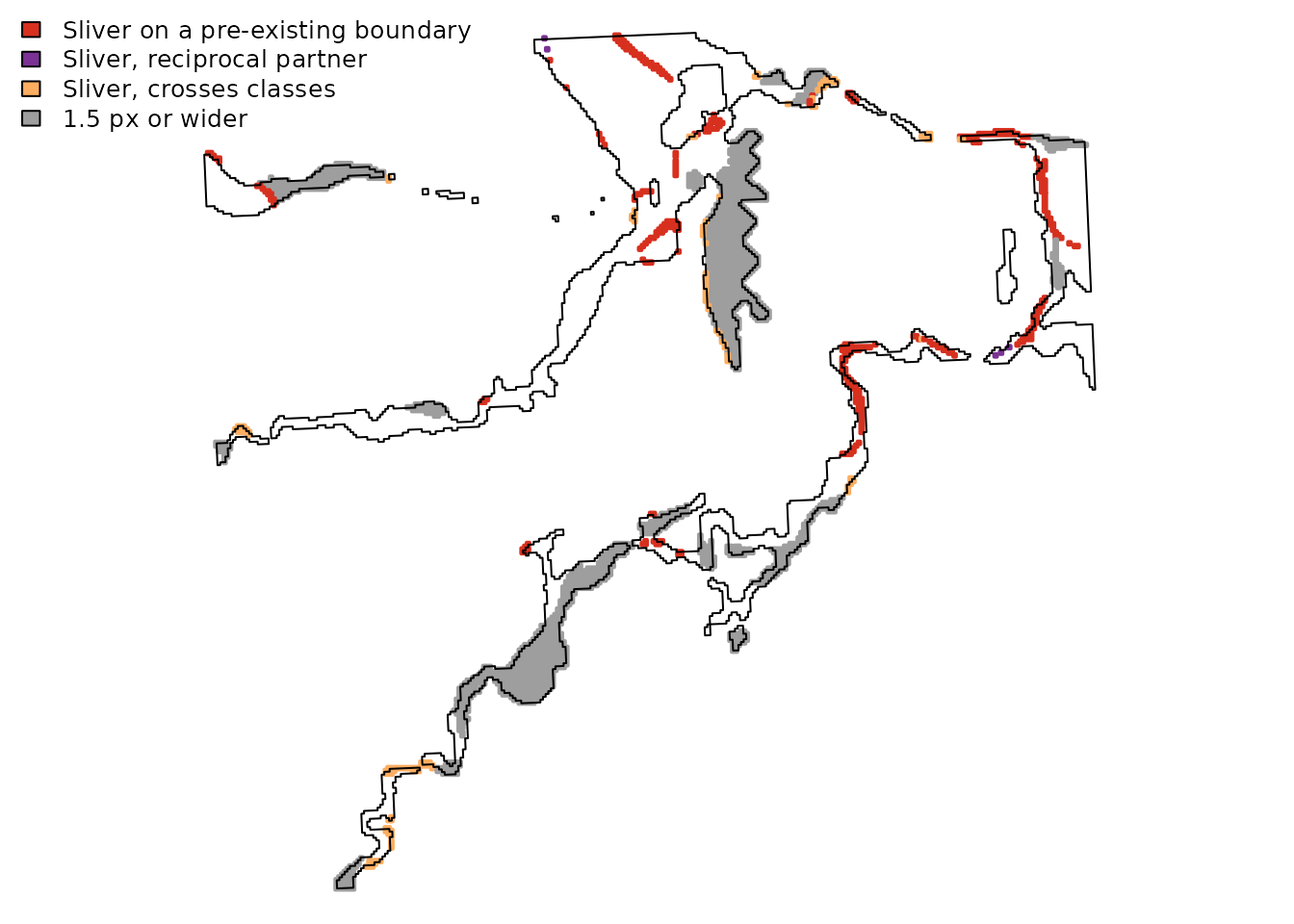
Change patches 2017–2023 by artifact evidence. Slivers on a pre-existing boundary (red) are the misregistration shape; slivers that cross class boundaries (orange) are thin but not explained by a shift; patches with a reciprocal partner (purple) are the channel-shift shape.
The two axes compose. Below are the change patches that survive the
5,000 m² area filter used above, with their artifact evidence: one of
them is a Trees -> Rangeland band 0.75 ha in area and
under 1.5 px wide that traces the 2017 forest edge — exactly the patch
the area filter exists to remove, walking through it on length alone.
With width and boundary evidence in hand, patch_area_min
can be lowered to recover small real changes without readmitting the
slivers.
large <- dft_transition_vectors(result$raster, changes_only = TRUE,
                                patch_area_min = patch_min)
large <- dft_transition_artifact(large, result$raster)

knitr::kable(
  sf::st_drop_geometry(large)[, c("patch_id", "transition", "area_ha", "width_px",
                                  "boundary_frac", "flag_sliver", "flag_boundary")],
  digits = 2,
  col.names = c("Patch", "Transition", "Area (ha)", "Width (px)",
                "Boundary frac.", "Sliver", "On boundary"),
  caption = paste0("Change patches surviving patch_area_min = ",
                   format(patch_min, big.mark = ","), " m\u00b2, with artifact evidence.")
)| Patch | Transition | Area (ha) | Width (px) | Boundary frac. | Sliver | On boundary |
|---|---|---|---|---|---|---|
| 1 | Trees -> Rangeland | 0.70 | 2.41 | 0.10 | FALSE | FALSE |
| 2 | Trees -> Rangeland | 0.94 | 2.35 | 0.00 | FALSE | FALSE |
| 3 | Crops -> Rangeland | 9.96 | 6.78 | 0.01 | FALSE | FALSE |
| 4 | Trees -> Water | 0.55 | 2.12 | 0.49 | FALSE | FALSE |
| 5 | Trees -> Rangeland | 2.41 | 3.71 | 0.00 | FALSE | FALSE |
| 6 | Trees -> Rangeland | 0.75 | 1.44 | 0.71 | TRUE | TRUE |
| 7 | Trees -> Rangeland | 1.51 | 2.19 | 0.10 | FALSE | FALSE |
| 8 | Trees -> Rangeland | 0.81 | 2.79 | 0.21 | FALSE | FALSE |
| 9 | Trees -> Rangeland | 7.99 | 4.87 | 0.11 | FALSE | FALSE |
| 10 | Trees -> Rangeland | 0.53 | 2.41 | 0.00 | FALSE | FALSE |
The independent check is spectral. The Trajectories as a Check on
Land-Cover Change vignette runs dft_rast_break() on a
Sentinel-2 kNDVI cube over the same reach and reads a mapped
Trees -> Rangeland outline with no spectral break as a
label change rather than trees coming off. That route confirms or
refutes individual patches but needs a cube, cannot separate riparian
deciduous trees from grass in peak summer, and cannot see the reciprocal
relationship at all. The geometric tags are the free, categorical-only
complement — use them to rank what to look at, and the trajectories to
settle it.
Temporal Evidence: Switch or Flicker?
The area filter and the geometric tags both work on the two-epoch
comparison, and a two-epoch comparison cannot see time. A
boundary-hugging sliver that is Rangeland in every year but
one is label noise; one that has been Rangeland every year
since 2020 is a real conversion; the geometry is identical. IO LULC is
annual, so the third leg is free: scan each pixel’s class sequence
across every year and ask whether it settled.
dft_rast_break_class() reports, per pixel, whether the
series is stable, a clean switch (one class for N years, then another
for M years, and nothing else) or flicker (more than one change), and
dates the clean switches. Its $raster is the same
from -> to transition layer
dft_rast_transition() produces for the two endpoints, so
the patch tools above take it unchanged. The bundled tile ships all
seven years.
years_all <- 2017:2023
series <- lapply(years_all, function(yr) {
  terra::rast(system.file("extdata", paste0("example_", yr, ".tif"),
                          package = "drift"))
})
names(series) <- years_all
series <- dft_rast_classify(series, source = "io-lulc")

bc <- dft_rast_break_class(series)

changed <- bc$summary |>
  dplyr::filter(from_class != to_class) |>
  dplyr::group_by(status) |>
  dplyr::summarise(n_cells = sum(n_cells), area_ha = sum(area), .groups = "drop") |>
  dplyr::mutate(pct_area = 100 * area_ha / sum(area_ha))

knitr::kable(changed, digits = 1, col.names = c(
  "Status", "Cells", "Area (ha)", "% of changed area"
), caption = "Pixels that differ between 2017 and 2023, by what the years in between say.")| Status | Cells | Area (ha) | % of changed area |
|---|---|---|---|
| break | 2138 | 21.4 | 62.8 |
| flicker | 1265 | 12.7 | 37.2 |
37% of the ground the two-epoch comparison reports as changed never settled: the label switched back and forth across the seven years. That is the categorical-only reading of the trajectory vignette’s “outline with no red” — a borderline pixel changing label, not trees coming off — and it needs no cube.
The clean breaks are dated, and the date matters as much as the
count. A switch whose new class holds for a single year is a clean break
with n_after == 1: the last year alone differs, and one
more year of data could turn it into flicker. Confidence is
min(n_before, n_after).
brk <- bc$summary |>
  dplyr::filter(status == "break") |>
  dplyr::group_by(break_year) |>
  dplyr::summarise(area_ha = sum(area), .groups = "drop")

ev <- terra::values(bc$breaks)
one <- !is.na(ev[, "n_flips"]) & ev[, "n_flips"] == 1
n_sustained <- sum(one & pmin(ev[, "n_before"], ev[, "n_after"]) >= 2)
n_endpoint <- sum(one & pmin(ev[, "n_before"], ev[, "n_after"]) == 1)

knitr::kable(brk, digits = 2, col.names = c("Break year", "Area (ha)"),
caption = "Clean switches by the first year of the new class.")| Break year | Area (ha) |
|---|---|
| 2018 | 2.64 |
| 2019 | 1.65 |
| 2020 | 7.12 |
| 2021 | 0.39 |
| 2022 | 1.82 |
| 2023 | 7.76 |
Of the 2138 clean-break pixels, 1098 hold the new class for at least
two years on each side of the switch and 1040 have 2017 or 2023 as the
odd year out — 776 of them are 2023 alone differing. The
2017 -> 2023 change on this reach is therefore three different
things: a sustained, dated conversion (32% of the changed area), an
endpoint that may itself be the noisy year, and flicker.
The scan also finds what no two-epoch comparison can: pixels that switched and switched back read as stable on the endpoints and are flicker here — 2,791 cells on this reach, none of them in any transition table.
codes <- terra::deepcopy(bc$raster)
levels(codes) <- NULL
is_changed <- (codes %/% 1000L) != (codes %% 1000L)
flick <- terra::ifel(is_changed & bc$breaks[["n_flips"]] >= 2, 1L, NA)
pal_yr <- hcl.colors(6, "Viridis")
par(mar = c(0, 0, 0, 0))
plot(aoi_proj, border = "black", lwd = 1)
terra::plot(flick, col = "#bdbdbd", legend = FALSE, add = TRUE)
terra::plot(bc$breaks[["break_year"]], col = pal_yr, type = "classes",
            legend = FALSE, add = TRUE)
# terra::plot(add = TRUE) leaves a coordinate system in which a keyword
# position can land off-frame, so anchor the legend in the empty lower right
u <- par("usr")
legend(x = u[1] + 0.74 * (u[2] - u[1]), y = u[3] + 0.42 * (u[4] - u[3]),
       title = "First year of new class", fill = c(pal_yr, "#bdbdbd"),
       legend = c(2018:2023, "Flickers"), bty = "n", cex = 0.8, xpd = NA)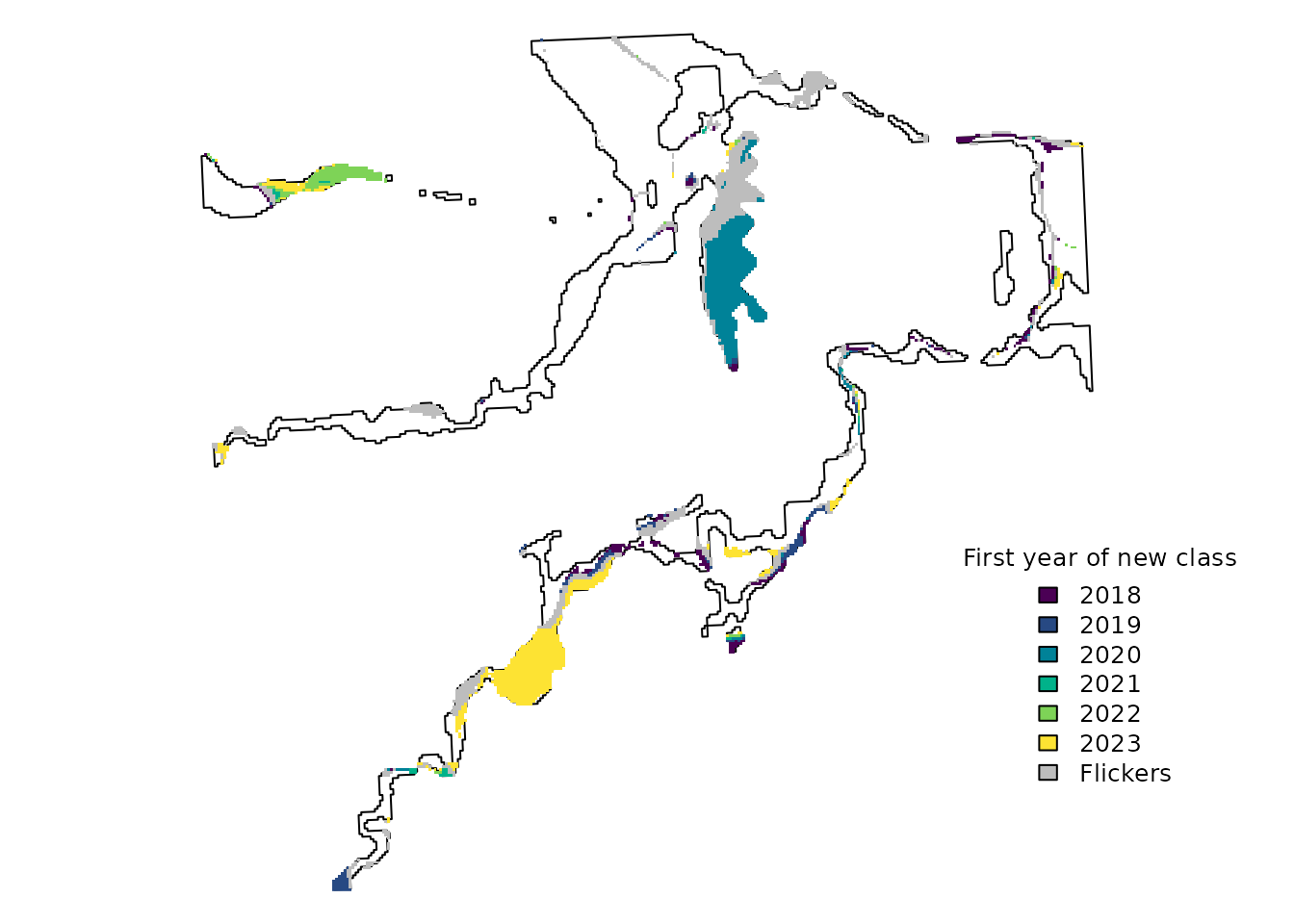
Break year for pixels with a clean switch (one class, then another, nothing else). Grey pixels changed between 2017 and 2023 but flicker in between.
Per patch, the three legs compose. terra::zonal() gives
each change patch the share of its cells that are a clean break,
alongside the width and boundary evidence from the section above.
patches7 <- dft_transition_vectors(bc$raster, changes_only = TRUE)
patches7 <- dft_transition_artifact(patches7, bc$raster)
pid <- terra::rasterize(terra::vect(patches7), bc$raster, field = "patch_id")
is_break <- terra::ifel(bc$breaks[["n_flips"]] == 1, 1L, 0L)
z <- terra::zonal(c(is_break, bc$breaks[["n_flips"]]), pid, fun = "mean", na.rm = TRUE)
names(z) <- c("patch_id", "break_frac", "n_flips_mean")
patches7 <- dplyr::left_join(patches7, z, by = "patch_id")

by_evidence <- sf::st_drop_geometry(patches7) |>
  dplyr::mutate(geometry = ifelse(flag_sliver & (flag_boundary | flag_reciprocal),
                                  "Artifact signature", "Other")) |>
  dplyr::group_by(geometry) |>
  # weighted mean first: a summarised `area_ha` would shadow the column
  dplyr::summarise(break_frac = stats::weighted.mean(break_frac, area_ha),
                   n_patches = dplyr::n(), area_ha = sum(area_ha),
                   .groups = "drop") |>
  dplyr::select(geometry, n_patches, area_ha, break_frac)

knitr::kable(by_evidence, digits = 2, col.names = c(
  "Geometric evidence", "Patches", "Area (ha)", "Clean-break share of cells"
), caption = "Change patches by geometric signature, with the area-weighted share of their cells that are a clean temporal break.")| Geometric evidence | Patches | Area (ha) | Clean-break share of cells |
|---|---|---|---|
| Artifact signature | 48 | 4.07 | 0.45 |
| Other | 45 | 29.96 | 0.65 |
Neither leg is proof. A patch that traces a pre-existing boundary and never settled is the artifact shape twice over; one that is thin but holds a dated break for three years is thin for a reason worth finding. The spectral route in the trajectory vignette is the third witness where it matters.
Interactive Map
Toggle between classified time periods and overlay tree loss transition layers to ground-truth change against multiple satellite basemaps.
tree_trans <- dft_rast_transition(classified, from = "2017", to = "2023",
                                  from_class = "Trees")
dft_map_interactive(classified, aoi = aoi, transition = tree_trans,
                    legend_position = "bottomleft")
Classified land cover by year (radio toggle) with tree loss transitions overlaid as toggleable layers. Use the fullscreen button (top left) to expand the map and access transition toggles in the layer control (top right).