
The cd package builds on ERA5-Land hourly reanalysis
(1950–present, ~9 km native grid) fetched from the DestinE Earth Data
Hub, aggregated to monthly, seasonal, and annual periods over British
Columbia, and published as Cloud-Optimized GeoTIFFs alongside a static
STAC catalog in a public S3 bucket. R consumer functions read those
GeoTIFFs directly via GDAL, crop to any area of interest, and compute
baselines, anomalies, and Mann-Kendall / Theil-Sen trend statistics.
This vignette runs the consumer pipeline on a regional administrative boundary — the Fish & Wildlife Compensation Program (FWCP) Peace Region, ~73,000 km² in northeastern British Columbia covering Williston Reservoir and surrounding watersheds.
Area of Interest
The bundled area of interest is the FWCP Peace Region polygon (single
multi-polygon, EPSG:4326). Any sf polygon works. The
watersheds within this region all drain to the Mackenzie River — the
Peace flows east into the Slave, which flows into the Mackenzie, which
empties into the Beaufort Sea on the Arctic Ocean.
We also carry British Columbia ecoregions through the analysis. Ecoregions partition the province into broad climate-physiography zones based on latitude, elevation, and dominant vegetation. Climate departure can vary across them in ways the regional average hides, and we use them later as the sub-region for the per-ecoregion breakdown.
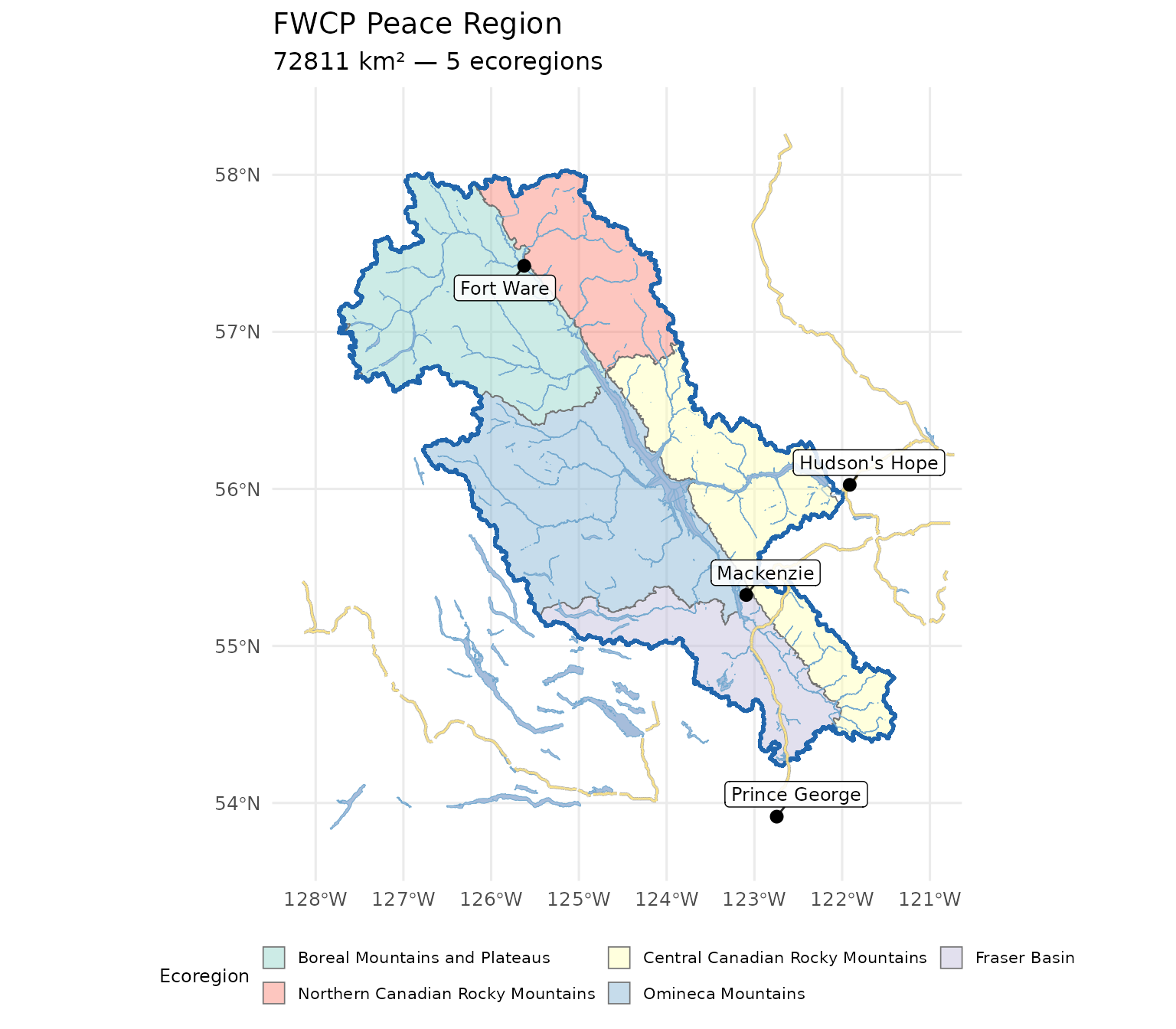
FWCP Peace Region area of interest (~73,000 km²) in northeastern British Columbia, coloured by ecoregion. Williston Reservoir dominates the basin.
Connect to the Data Catalog
The producer pipeline in this repository fetches ERA5-Land hourly reanalysis data, derives variables (vapour pressure deficit, relative humidity, soil moisture), aggregates to monthly / seasonal / annual, and writes Cloud-Optimized GeoTIFFs to S3. Alongside the GeoTIFFs we publish a static SpatioTemporal Asset Catalog (STAC) — a small set of JSON files that index the assets. Both the GeoTIFFs and the catalog JSON live at https://stac-era5-land.s3.us-west-2.amazonaws.com/catalog.json.
cd::cd_catalog() reads that URL by default. The
Cloud-Optimized GeoTIFFs are also usable directly outside R — for
example, in QGIS via the STAC plugin, in gdalcubes, or with
any STAC-aware client.
catalog <- cd::cd_catalog()
kableExtra::kable_styling(
  knitr::kable(catalog, label = NA,
    caption = "Available climate variables and periods in the STAC catalog."),
  bootstrap_options = c("striped", "hover", "condensed")
) |>
kableExtra::scroll_box(height = "320px")Extract Climate Time Series
cd::cd_extract() crops each cloud-hosted GeoTIFF to the
area of interest and computes the spatial mean per year. For an area of
interest of this size a live extraction takes a few seconds per
variable. To keep the vignette fast and reproducible we load a
pre-computed result of exactly that call.
ts <- cd::cd_extract(catalog, aoi)
head(ts, 10)| variable | period | year | value |
|---|---|---|---|
| prcp | annual | 1950 | 645.5450 |
| prcp | annual | 1951 | 665.1381 |
| prcp | annual | 1952 | 673.8270 |
| prcp | annual | 1953 | 828.5204 |
| prcp | annual | 1954 | 942.6607 |
| prcp | annual | 1955 | 729.9778 |
| prcp | annual | 1956 | 752.0231 |
| prcp | annual | 1957 | 783.3298 |
| prcp | annual | 1958 | 698.6779 |
| prcp | annual | 1959 | 882.8473 |
Trends
An anomaly is the difference between a year’s value and the average value over a reference period. Here the reference is 1951–1980 — the three decades before climate change accelerated, the same baseline Hansen et al. (2012) used to track global temperature outliers. Saying a year is “+1.5 °C” means it was 1.5 °C warmer than the average year in 1951–1980.
The trend table shows two rows per variable, fit from two different start years:
- 1951–present (75 years) — the long view. How much has the variable changed since the pre-warming reference?
- 1981–present (45 years) — the recent view. Starts at the beginning of the most recent WMO “climate normal” (1981–2010), the period used in IPCC reports, so the numbers are easy to compare against published summaries.
If the 45-year slope is steeper than the 75-year slope, change has accelerated. Shallower means it has slowed. Similar means a roughly steady rate across the full record. “Total Change” is the slope times the number of years in the window — the cumulative shift.
bl_early <- cd::cd_baseline(ts, baseline_years = 1951:1980)
ano      <- cd::cd_anomaly(ts, bl_early)
trn      <- cd::cd_trend(ano, trend_start = c(1951, 1981))
cd::cd_summary(trn)| Parameter | Period | Start | Slope | Years | Total Change | Unit | p-value |
|---|---|---|---|---|---|---|---|
| Precipitation | Annual | 1951 | 0.085 | 75 | 6.4 | % | 0.1971 |
| Precipitation | Annual | 1981 | -0.010 | 45 | -0.4 | % | 0.9298 |
| Precipitation | Fall | 1951 | 0.065 | 75 | 4.9 | % | 0.4926 |
| Precipitation | Fall | 1981 | 0.083 | 45 | 3.7 | % | 0.6884 |
| Precipitation | Spring | 1951 | 0.184 | 75 | 13.8 | % | 0.1644 |
| Precipitation | Spring | 1981 | -0.231 | 45 | -10.4 | % | 0.3044 |
| Precipitation | Summer | 1951 | 0.175 | 75 | 13.1 | % | 0.1847 |
| Precipitation | Summer | 1981 | -0.121 | 45 | -5.4 | % | 0.7468 |
| Precipitation | Winter | 1951 | -0.050 | 75 | -3.8 | % | 0.6606 |
| Precipitation | Winter | 1981 | 0.187 | 45 | 8.4 | % | 0.4281 |
| Relative humidity | Annual | 1951 | 0.001 | 75 | 0.1 | % | 0.8620 |
| Relative humidity | Annual | 1981 | -0.016 | 45 | -0.7 | % | 0.3947 |
| Relative humidity | Fall | 1951 | -0.016 | 75 | -1.2 | % | 0.0906 |
| Relative humidity | Fall | 1981 | -0.022 | 45 | -1.0 | % | 0.1678 |
| Relative humidity | Spring | 1951 | -0.009 | 75 | -0.7 | % | 0.3848 |
| Relative humidity | Spring | 1981 | -0.054 | 45 | -2.4 | % | 0.0227 |
| Relative humidity | Summer | 1951 | -0.007 | 75 | -0.6 | % | 0.7558 |
| Relative humidity | Summer | 1981 | 0.001 | 45 | 0.0 | % | 0.9922 |
| Relative humidity | Winter | 1951 | 0.035 | 75 | 2.7 | % | 0.0026 |
| Relative humidity | Winter | 1981 | 0.021 | 45 | 1.0 | % | 0.3527 |
| Snow cover | Annual | 1951 | -0.053 | 75 | -4.0 | % | 0.0026 |
| Snow cover | Annual | 1981 | -0.063 | 45 | -2.8 | % | 0.0516 |
| Snow cover | Fall | 1951 | -0.032 | 75 | -2.4 | % | 0.4051 |
| Snow cover | Fall | 1981 | -0.078 | 45 | -3.5 | % | 0.3630 |
| Snow cover | Spring | 1951 | -0.047 | 75 | -3.5 | % | 0.0014 |
| Snow cover | Spring | 1981 | -0.047 | 45 | -2.1 | % | 0.2444 |
| Snow cover | Summer | 1951 | -0.121 | 75 | -9.1 | % | 0.0008 |
| Snow cover | Summer | 1981 | -0.118 | 45 | -5.3 | % | 0.0766 |
| Snow cover | Winter | 1951 | 0.000 | 75 | 0.0 | % | 0.2816 |
| Snow cover | Winter | 1981 | 0.000 | 45 | 0.0 | % | 0.3945 |
| Snowfall | Annual | 1951 | -0.088 | 75 | -6.6 | % | 0.2528 |
| Snowfall | Annual | 1981 | -0.073 | 45 | -3.3 | % | 0.6317 |
| Snowfall | Fall | 1951 | 0.019 | 75 | 1.4 | % | 0.9344 |
| Snowfall | Fall | 1981 | -0.046 | 45 | -2.1 | % | 0.7767 |
| Snowfall | Spring | 1951 | -0.102 | 75 | -7.6 | % | 0.4587 |
| Snowfall | Spring | 1981 | -0.267 | 45 | -12.0 | % | 0.4631 |
| Snowfall | Summer | 1951 | -0.735 | 75 | -55.1 | % | 0.0015 |
| Snowfall | Summer | 1981 | -0.544 | 45 | -24.5 | % | 0.1295 |
| Snowfall | Winter | 1951 | -0.044 | 75 | -3.3 | % | 0.7076 |
| Snowfall | Winter | 1981 | 0.145 | 45 | 6.5 | % | 0.4631 |
| Snowfall fraction | Annual | 1951 | -0.079 | 75 | -5.9 | % | 0.0078 |
| Snowfall fraction | Annual | 1981 | -0.003 | 45 | -0.1 | % | 0.9143 |
| Snowmelt | Annual | 1951 | -0.039 | 75 | -2.9 | % | 0.5279 |
| Snowmelt | Annual | 1981 | -0.107 | 45 | -4.8 | % | 0.3947 |
| Snowmelt | Fall | 1951 | -0.149 | 75 | -11.2 | % | 0.4208 |
| Snowmelt | Fall | 1981 | 0.177 | 45 | 8.0 | % | 0.6740 |
| Snowmelt | Spring | 1951 | 0.559 | 75 | 41.9 | % | 0.0006 |
| Snowmelt | Spring | 1981 | 0.550 | 45 | 24.7 | % | 0.0944 |
| Snowmelt | Summer | 1951 | -0.807 | 75 | -60.5 | % | 0.0066 |
| Snowmelt | Summer | 1981 | -0.822 | 45 | -37.0 | % | 0.0944 |
| Snowmelt | Winter | 1951 | 0.056 | 75 | 4.2 | % | 0.5987 |
| Snowmelt | Winter | 1981 | 0.419 | 45 | 18.9 | % | 0.3376 |
| Day of 50% melt | Annual | 1951 | -0.150 | 75 | -11.3 | day | 0.0018 |
| Day of 50% melt | Annual | 1981 | -0.119 | 45 | -5.4 | day | 0.2141 |
| Peak weekly melt rate | Annual | 1951 | 0.101 | 75 | 7.6 | mm/wk | 0.3848 |
| Peak weekly melt rate | Annual | 1981 | 0.090 | 45 | 4.1 | mm/wk | 0.6598 |
| Soil moisture | Annual | 1951 | -0.002 | 75 | -0.1 | % | 0.8981 |
| Soil moisture | Annual | 1981 | -0.017 | 45 | -0.7 | % | 0.6041 |
| Soil moisture | Fall | 1951 | 0.000 | 75 | 0.0 | % | 0.9964 |
| Soil moisture | Fall | 1981 | -0.003 | 45 | -0.2 | % | 0.9376 |
| Soil moisture | Spring | 1951 | 0.032 | 75 | 2.4 | % | 0.0151 |
| Soil moisture | Spring | 1981 | -0.010 | 45 | -0.5 | % | 0.7100 |
| Soil moisture | Summer | 1951 | -0.036 | 75 | -2.7 | % | 0.1728 |
| Soil moisture | Summer | 1981 | -0.069 | 45 | -3.1 | % | 0.2952 |
| Soil moisture | Winter | 1951 | -0.005 | 75 | -0.4 | % | 0.4983 |
| Soil moisture | Winter | 1981 | -0.003 | 45 | -0.1 | % | 0.8911 |
| Snow water equivalent | Annual | 1951 | -0.098 | 75 | -7.3 | % | 0.2644 |
| Snow water equivalent | Annual | 1981 | -0.116 | 45 | -5.2 | % | 0.6598 |
| Snow water equivalent | Fall | 1951 | 0.006 | 75 | 0.4 | % | 0.9854 |
| Snow water equivalent | Fall | 1981 | -0.443 | 45 | -19.9 | % | 0.3328 |
| Snow water equivalent | Spring | 1951 | -0.119 | 75 | -8.9 | % | 0.2723 |
| Snow water equivalent | Spring | 1981 | -0.127 | 45 | -5.7 | % | 0.6041 |
| Snow water equivalent | Summer | 1951 | -0.792 | 75 | -59.4 | % | 0.0029 |
| Snow water equivalent | Summer | 1981 | -0.659 | 45 | -29.7 | % | 0.0799 |
| Snow water equivalent | Winter | 1951 | 0.009 | 75 | 0.7 | % | 0.9126 |
| Snow water equivalent | Winter | 1981 | 0.068 | 45 | 3.1 | % | 0.8220 |
| Annual peak snow water equivalent | Annual | 1951 | -0.075 | 75 | -5.7 | mm | 0.7697 |
| Annual peak snow water equivalent | Annual | 1981 | -0.251 | 45 | -11.3 | mm | 0.6884 |
| Maximum temperature | Annual | 1951 | 0.027 | 75 | 2.0 | °C | 0.0000 |
| Maximum temperature | Annual | 1981 | 0.021 | 45 | 0.9 | °C | 0.0449 |
| Maximum temperature | Fall | 1951 | 0.013 | 75 | 1.0 | °C | 0.0659 |
| Maximum temperature | Fall | 1981 | 0.029 | 45 | 1.3 | °C | 0.0338 |
| Maximum temperature | Spring | 1951 | 0.025 | 75 | 1.9 | °C | 0.0007 |
| Maximum temperature | Spring | 1981 | 0.011 | 45 | 0.5 | °C | 0.6179 |
| Maximum temperature | Summer | 1951 | 0.026 | 75 | 2.0 | °C | 0.0004 |
| Maximum temperature | Summer | 1981 | 0.030 | 45 | 1.3 | °C | 0.0617 |
| Maximum temperature | Winter | 1951 | 0.045 | 75 | 3.4 | °C | 0.0000 |
| Maximum temperature | Winter | 1981 | 0.015 | 45 | 0.7 | °C | 0.4752 |
| Mean temperature | Annual | 1951 | 0.030 | 75 | 2.2 | °C | 0.0000 |
| Mean temperature | Annual | 1981 | 0.023 | 45 | 1.0 | °C | 0.0264 |
| Mean temperature | Fall | 1951 | 0.020 | 75 | 1.5 | °C | 0.0099 |
| Mean temperature | Fall | 1981 | 0.038 | 45 | 1.7 | °C | 0.0053 |
| Mean temperature | Spring | 1951 | 0.028 | 75 | 2.1 | °C | 0.0001 |
| Mean temperature | Spring | 1981 | 0.006 | 45 | 0.3 | °C | 0.7468 |
| Mean temperature | Summer | 1951 | 0.031 | 75 | 2.4 | °C | 0.0000 |
| Mean temperature | Summer | 1981 | 0.034 | 45 | 1.5 | °C | 0.0113 |
| Mean temperature | Winter | 1951 | 0.044 | 75 | 3.3 | °C | 0.0002 |
| Mean temperature | Winter | 1981 | 0.007 | 45 | 0.3 | °C | 0.7321 |
| Minimum temperature | Annual | 1951 | 0.032 | 75 | 2.4 | °C | 0.0000 |
| Minimum temperature | Annual | 1981 | 0.024 | 45 | 1.1 | °C | 0.0116 |
| Minimum temperature | Fall | 1951 | 0.025 | 75 | 1.9 | °C | 0.0027 |
| Minimum temperature | Fall | 1981 | 0.046 | 45 | 2.1 | °C | 0.0014 |
| Minimum temperature | Spring | 1951 | 0.027 | 75 | 2.0 | °C | 0.0001 |
| Minimum temperature | Spring | 1981 | 0.003 | 45 | 0.1 | °C | 0.7917 |
| Minimum temperature | Summer | 1951 | 0.035 | 75 | 2.6 | °C | 0.0000 |
| Minimum temperature | Summer | 1981 | 0.036 | 45 | 1.6 | °C | 0.0015 |
| Minimum temperature | Winter | 1951 | 0.043 | 75 | 3.3 | °C | 0.0003 |
| Minimum temperature | Winter | 1981 | 0.005 | 45 | 0.2 | °C | 0.7917 |
| Vapour pressure deficit | Annual | 1951 | 0.005 | 75 | 0.3 | Pa | 0.0008 |
| Vapour pressure deficit | Annual | 1981 | 0.005 | 45 | 0.2 | Pa | 0.0963 |
| Vapour pressure deficit | Fall | 1951 | 0.002 | 75 | 0.2 | Pa | 0.0323 |
| Vapour pressure deficit | Fall | 1981 | 0.005 | 45 | 0.2 | Pa | 0.0834 |
| Vapour pressure deficit | Spring | 1951 | 0.005 | 75 | 0.4 | Pa | 0.0001 |
| Vapour pressure deficit | Spring | 1981 | 0.008 | 45 | 0.4 | Pa | 0.0141 |
| Vapour pressure deficit | Summer | 1951 | 0.009 | 75 | 0.7 | Pa | 0.0338 |
| Vapour pressure deficit | Summer | 1981 | 0.009 | 45 | 0.4 | Pa | 0.4057 |
| Vapour pressure deficit | Winter | 1951 | 0.001 | 75 | 0.1 | Pa | 0.0007 |
| Vapour pressure deficit | Winter | 1981 | 0.000 | 45 | 0.0 | Pa | 0.8220 |
cd::cd_plot_timeseries(
  ano, variable = "prcp", period = "annual", trend = trn,
  title = "Annual Precipitation Anomaly — FWCP Peace Region"
)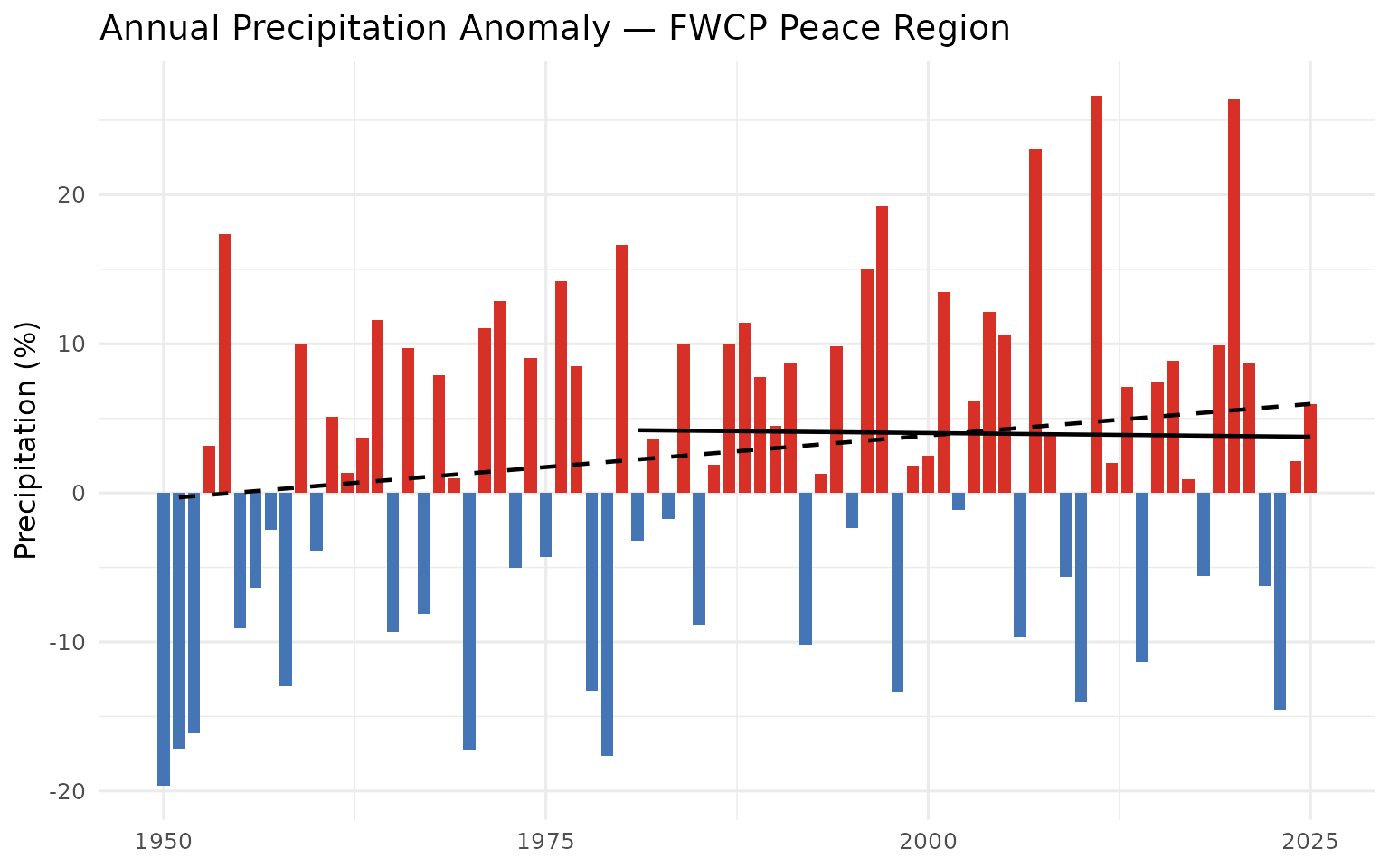
Annual precipitation anomaly (% of 1951-1980 baseline) for the FWCP Peace Region. The per-ecoregion mean temperature panel is shown later in the Per-Ecoregion section.
Recent Decade vs Pre-Warming Reference
The table below compares the recent decade (2015–2025) directly against the pre-warming reference (1951–1980). Δ absolute is the difference of the two means in the variable’s native units. Δ % is shown only where percent change makes physical sense (precipitation, soil moisture, VPD, relative humidity).
Two p-values appear side-by-side because they answer different questions. Δ p (windows) asks whether the recent decade differs from the pre-warming reference. Trend p (75-yr) asks whether the full series ramps year-on-year. A sudden step change shows up as significant Δ p but not trend p; a gradual ramp shows up as both.
The recent decade was 1.7 to 2.4 °C warmer than the pre-warming reference for annual mean, daytime maximum, and overnight minimum, with both window and trend p-values below 0.001. Vapour pressure deficit is up significantly on both tests. Annual precipitation was about 3 to 4 % higher in the recent decade; neither test confirms the shift (Δ p ≈ 0.4, trend p ≈ 0.20). Soil moisture and relative humidity show no meaningful change.
cmp <- cd::cd_compare(ts) # defaults: 2015–2025 vs 1951–1980, Welch t-test| Variable | Period | Recent (2015–2025) | Pre-warming (1951–1980) | Δ absolute | Δ % | Δ p (windows) | Trend p (75-yr) |
|---|---|---|---|---|---|---|---|
| prcp | annual | 835.20 | 803.11 | 32.08 | 4.0 | 0.308 | 0.197 |
| prcp | fall | 239.18 | 230.76 | 8.42 | 3.7 | 0.622 | 0.493 |
| prcp | spring | 155.72 | 150.62 | 5.10 | 3.4 | 0.643 | 0.164 |
| prcp | summer | 266.04 | 242.15 | 23.89 | 9.9 | 0.283 | 0.185 |
| prcp | winter | 174.26 | 179.59 | -5.33 | -3.0 | 0.674 | 0.661 |
| rh | annual | 74.08 | 74.08 | 0.00 | 0.0 | 0.992 | 0.862 |
| rh | fall | 79.38 | 80.16 | -0.78 | -1.0 | 0.279 | 0.091 |
| rh | spring | 68.43 | 69.49 | -1.06 | -1.5 | 0.159 | 0.385 |
| rh | summer | 67.25 | 67.63 | -0.38 | -0.6 | 0.760 | 0.756 |
| rh | winter | 81.25 | 79.05 | 2.20 | 2.8 | 0.004 | 0.003 |
| snow_cover | annual | 59.89 | 63.84 | -3.95 | NA | 0.001 | 0.003 |
| snow_cover | fall | 49.76 | 52.03 | -2.27 | NA | 0.424 | 0.405 |
| snow_cover | spring | 88.85 | 93.80 | -4.95 | NA | 0.004 | 0.001 |
| snow_cover | summer | 4.22 | 12.80 | -8.58 | NA | 0.000 | 0.001 |
| snow_cover | winter | 96.73 | 96.71 | 0.02 | NA | 0.238 | 0.282 |
| snowfall | annual | 405.53 | 432.37 | -26.84 | -6.2 | 0.089 | 0.253 |
| snowfall | fall | 136.62 | 135.00 | 1.61 | 1.2 | 0.895 | 0.934 |
| snowfall | spring | 94.08 | 109.02 | -14.94 | -13.7 | 0.074 | 0.459 |
| snowfall | summer | 4.87 | 12.02 | -7.15 | -59.5 | 0.002 | 0.002 |
| snowfall | winter | 169.96 | 176.32 | -6.36 | -3.6 | 0.619 | 0.708 |
| snowfall_fraction | annual | 48.45 | 53.56 | -5.10 | NA | 0.005 | 0.008 |
| snowmelt | annual | 381.07 | 409.27 | -28.20 | -6.9 | 0.139 | 0.528 |
| snowmelt | fall | 25.92 | 30.93 | -5.02 | -16.2 | 0.214 | 0.421 |
| snowmelt | spring | 289.89 | 212.24 | 77.65 | 36.6 | 0.002 | 0.001 |
| snowmelt | summer | 63.82 | 165.05 | -101.23 | -61.3 | 0.001 | 0.007 |
| snowmelt | winter | 1.44 | 1.05 | 0.39 | 37.2 | 0.599 | 0.599 |
| snowmelt_doy_50 | annual | 137.74 | 148.50 | -10.75 | NA | 0.000 | 0.002 |
| snowmelt_rate_peak | annual | 118.44 | 116.52 | 1.93 | 1.7 | 0.805 | 0.385 |
| soil_moisture | annual | 0.32 | 0.32 | 0.00 | -0.3 | 0.749 | 0.898 |
| soil_moisture | fall | 0.32 | 0.32 | 0.00 | -0.4 | 0.821 | 0.996 |
| soil_moisture | spring | 0.32 | 0.32 | 0.01 | 1.9 | 0.029 | 0.015 |
| soil_moisture | summer | 0.33 | 0.33 | -0.01 | -2.5 | 0.132 | 0.173 |
| soil_moisture | winter | 0.31 | 0.31 | 0.00 | -0.2 | 0.819 | 0.498 |
| swe | annual | 121.65 | 135.11 | -13.46 | -10.0 | 0.104 | 0.264 |
| swe | fall | 29.15 | 30.24 | -1.09 | -3.6 | 0.751 | 0.985 |
| swe | spring | 259.56 | 292.80 | -33.24 | -11.4 | 0.100 | 0.272 |
| swe | summer | 5.27 | 21.50 | -16.23 | -75.5 | 0.000 | 0.003 |
| swe | winter | 192.64 | 195.91 | -3.27 | -1.7 | 0.754 | 0.913 |
| swe_max | annual | 333.64 | 348.42 | -14.79 | -4.2 | 0.433 | 0.770 |
| tmax | annual | 3.66 | 1.99 | 1.67 | NA | 0.000 | 0.000 |
| tmax | fall | 3.49 | 2.55 | 0.93 | NA | 0.039 | 0.066 |
| tmax | spring | 3.93 | 2.16 | 1.76 | NA | 0.000 | 0.001 |
| tmax | summer | 16.62 | 15.00 | 1.62 | NA | 0.001 | 0.000 |
| tmax | winter | -9.40 | -11.77 | 2.37 | NA | 0.001 | 0.000 |
| tmean | annual | -0.59 | -2.41 | 1.82 | NA | 0.000 | 0.000 |
| tmean | fall | -0.32 | -1.58 | 1.26 | NA | 0.005 | 0.010 |
| tmean | spring | -0.75 | -2.57 | 1.82 | NA | 0.000 | 0.000 |
| tmean | summer | 11.64 | 9.76 | 1.88 | NA | 0.000 | 0.000 |
| tmean | winter | -12.92 | -15.27 | 2.34 | NA | 0.003 | 0.000 |
| tmin | annual | -4.12 | -6.05 | 1.93 | NA | 0.000 | 0.000 |
| tmin | fall | -3.19 | -4.71 | 1.52 | NA | 0.001 | 0.003 |
| tmin | spring | -4.76 | -6.49 | 1.74 | NA | 0.000 | 0.000 |
| tmin | summer | 6.93 | 4.81 | 2.12 | NA | 0.000 | 0.000 |
| tmin | winter | -15.47 | -17.81 | 2.33 | NA | 0.004 | 0.000 |
| vpd | annual | 2.14 | 1.86 | 0.28 | 15.1 | 0.002 | 0.001 |
| vpd | fall | 1.48 | 1.32 | 0.16 | 12.3 | 0.065 | 0.032 |
| vpd | spring | 2.05 | 1.67 | 0.38 | 22.8 | 0.000 | 0.000 |
| vpd | summer | 4.62 | 4.06 | 0.55 | 13.6 | 0.045 | 0.034 |
| vpd | winter | 0.43 | 0.40 | 0.03 | 6.5 | 0.023 | 0.001 |
Daytime Highs and Overnight Lows
Alongside the daily mean, the cd package ships tmax (daytime maximum) and tmin (overnight minimum). When overnight minimums warm faster than daytime maximums, that’s the “day-night asymmetry” — a textbook fingerprint of greenhouse warming, first documented globally by Karl et al. (1993) (overnight minimums rose roughly three times faster than daytime maximums between 1951 and 1990). Whether a region shows the signal depends on local geography (valley inversions, snow cover, slope-aspect mix).
For the FWCP Peace Region, overnight minimums are warming faster than daytime maximums. Daytime maximums warmed about +0.027 °C/year since 1951 (+2.0 °C cumulative); overnight minimums warmed about +0.032 °C/year (+2.4 °C cumulative). The overnight side has gained roughly 0.4 °C more than the daytime side over the full record, narrowing the diurnal temperature range by the same amount.
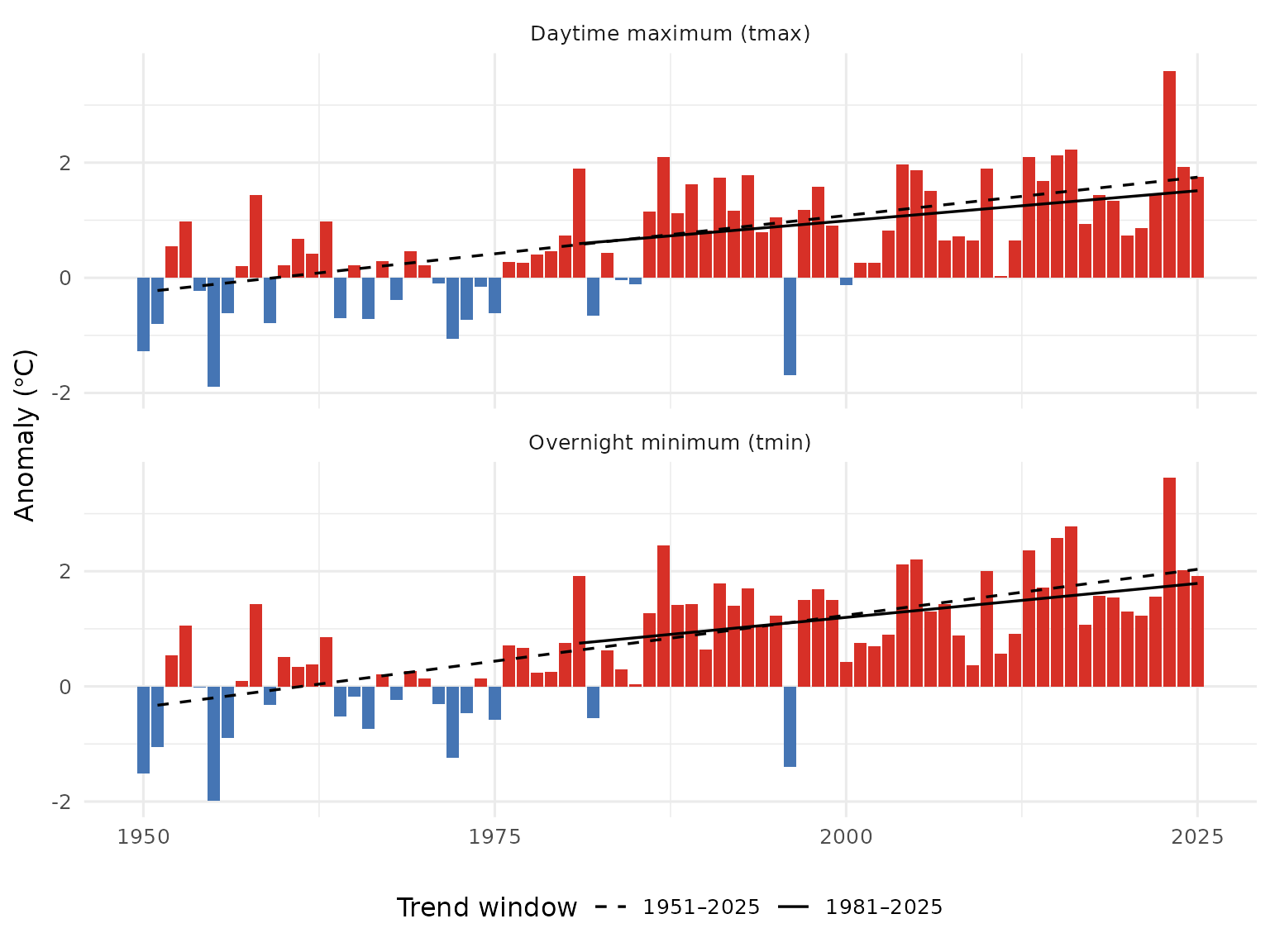
Annual tmax (top) and tmin (bottom) anomalies for the FWCP Peace Region, relative to the 1951-1980 baseline. Dashed line is the 75-year Theil-Sen trend (1951-present); solid line is the 45-year trend (1981-present).
Snowpack
In BC, most of the year’s runoff starts as winter snow. The snowpack stores it, then releases it as meltwater across spring and summer. That delayed release is what keeps creeks flowing through late summer and what drives the spring freshet — the annual flood pulse that salmonids time their up-river migrations to.
Cordillera-wide, snowpack has been declining for decades (Mote et al. 2018; Pederson et al. 2011). Najafi et al. (2017) attribute the observed spring SWE decline across BC river basins — including the Peace — to human-caused warming. Kang et al. (2016) document a ~10-day earlier freshet on the neighbouring Fraser over 1949–2006, with declining summer flows during the salmon migration window.
For the FWCP Peace Region, the snowpack signal in our data is unambiguous and concentrated in the warm shoulders of the year. Annual snow water equivalent (SWE) declined ~10% (135 → 122 mm), but the seasonal breakdown is sharper: summer SWE collapsed by 75% (21.5 → 5.3 mm) and spring snowmelt rose 37% (212 → 290 mm) as the freshet shifted earlier into the calendar. Total annual snowfall barely changed (-6%) — the SWE decline is mostly about warming removing snow earlier, not less snow falling.
A note on how to read the snow numbers below. ERA5-Land works on a roughly 9 km grid: each cell is a single number averaging snow over about 80 km² of mixed terrain. Cross-checking against four BC automated snow stations inside the AOI (95 paired station-years, 1985–2025), the model is biased on absolute peak SWE — too low at high-snow Coast Mountain stations, too high at drier interior basins — but the bias is stable over time at every site (the gap between model and stations in 2020 is the same size as in 1990). So the trends and changes below are credible. The absolute mm values are not ground truth.
Seasonal snowpack curve
The four monthly-native snow variables — SWE, snowfall, snowmelt, and snow cover — show when snow accumulates and melts. Aggregated to the four standard meteorological seasons — winter (December–February), spring (March–May), summer (June–August), and fall (September–November) — the table below compares the recent decade (2015-2025) against the pre-warming reference (1951-1980) directly. The headline numbers above (summer SWE collapse, spring snowmelt rise) are in the summer and spring rows.
| Variable | Season | Pre-warming (1951–1980) | Recent (2015–2025) | Δ % |
|---|---|---|---|---|
| SWE (mm) | winter | 195.9 | 192.6 | -1.7 |
| SWE (mm) | spring | 292.8 | 259.6 | -11.4 |
| SWE (mm) | summer | 21.5 | 5.3 | -75.5 |
| SWE (mm) | fall | 30.2 | 29.1 | -3.6 |
| Snowfall (mm) | winter | 176.3 | 170.0 | -3.6 |
| Snowfall (mm) | spring | 109.0 | 94.1 | -13.7 |
| Snowfall (mm) | summer | 12.0 | 4.9 | -59.5 |
| Snowfall (mm) | fall | 135.0 | 136.6 | 1.2 |
| Snowmelt (mm) | winter | 1.1 | 1.4 | 37.2 |
| Snowmelt (mm) | spring | 212.2 | 289.9 | 36.6 |
| Snowmelt (mm) | summer | 165.0 | 63.8 | -61.3 |
| Snowmelt (mm) | fall | 30.9 | 25.9 | -16.2 |
Annual snowpack signals
Three annual numbers capture how the snowpack is changing:
- Peak SWE — the year’s maximum snow water equivalent. How much snow is in the bank at the height of winter? (Mote et al. 2018, 2005)
- Snowmelt 50% day-of-year (DOY-50) — the day by which half the year’s melt has run off. Earlier = freshet shifting into spring. (Stewart et al. 2005; Cayan et al. 2001)
- Snowfall fraction — the share of annual precipitation that falls as snow rather than rain. (Knowles et al. 2006)
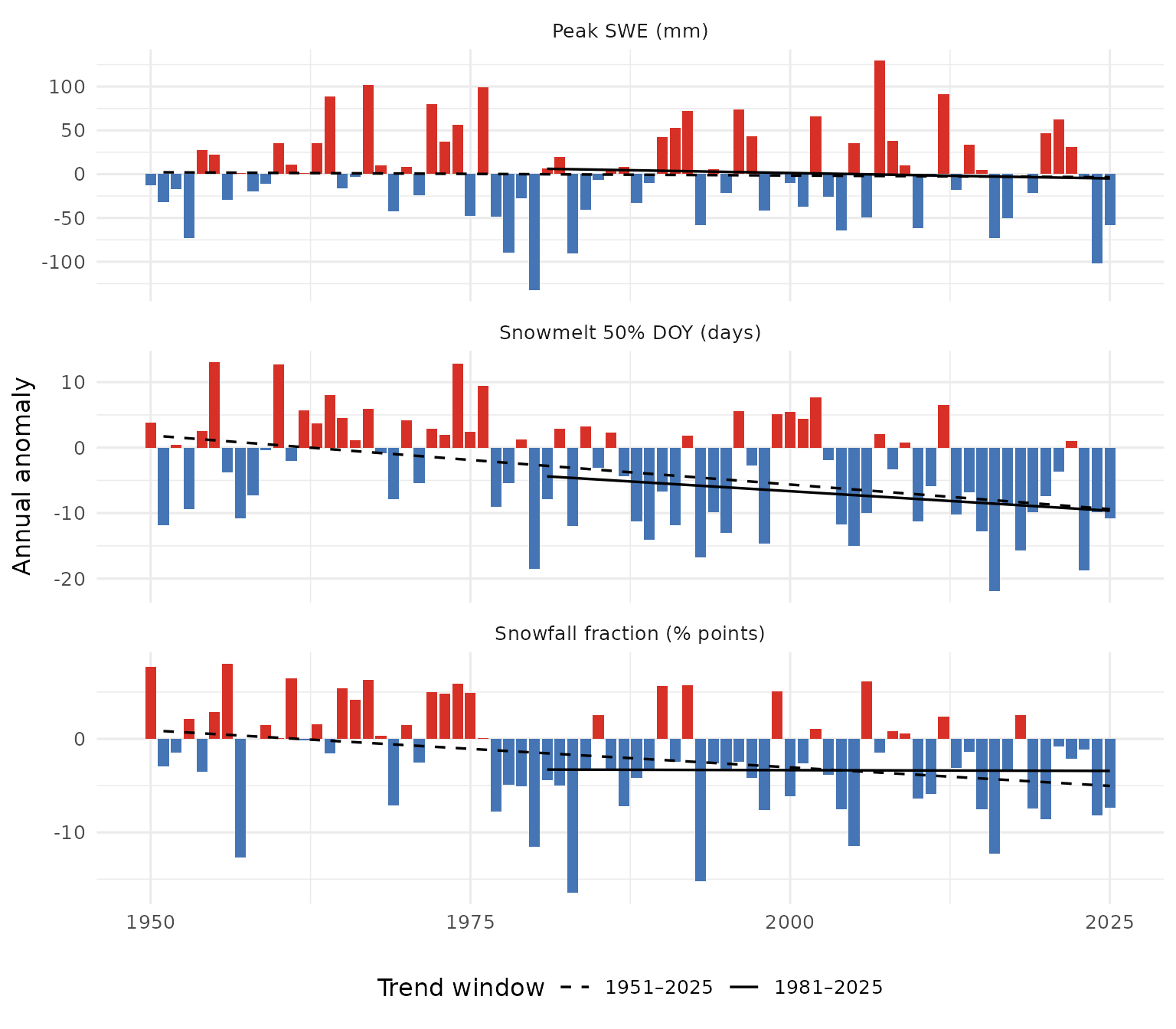
Annual snowpack signals for the FWCP Peace Region, relative to the 1951-1980 baseline. Each panel uses its own y-axis. Dashed line is the 75-year Theil-Sen trend; solid line is the 45-year trend.
What this means for the FWCP Peace Region
Three findings carry the snowpack story for the Peace.
Snow is leaving the region earlier each year, not falling less. Total annual snowfall is roughly stable (-6%); the snowpack decline is dominated by earlier melt, not by less snow. The seasonal data make this concrete: spring snowmelt is up 37% while summer snowmelt is down 61% — same total melt, redistributed earlier into the year. This matches the broader Pacific-Northwest signal documented since Mote et al. (2005).
The freshet is shifting into spring. Spring snowmelt up 37% is direct evidence of an earlier freshet centroid — consistent in direction and rough magnitude with Stewart et al.’s (2005) 1-4 week earlier streamflow timing across western North America, and with the 10-day Fraser freshet advance documented by Kang et al. (2016) for a basin whose southern boundary is just south of the FWCP Peace Region.
Summer is becoming snow-free. Summer SWE has collapsed by 75% and summer snowmelt is down 61%. The high-elevation snowpack that historically lingered into summer no longer does in the recent decade. For aquatic ecosystems downstream, this is a loss of late- season cold-water input to streams during the warmest part of the year.
Spatial Pattern
The zonal mean reduces a region this size to a single number; the spatial pattern carries the rest of the story.
Warming is not spatially uniform. Total departures range from about +1.5 °C in the southeast to over +2.1 °C in the west and centre. The dominant gradient runs east-to-west — the western half of the region averages roughly 0.2 °C more warming than the eastern half — with a smaller south-to-north component. The west-of-Rockies pattern is consistent with windward-slope amplification along the Continental Divide.
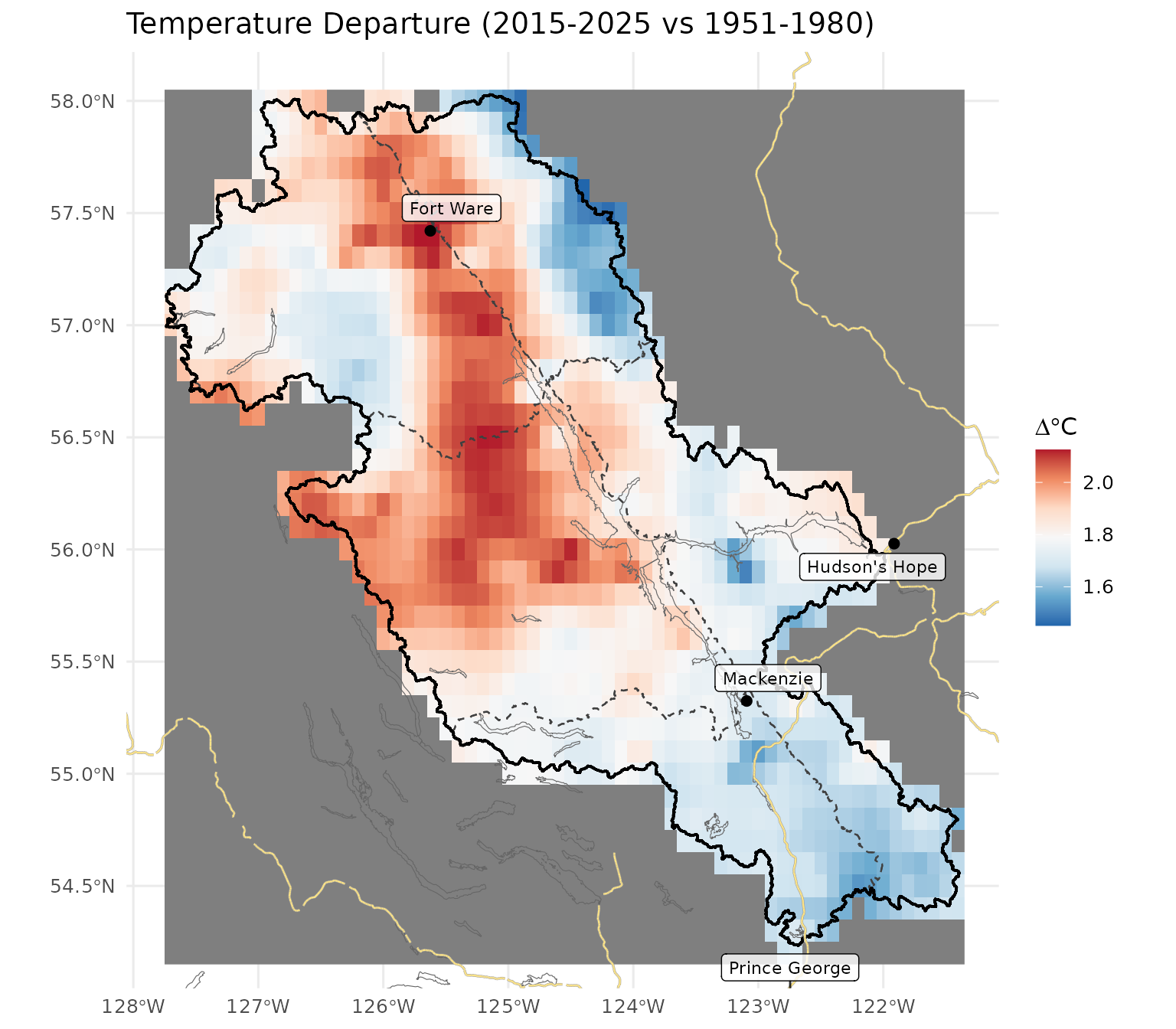
Spatial pattern of annual mean temperature departure across the FWCP Peace Region (2015-2025 mean minus 1951-1980 mean, degrees C).
Per-Ecoregion Variation
The regional zonal mean averages over five ecoregions with different elevations and exposures. To check whether the regional story holds within each ecoregion — and where it does not — we run the same pipeline on each ecoregion polygon individually.
All five ecoregions warmed at roughly the same rate — about +0.3 °C per decade since 1951, with cumulative changes within 0.2 °C of each other. Precipitation is the variable that diverges: the two northernmost ecoregions (Boreal Mountains and Plateaus, Northern Canadian Rocky Mountains) show statistically significant precipitation increases, while the southern and central ecoregions do not. Vapour pressure deficit is up significantly in all five.
# For each ecoregion polygon, run the same cd pipeline as the regional one:
results <- lapply(seq_len(nrow(ecoregions)), function(i) {
  poly  <- ecoregions[i, ]
  ts_i  <- cd::cd_extract(catalog, poly)
  bl_i  <- cd::cd_baseline(ts_i, baseline_years = 1951:1980)
  ano_i <- cd::cd_anomaly(ts_i, bl_i)
  trn_i <- cd::cd_trend(ano_i, trend_start = c(1951, 1981))
  cmp_i <- cd::cd_compare(ts_i, window_a = 2015:2025, window_b = 1951:1980)
  list(ano = ano_i, trn = trn_i, cmp = cmp_i)
})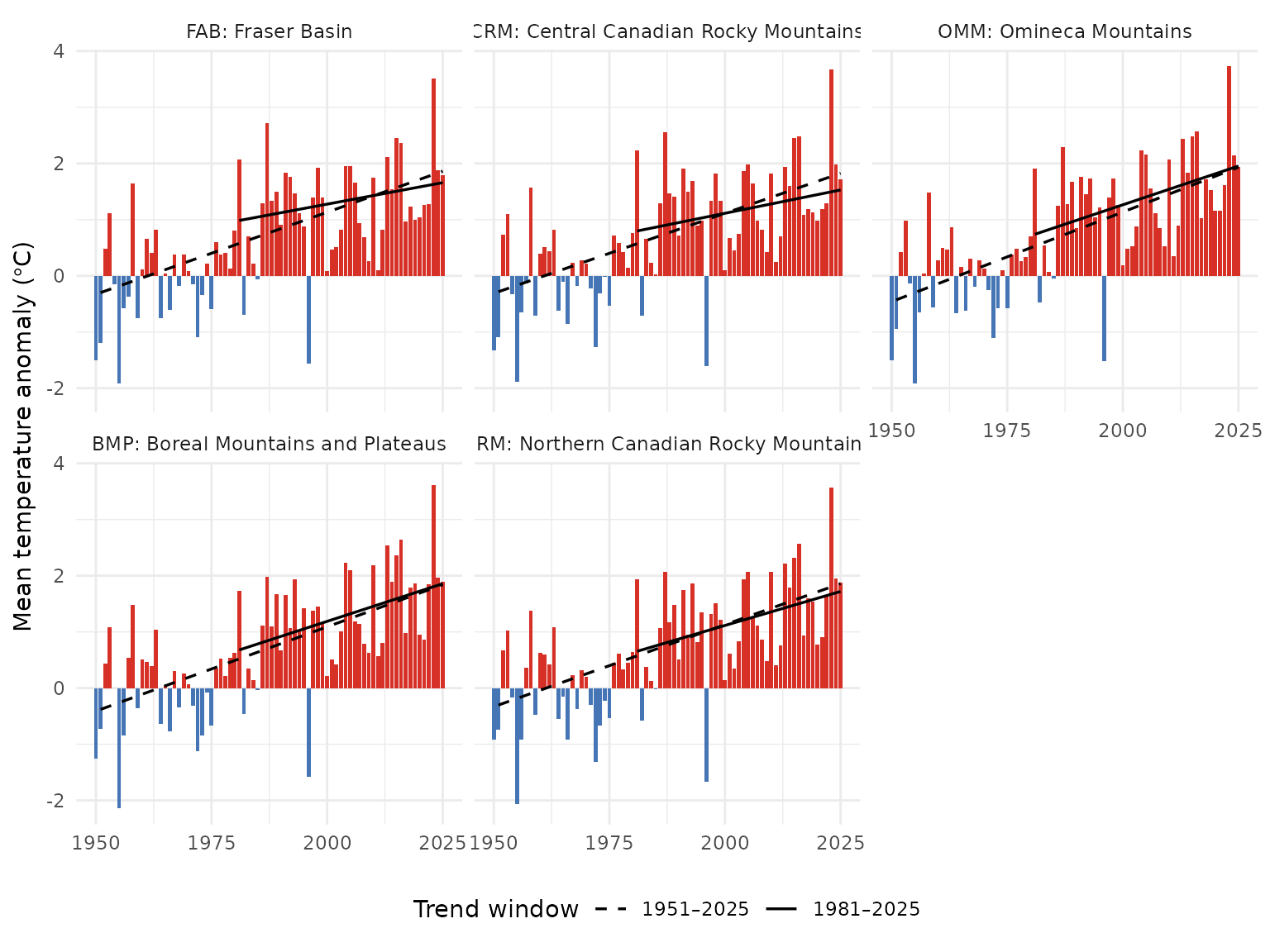
Annual mean temperature anomaly relative to the 1951-1980 baseline, by ecoregion. Dashed line is the 75-year Theil-Sen trend (1951-present); solid line is the 45-year trend (1981-present). A solid line steeper than the dashed line indicates accelerating warming.
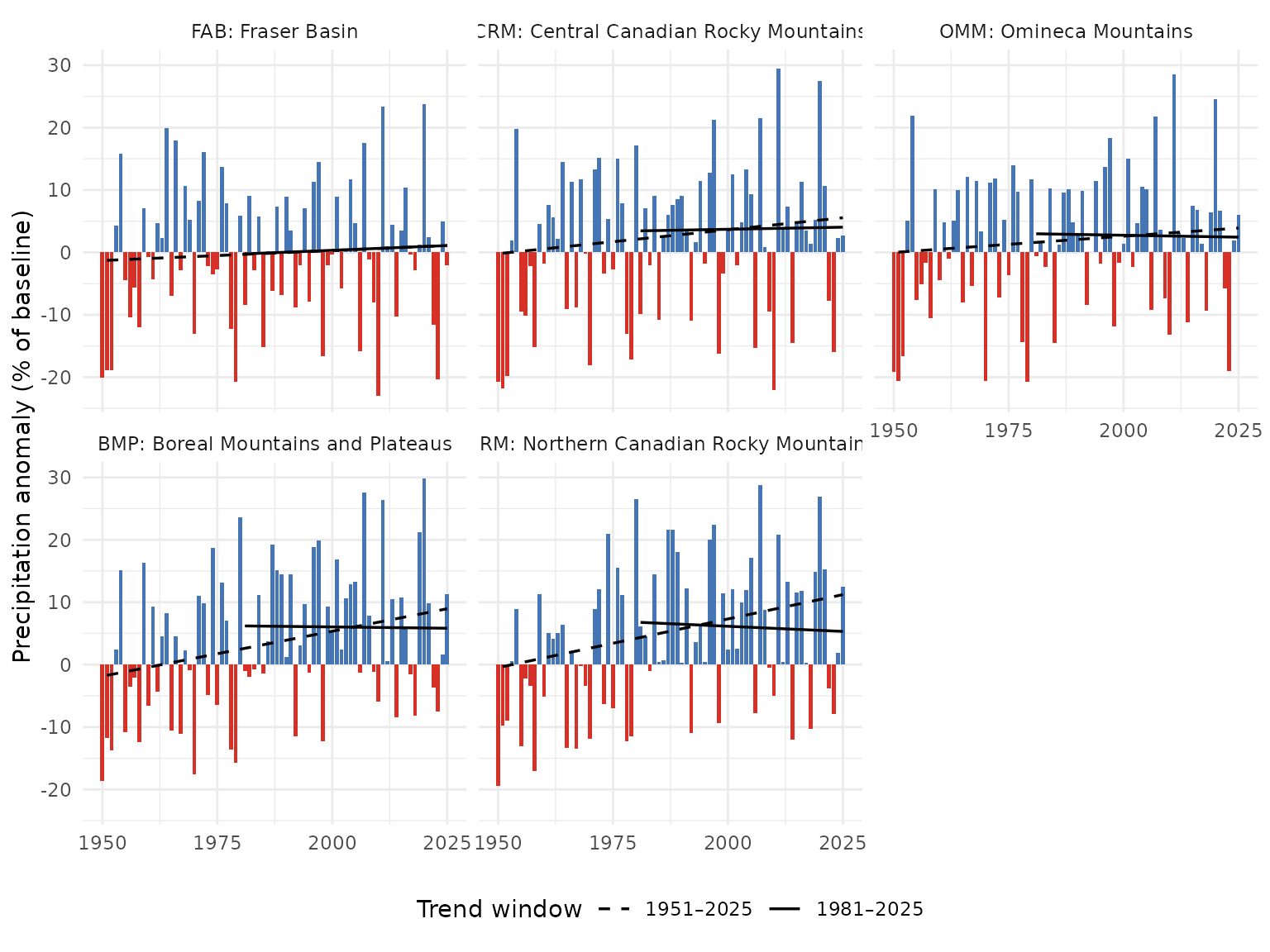
Annual precipitation anomaly (% of the 1951-1980 baseline) by ecoregion. Dashed line is the 75-year trend (1951-present); solid line is the 45-year trend (1981-present). The two northernmost ecoregions (BMP, NRM) show statistically significant precipitation increases over the full record; the others do not.
Snow per ecoregion
Two snow metrics are worth viewing per-ecoregion: peak snow water equivalent (annual snowpack magnitude) and DOY-50 (the day-of-year by which half the year’s snowmelt has already happened — earlier values mean an earlier freshet). The two figures below show how each varies ecoregion to ecoregion. Pair them with the Watershed Groups Across Ecoregions section below to read each watershed group’s dominant ecoregion’s signal.
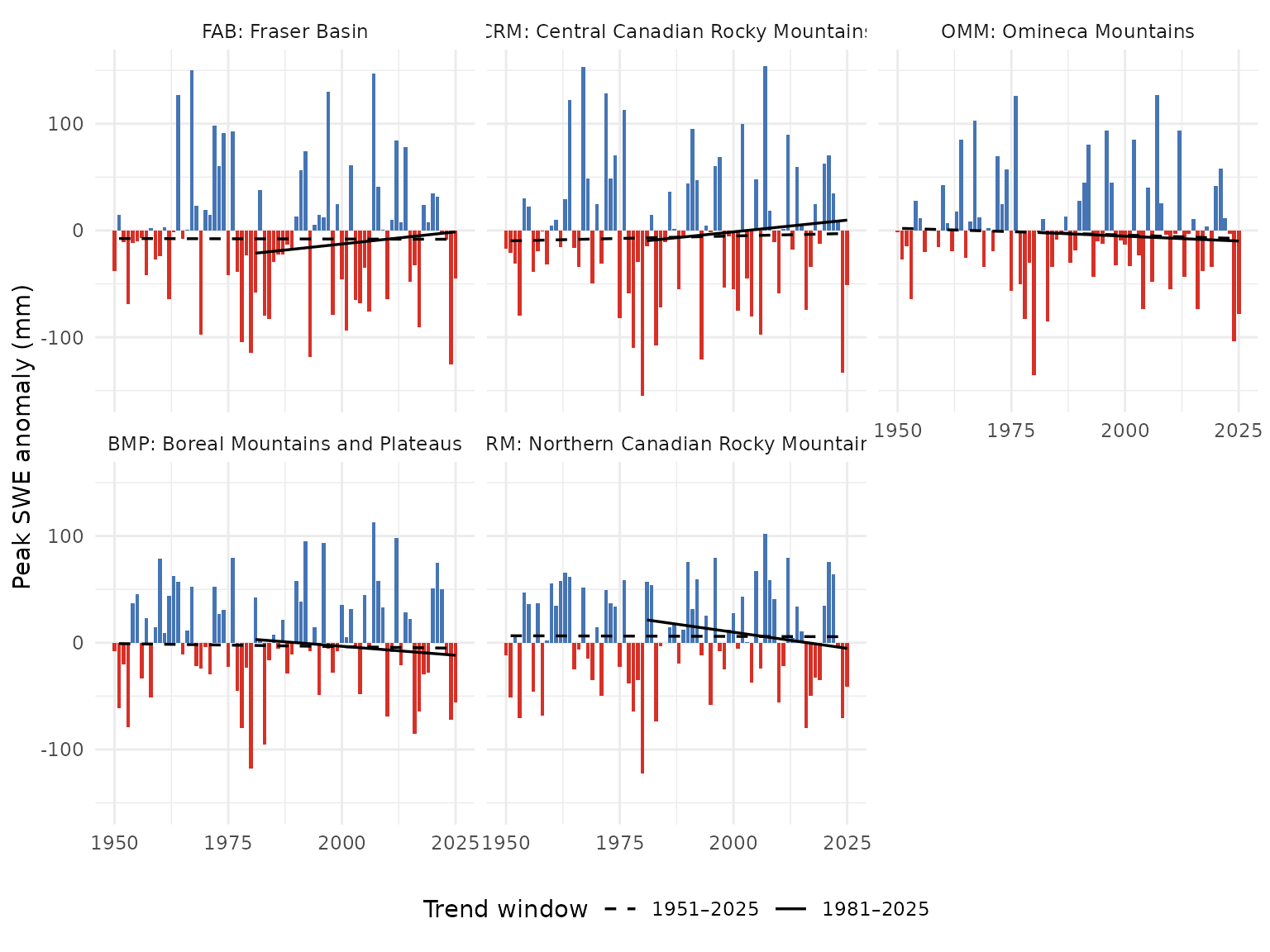
Annual peak snow water equivalent (SWE) anomaly by ecoregion, relative to the 1951-1980 baseline. Bars are mm of water-equivalent snowpack departure from baseline. Dashed line is the 75-year Theil-Sen trend (1951-present); solid line is the 45-year trend (1981-present).
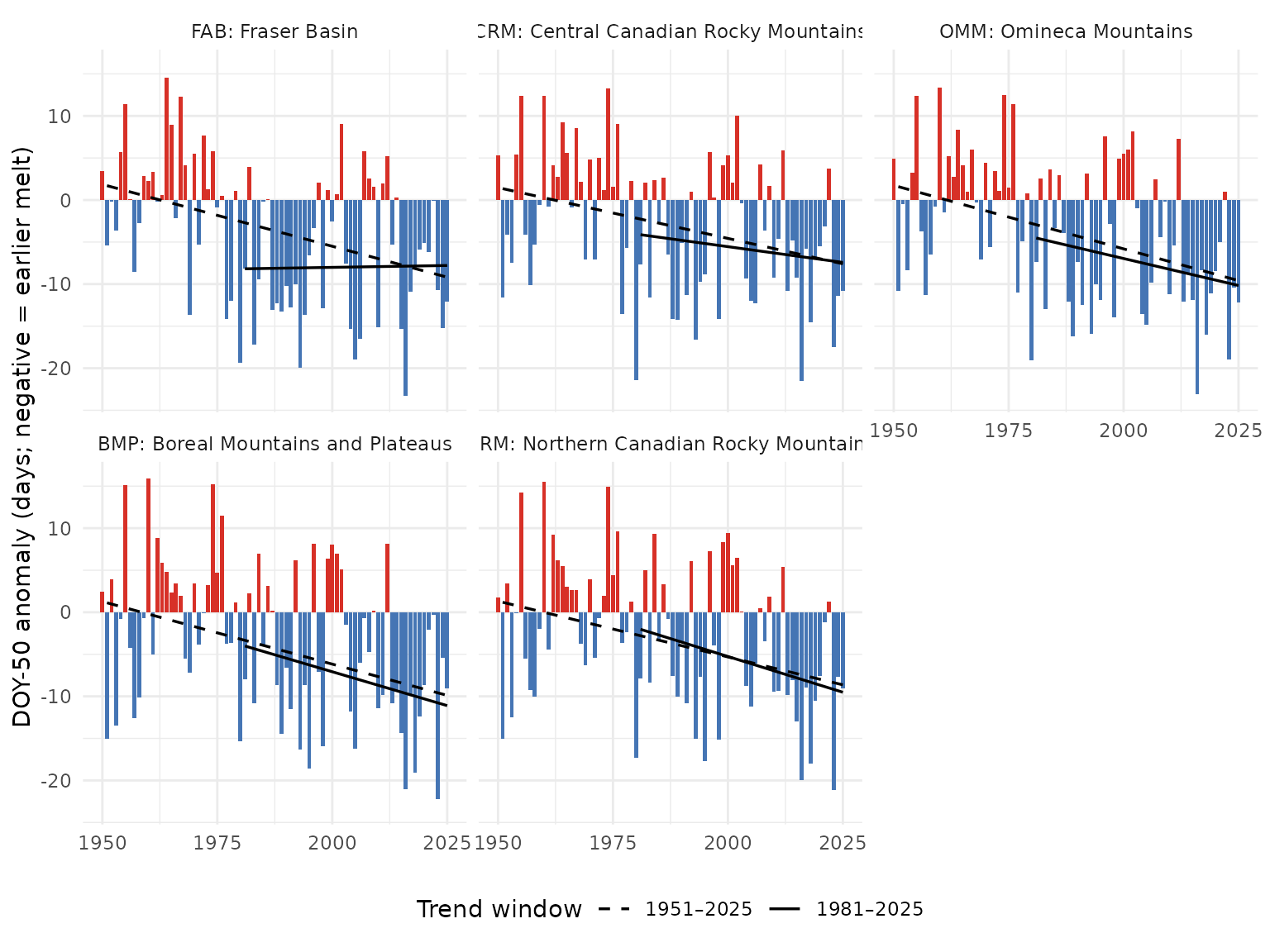
Snowmelt 50% day-of-year (DOY-50) anomaly by ecoregion, relative to the 1951-1980 baseline. Negative values (red) mean the freshet midpoint shifted earlier in the year. Dashed line is the 75-year Theil-Sen trend; solid line is the 45-year trend.
| Ecoregion | tmean degC/dec | tmax degC/dec | tmin degC/dec | prcp mm/yr | prcp p | vpd hPa/dec | vpd p | prcp pct change | soil moisture pct change |
|---|---|---|---|---|---|---|---|---|---|
| FAB | 0.29 | 0.26 | 0.30 | 0.032 | 0.634 | 0.061 | 0.002 | 0.8 | -1.3 |
| CRM | 0.29 | 0.25 | 0.30 | 0.077 | 0.253 | 0.045 | 0.001 | 4.1 | -0.5 |
| OMM | 0.32 | 0.29 | 0.34 | 0.052 | 0.421 | 0.054 | 0.000 | 2.5 | -0.7 |
| BMP | 0.30 | 0.27 | 0.33 | 0.144 | 0.023 | 0.033 | 0.003 | 6.3 | 0.3 |
| NRM | 0.29 | 0.26 | 0.31 | 0.156 | 0.015 | 0.030 | 0.004 | 6.6 | 0.6 |
Ecoregion codes used in the table above: FAB — Fraser Basin; CRM — Central Canadian Rocky Mountains; OMM — Omineca Mountains; BMP — Boreal Mountains and Plateaus; NRM — Northern Canadian Rocky Mountains.
Watershed Groups Across Ecoregions
The FWCP Peace Region is reported and managed at the watershed-group scale — the British Columbia Freshwater Atlas hydrological reporting unit, and the unit the Fish & Wildlife Compensation Program funds work in. Sixteen watershed groups make up the canonical FWCP Peace list. They span the five ecoregions in different ways: some sit entirely within one, others split across two or three. The map below shows the watershed groups labelled with their codes, on top of the ecoregion fills. The table that follows gives, for each watershed group, the share of its area falling in each ecoregion.
The Upper Peace River watershed group is also intersected by the FWCP boundary, but only at its upstream end — its main drainage runs east beyond the region, so it is excluded here to keep the reporting unit clean.
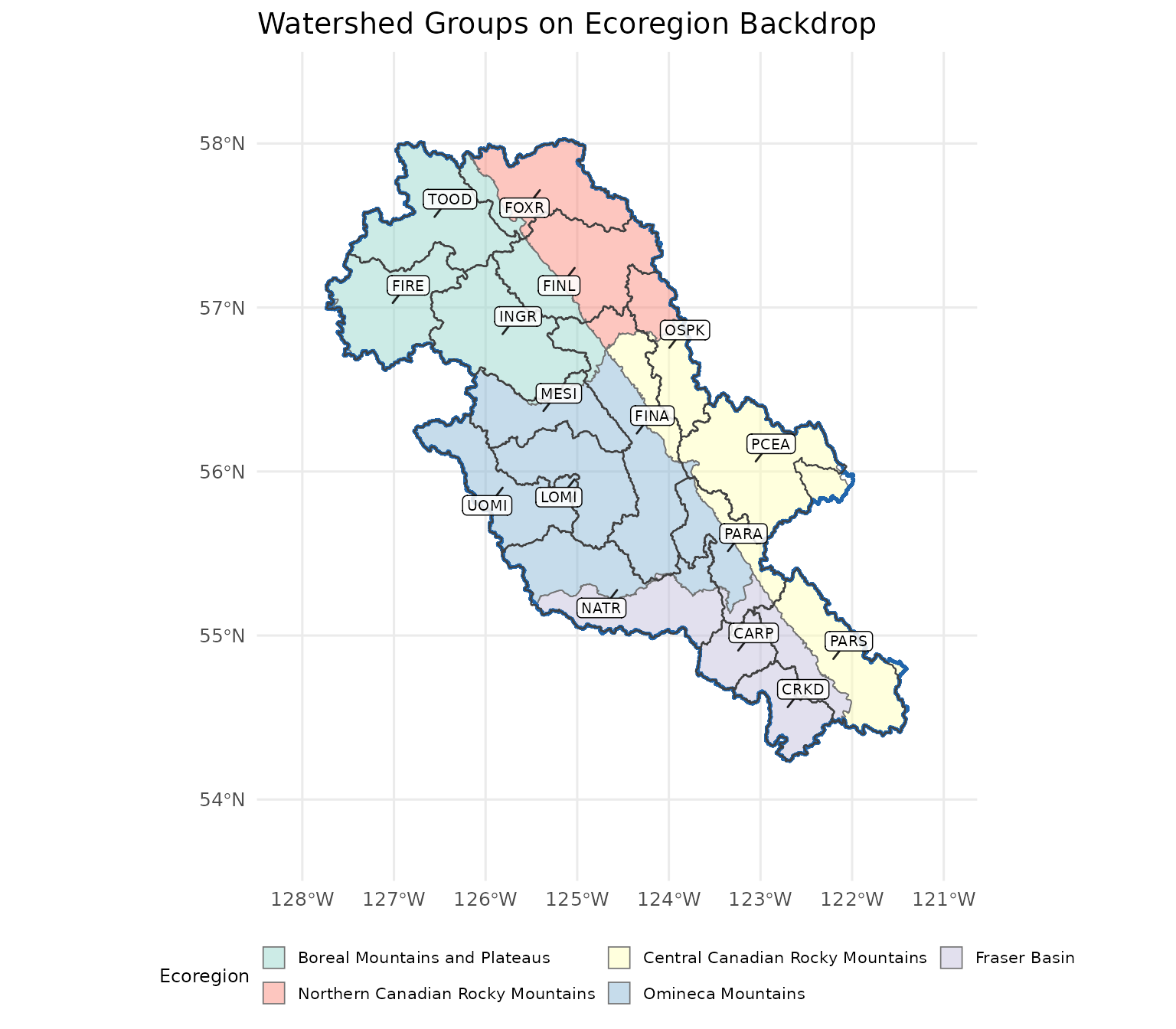
Watershed groups intersecting the FWCP Peace Region (full extent, including the parts spilling outside the FWCP boundary), labelled with their codes, on top of ecoregion fills. The Fraser Basin, Central Canadian Rockies, and Omineca Mountains ecoregions occupy the southern and central portions; Boreal Mountains and Plateaus and Northern Canadian Rocky Mountains sit in the north.
| Code | Name | km² in FWCP | FAB % | CRM % | OMM % | BMP % | NRM % |
|---|---|---|---|---|---|---|---|
| CARP | Carp Lake | 1794 | 100.0 | 0.0 | 0.0 | 0.0 | 0.0 |
| CRKD | Crooked River | 2172 | 100.0 | 0.0 | 0.0 | 0.0 | 0.0 |
| FINA | Finlay Arm | 7383 | 0.3 | 20.2 | 61.8 | 10.3 | 7.4 |
| FINL | Finlay River | 5479 | 0.0 | 0.0 | 0.0 | 30.4 | 69.6 |
| FIRE | Firesteel River | 4376 | 0.0 | 0.0 | 1.0 | 99.0 | 0.0 |
| FOXR | Fox River | 4279 | 0.0 | 0.0 | 0.0 | 16.8 | 83.2 |
| INGR | Ingenika River | 5328 | 0.0 | 0.0 | 0.7 | 99.3 | 0.0 |
| LOMI | Lower Omineca River | 4013 | 0.0 | 0.0 | 100.0 | 0.0 | 0.0 |
| MESI | Mesilinka River | 3294 | 0.0 | 0.0 | 94.8 | 5.2 | 0.0 |
| NATR | Nation River | 6889 | 49.3 | 0.0 | 50.7 | 0.0 | 0.0 |
| OSPK | Ospika River | 2973 | 0.0 | 60.5 | 0.0 | 0.0 | 39.5 |
| PARA | Parsnip Arm | 3729 | 15.1 | 31.3 | 53.5 | 0.0 | 0.0 |
| PARS | Parsnip River | 5583 | 28.6 | 71.4 | 0.0 | 0.0 | 0.0 |
| PCEA | Peace Arm | 5861 | 0.0 | 98.8 | 1.2 | 0.0 | 0.0 |
| TOOD | Toodoggone River | 4849 | 0.0 | 0.0 | 0.0 | 100.0 | 0.0 |
| UOMI | Upper Omineca River | 3905 | 0.0 | 0.0 | 100.0 | 0.0 | 0.0 |
Interpretation
Three findings emerge from the climate departures shown above.
Warming is broad, fast, and uniform. All five ecoregions warmed between +1.7 °C and +1.9 °C cumulative since 1951, at a rate near +0.3 °C per decade, with Mann-Kendall p-values below 0.001 in every ecoregion. The trend is statistically significant beyond reasonable doubt of being random noise. Daily maximum, daily minimum, and daily mean temperatures all tell the same story. There is no thermal hot spot. The whole region has moved together. A subtle gradient does emerge — the northern, higher-elevation ecoregions (Omineca Mountains, Boreal Mountains and Plateaus) warmed about 0.2 °C more than the southern Fraser Basin, consistent with the elevation-dependent warming signal documented at mid-latitude mountain sites (Pepin et al. 2015), though the regional evidence base remains heterogeneous and not every mountain region shows the same pattern (Rangwala and Miller 2012). The gradient is small relative to the regional signal.
Precipitation is increasing significantly only in the two northernmost ecoregions. Across the FWCP Peace as a whole, the long-term trend in annual precipitation is not statistically significant. Broken out by ecoregion, Boreal Mountains and Plateaus and Northern Canadian Rocky Mountains — both in the northern half of the region — show real increases in annual precipitation (p = 0.02 and 0.01). The southern and central ecoregions show no significant change. This is a north-versus-south contrast that the regional average hides, and the place where breaking the analysis down by ecoregion was worth doing.
Mapping that contrast onto the watershed-group reporting unit: five watershed groups sit in or are dominated by the wetter ecoregions — Toodoggone, Firesteel and Ingenika sit almost entirely within Boreal Mountains and Plateaus, and Finlay and Fox are mostly in Northern Canadian Rocky Mountains. For these, the small upward precipitation trend is statistically defensible. The remaining 13 watershed groups sit elsewhere — Fraser Basin, Central Canadian Rockies, Omineca Mountains — where annual precipitation has not changed in a way distinguishable from natural variability.
The atmosphere is drying despite, in places, more precipitation. Vapour pressure deficit — the gap between how much water the air could hold and how much it actually does — rose significantly in every ecoregion (p < 0.005 across all five), mirroring the continental-scale drying that Ficklin and Novick (2017) documented for the United States as a whole, driven by combined air-temperature increases and relative-humidity changes. Warmer air holds more water before saturating, and that pulls moisture out of soil and vegetation through evaporation and transpiration. Soil moisture is essentially flat in every ecoregion — even where precipitation increased — because the warmer atmosphere is drinking the extra water back. This is the headline ecological finding for the region: water inputs may be rising in places, but soil and vegetation are not seeing more available moisture.
Snow is leaving the region earlier, not falling less. Annual snowfall across the FWCP Peace is essentially unchanged (-6%); the snowpack story is about timing, not quantity. Spring snowmelt rose 37% (212 → 290 mm) and summer snowmelt fell 61% (165 → 64 mm) — same total annual melt, redistributed earlier in the calendar. Annual peak snow water equivalent (SWE) is down about 10% (135 → 122 mm), and most strikingly, summer SWE has collapsed by 75%: the high-elevation snowpack that historically lingered into June and July no longer does. This is the direct mechanism behind the freshet shift described in the snow-trend literature: warmer winters and springs do not stop snow from falling — they shorten how long it stays on the ground.
The freshet-timing signal is broadly uniform across the region — DOY-50 (day-of-year by which half the year’s snowmelt has happened) is shifting earlier at roughly 1 day per decade in every one of the five ecoregions, with Mann-Kendall p-values below 0.01 in each (median p ≈ 0.005). All sixteen FWCP Peace watershed groups, regardless of which ecoregion they sit in, are seeing the same order-of-magnitude earlier melt. The peak-SWE signal is noisier — small recent-decade declines show up in every ecoregion, but the year-to-year variability is large enough that the long-term Theil-Sen slopes do not reach statistical significance at the ecoregion scale. The 75% summer-SWE collapse is detectable in the regional aggregate because spatial averaging suppresses that variability.
For the cold-water resident salmonids the FWCP Peace supports — bull trout, Arctic grayling, mountain whitefish, rainbow trout, kokanee — these signals compound. Stream temperatures track ambient air temperatures, so warmer air means warmer water. Cold-water fish lose thermal habitat under that forcing more than warm-water fish do (Eaton and Scheller 1996), and warming summer streams combined with altered low flows reduce salmonid reproductive success (Mantua et al. 2010). Three knock-on effects matter here. Late-summer low flows are not being relieved — even where precipitation rose, the warmer atmosphere drinks the extra back. The cold-water input that high-elevation snowpack provides during the warmest weeks of summer is dropping in parallel with summer SWE. The spring freshet — the high-flow event that shapes channels, moves spawning gravels, and refills off-channel rearing habitat — is arriving weeks earlier, just when salmon timing depends on it.