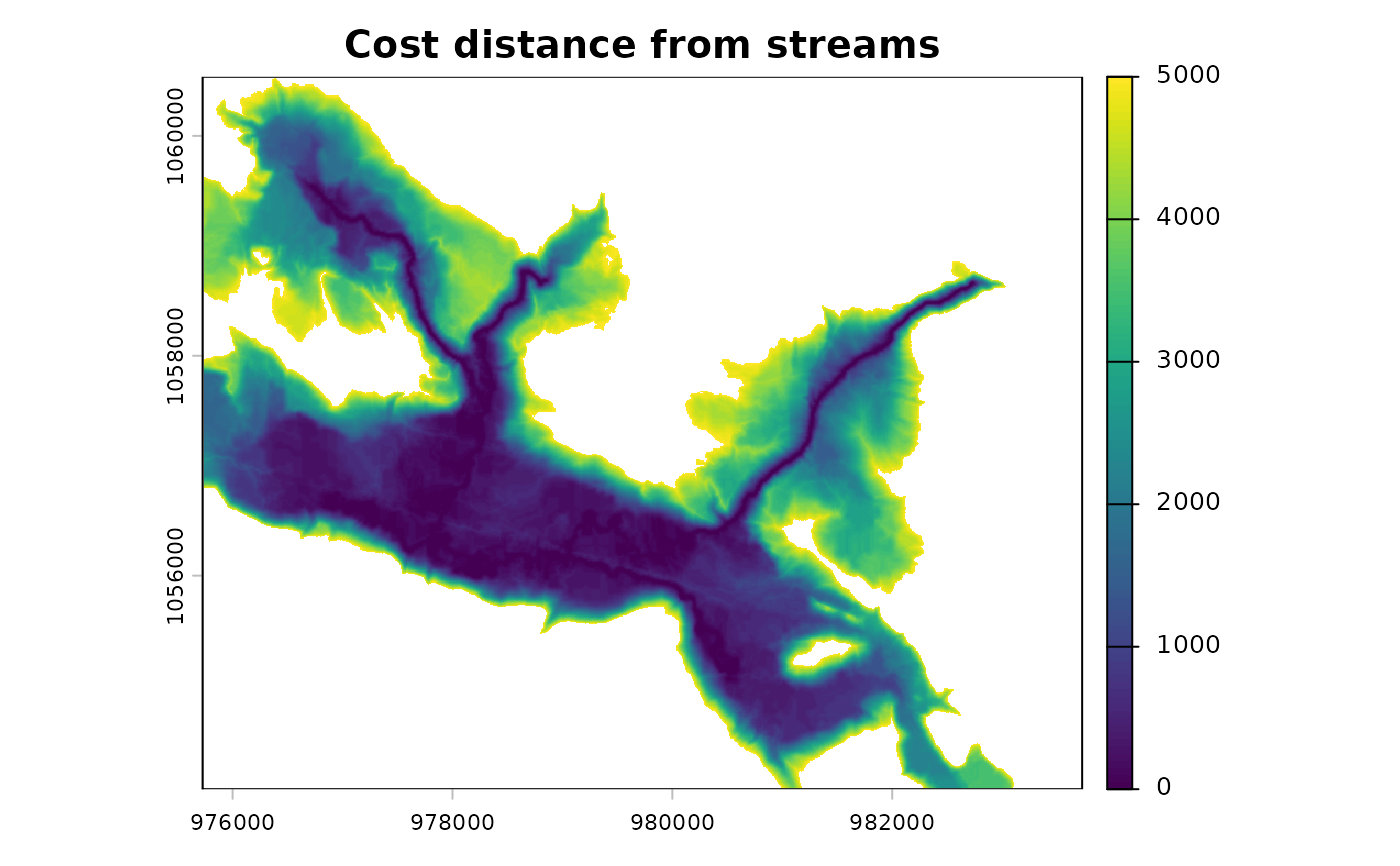
Computes the least-cost distance from every cell to the nearest stream cell, accumulating friction (typically slope) along the path. Stream cells are seed points with cost zero.
Arguments
- friction
A
SpatRasterof movement cost per cell (e.g., percent slope). Higher values = harder to traverse.- streams
A
SpatRasterof rasterized streams (output offl_stream_rasterize()). Any non-NAcell is treated as a seed point.
Value
A SpatRaster of accumulated cost distance. Stream cells have
value 0; other cells increase with cost-weighted distance from the
nearest stream.
Details
Uses terra::costDist() which implements a push-broom algorithm for
weighted distance. The friction raster defines per-cell traversal cost
and streams identifies seed cells (cost = 0).
Cells that are NA in friction are impassable barriers.
Seeds are encoded by setting stream cells to zero in the friction surface,
which is only unambiguous if no other cell is zero. Friction rasters do
contain exact zeros — integer-metre DEMs, hydro-flattened lake surfaces and
void-filled plateaus all quantize to perfectly flat — so cells with friction
exactly 0 are floored to 1e-6 before seeding. Flat ground therefore
remains cheap to cross but is no longer a cost source: at 10 m resolution a
100 km path over floored ground accumulates 0.1, against a typical
cost_threshold of 2500.
Negative friction is not floored — terra::costDist() rejects a negative
cost surface, and that error is left intact.
If your friction is in units whose typical values approach 1e-6, floor the
raster yourself before calling.
Examples
dem <- terra::rast(system.file("testdata/dem.tif", package = "flooded"))
slope <- terra::rast(system.file("testdata/slope.tif", package = "flooded"))
streams <- sf::st_read(
  system.file("testdata/streams.gpkg", package = "flooded"),
  quiet = TRUE
)
stream_r <- fl_stream_rasterize(streams, dem, field = "upstream_area_ha")
cost <- fl_cost_distance(slope, stream_r)
terra::plot(cost, main = "Cost distance from streams", range = c(0, 5000))