
Valley confinement from DEM and stream network
Source:vignettes/valley-confinement.Rmd
valley-confinement.RmdThis vignette walks through the full flooded pipeline on
a section of Neexdzii Kwah (Bulkley River) near Topley, BC. The test
data covers ~5 km of mainstem plus tributaries (Richfield Creek, Cesford
Creek, Robert Hatch Creek) at 10 m resolution.
The bundled stream network is filtered to order 4+ streams that coho
can reach, as modelled by link’s
default configuration, with upstream area and precipitation
from fwapg. This focuses the floodplain delineation on the mainstem
corridor and major tributaries — the streams most relevant to
restoration planning and where investment has the greatest impact on
higher-value salmon habitat. Filtering also constrains the
analysis-of-interest (AOI) for practical downstream applications like
orthophoto acquisition and review, where cost control matters. All
watershed tributaries contribute to floodplain health, but a
bring-your-own-DEM tool benefits from demonstrating the pipeline on a
focused corridor. See data-raw/network_extract.R for the
extraction script.
Load data
library(flooded)
#>
#>  'Whatever you think is a permanent, lasting, eternal feature of human life — all of it will be affected by climate change.' - David Wallace-Wells
#>   source
library(terra)
#> terra 1.9.50
library(sf)
#> Linking to GEOS 3.12.1, GDAL 3.8.4, PROJ 9.4.0; sf_use_s2() is TRUE

dem <- rast(system.file("testdata/dem.tif", package = "flooded"))
slope <- rast(system.file("testdata/slope.tif", package = "flooded"))
streams <- st_read(
  system.file("testdata/streams.gpkg", package = "flooded"),
  quiet = TRUE
)

cat("DEM:", ncol(dem), "x", nrow(dem), "pixels at", res(dem)[1], "m\n")
#> DEM: 800 x 648 pixels at 10 m
cat("Streams:", nrow(streams), "segments\n")
#> Streams: 50 segments
cat("Upstream area range:", range(streams$upstream_area_ha), "ha\n")
#> Upstream area range: 1928.765 110337.4 ha
cat("Mean annual precip range:", range(streams$map_upstream), "mm\n")
#> Mean annual precip range: 512 585 mm
plot(dem, main = "Elevation (m)")
plot(st_geometry(streams), add = TRUE, col = "blue", lwd = 1.5)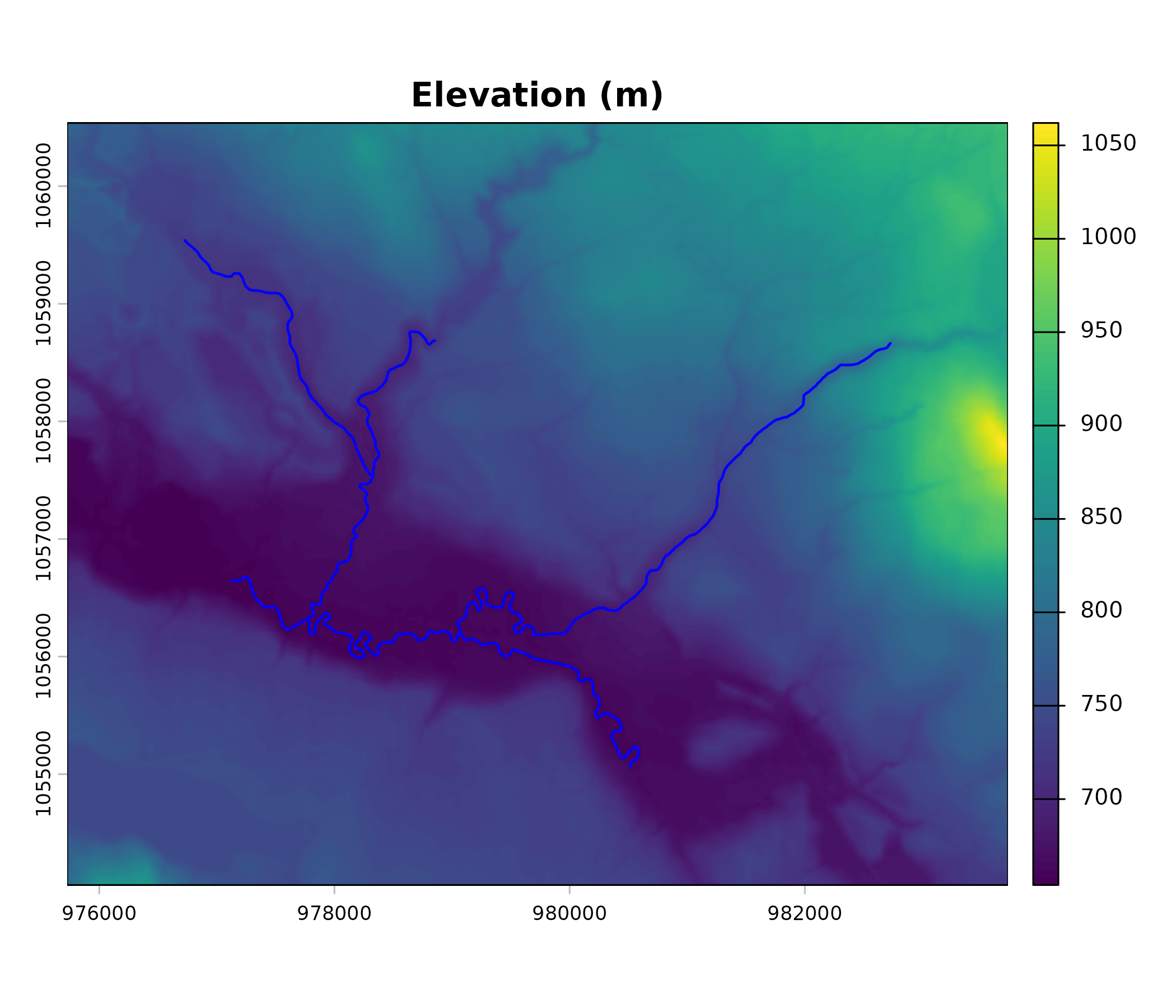
DEM with stream network overlay.
Step 1: Rasterize streams
Burn the stream network onto the DEM grid (Figure @ref(fig:plot-dem)) using upstream contributing area as the cell value (Figure @ref(fig:plot-streams)). This is what the VCA bankfull regression expects — it estimates flood depth from contributing area in hectares.
stream_r <- fl_stream_rasterize(streams, dem, field = "upstream_area_ha")
plot(stream_r, main = "Upstream area (ha)")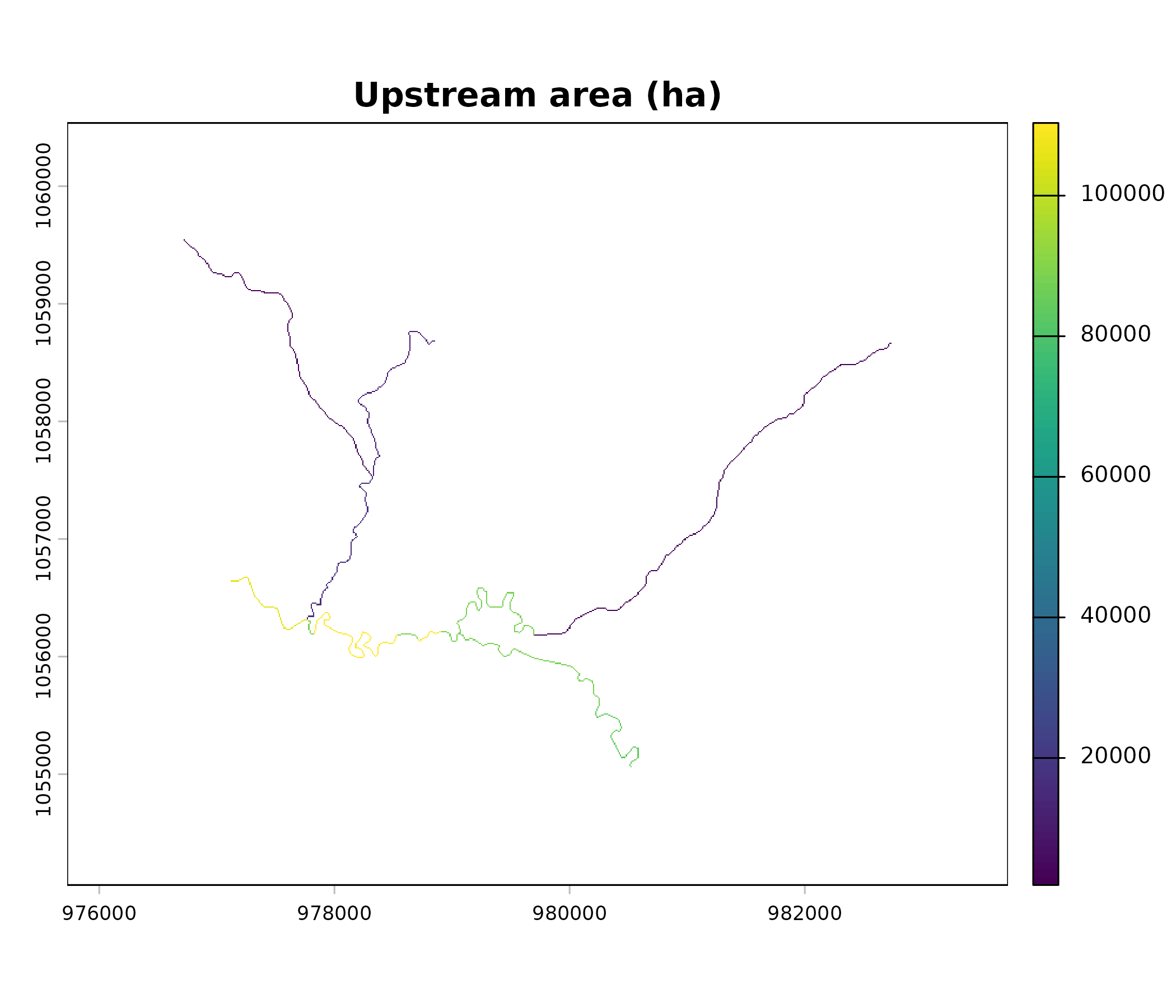
Rasterized streams coloured by upstream area (ha).
Step 2: Precipitation
The VCA bankfull regression has a precipitation term that strongly controls flood depth:
area_km2       = upstream_area_ha / 100
precip_cm      = precip_mm / 10

bankfull_width = (area_km2 ^ 0.280) * 0.196 * (precip_cm ^ 0.355)
bankfull_depth = bankfull_width ^ 0.607 * 0.145
flood_depth    = bankfull_depth * flood_factor
Hall et al. (2007) and Nagel et al. (2014) both specify drainage area in km^2 and mean annual precipitation in cm/yr, so the hectares and millimetres carried on the stream network are converted before the coefficients are applied.
With precip = NULL (the default), the precipitation term
drops out and flood depths are underestimated. For the Bulkley mainstem
(upstream_area_ha ~ 110,000), at
flood_factor = 6 the difference is ~1.1 m vs ~2.5 m flood
depth.
The test data includes map_upstream — mean annual
precipitation (mm) from fwapg/ClimateBC, carried as a stream attribute.
We rasterize it alongside the streams to create a spatially varying
precipitation surface at stream cells.
precip_r <- fl_stream_rasterize(streams, dem, field = "map_upstream")
cat("Precip at stream cells:", range(values(precip_r), na.rm = TRUE), "mm\n")
#> Precip at stream cells: 512 585 mm
Step 3: Individual mask components
The VCA combines four spatial criteria. Let’s inspect each one.
Slope mask
Cells with slope <= 9% (the VCA default) represent potentially flat valley floor (Figure @ref(fig:plot-slope-mask)).
mask_slope <- fl_mask(slope, threshold = 9, operator = "<=")
cat("Gentle slope:", sum(values(mask_slope) == 1, na.rm = TRUE), "cells\n")
#> Gentle slope: 280449 cells
plot(mask_slope, col = c("grey90", "darkgreen"), main = "Slope <= 9%",
     legend = FALSE)
plot(st_geometry(streams), add = TRUE, col = "blue", lwd = 0.8)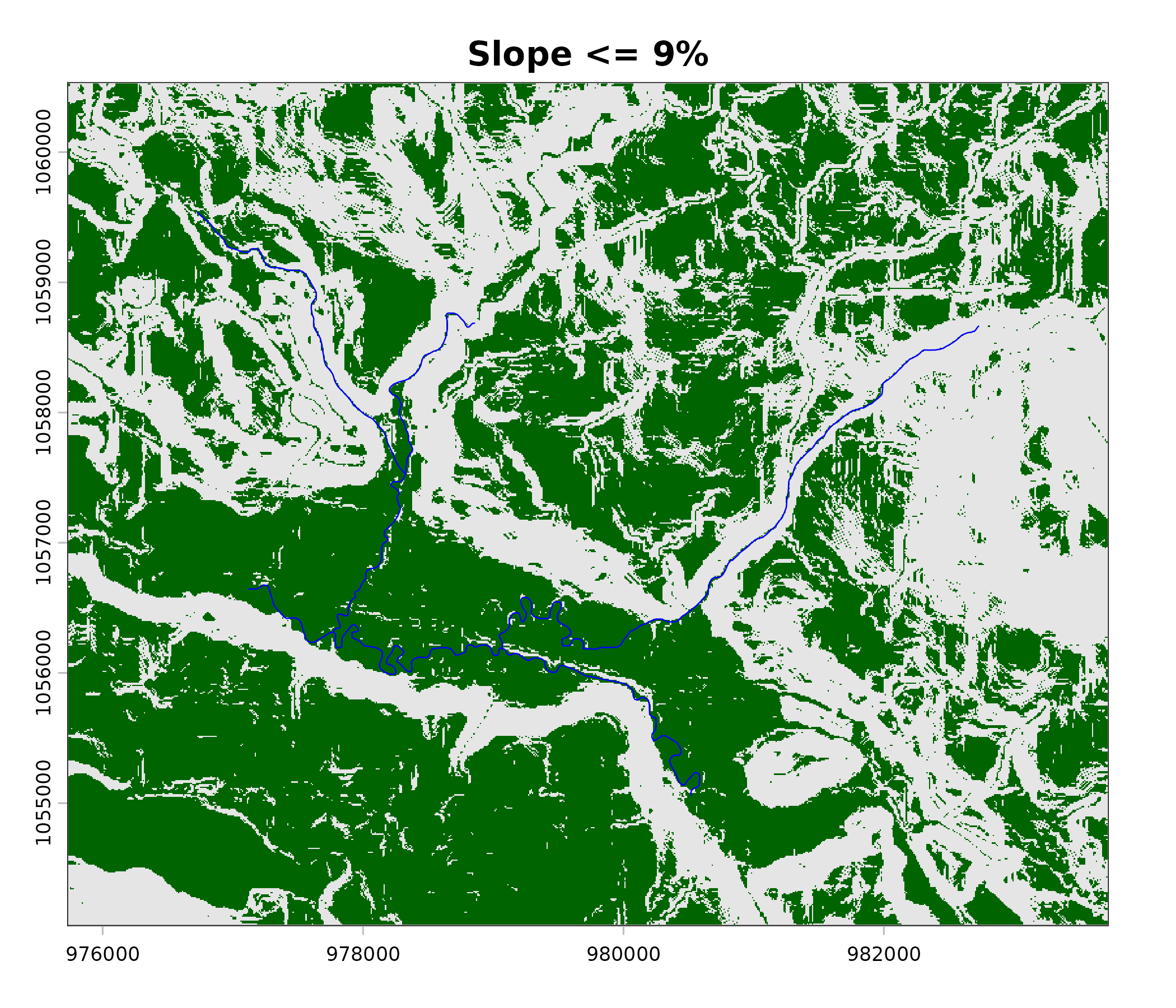
Slope mask: green = slope <= 9%.
Distance mask
Cells within 1000 m of a stream (half the default
max_width = 2000; Figure @ref(fig:plot-dist-mask)).
mask_dist <- fl_mask_distance(stream_r, threshold = 1000)
cat("Within 1 km:", sum(values(mask_dist) == 1, na.rm = TRUE), "cells\n")
#> Within 1 km: 277943 cells
plot(mask_dist, col = c("grey90", "steelblue"), main = "Within 1 km of stream",
     legend = FALSE)
plot(st_geometry(streams), add = TRUE, col = "blue", lwd = 0.8)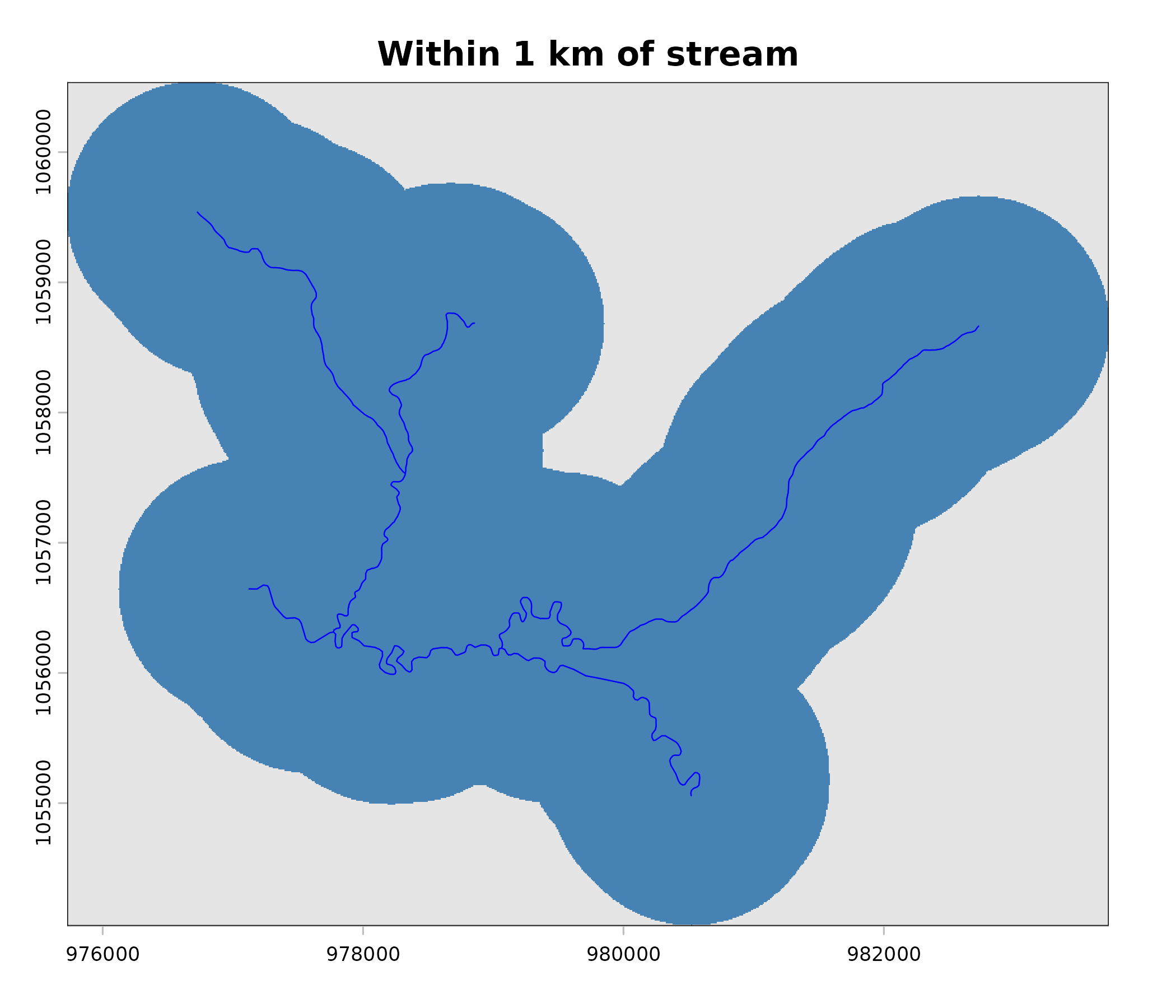
Distance mask: corridor within 1 km of streams.
Cost distance
Accumulated cost (slope-weighted) distance from streams (Figure @ref(fig:plot-cost)). The VCA default threshold is 2500.
cost <- fl_cost_distance(slope, stream_r)
mask_cost <- fl_mask(cost, threshold = 2500, operator = "<")
cat("Cost < 2500:", sum(values(mask_cost) == 1, na.rm = TRUE), "cells\n")
#> Cost < 2500: 110827 cells
plot(cost, main = "Cost distance", range = c(0, 5000))
plot(st_geometry(streams), add = TRUE, col = "blue", lwd = 0.8)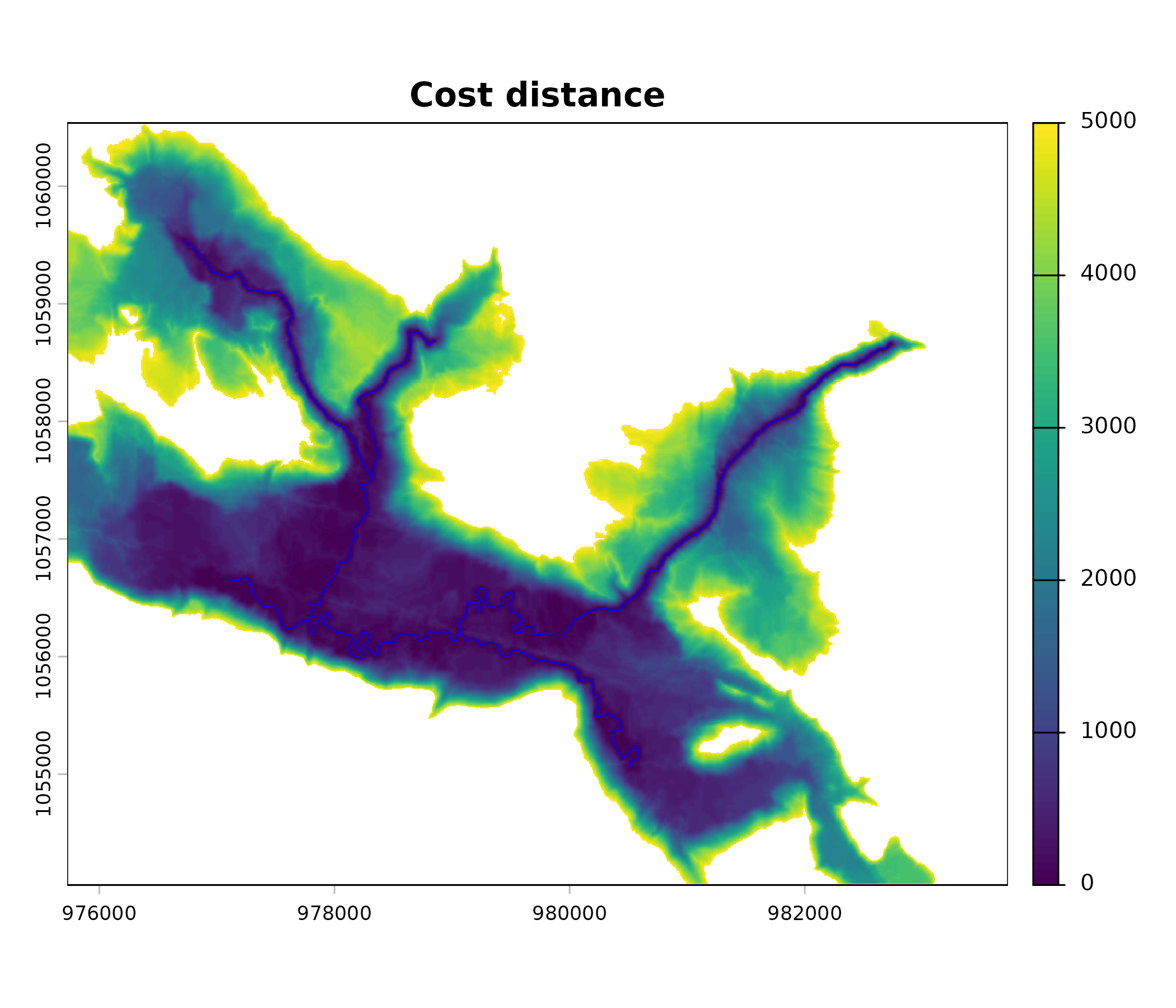
Cost distance from streams. Warm colours = high cost.
Flood model
The bankfull regression estimates flood depth from upstream contributing area and precipitation, interpolates the water surface outward from streams, and identifies cells below the flood surface (Figure @ref(fig:plot-flood)).
flood <- fl_flood_model(dem, stream_r, flood_factor = 6, precip = precip_r,
                        max_width = 2000)
cat("Flooded cells:", sum(values(flood[["flooded"]]) == 1, na.rm = TRUE), "\n")
#> Flooded cells: 30559
depth <- flood[["flood_depth"]]
depth[depth == 0] <- NA
plot(depth, main = "Flood depth (m)")
plot(st_geometry(streams), add = TRUE, col = "blue", lwd = 0.8)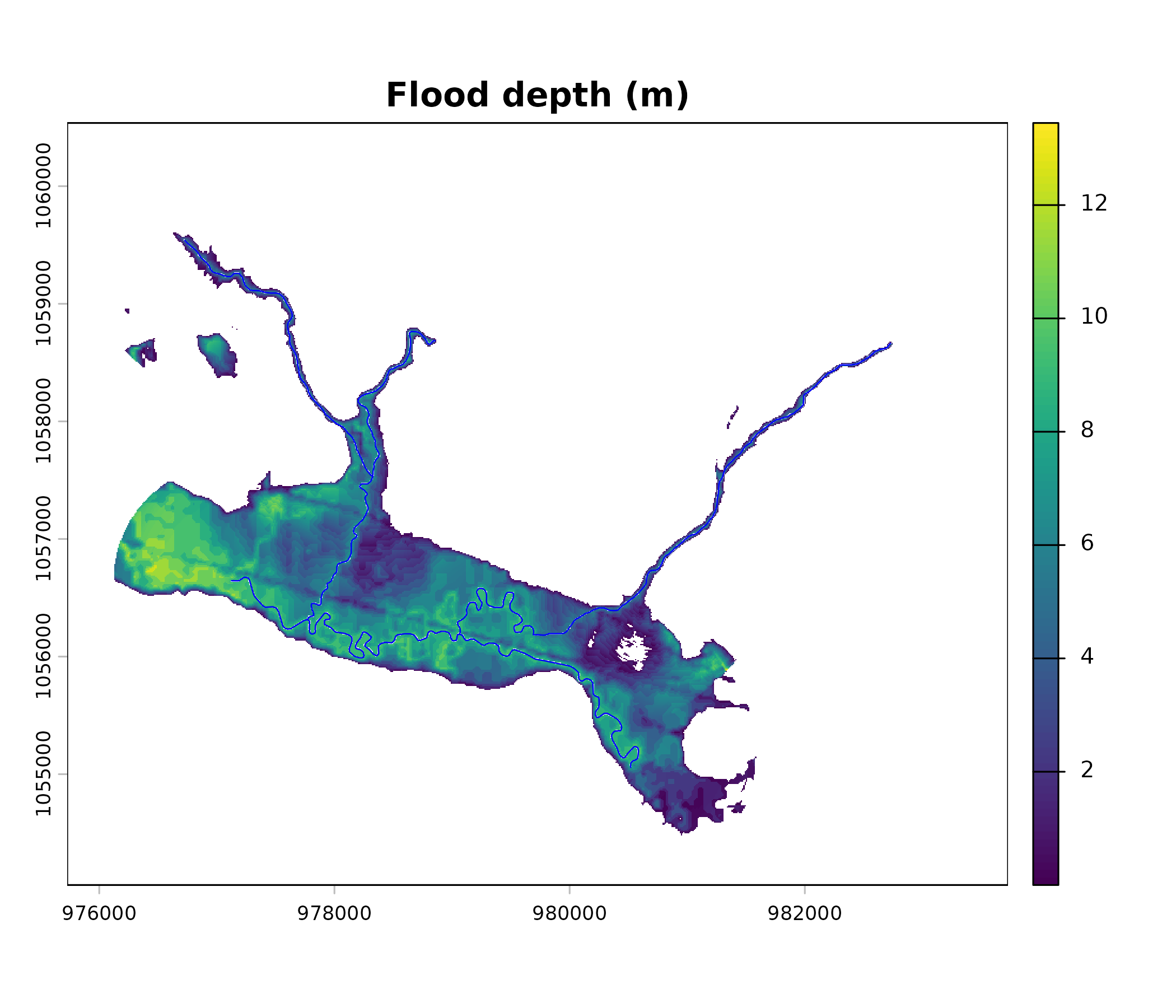
Flood model: depth above terrain (m).
Step 4: Full VCA pipeline
fl_valley_confine() chains all the above (slope +
distance + cost + flood masks), applies morphological cleanup (closing,
hole filling, small patch removal, majority filter), and returns a
binary valley raster (Figure @ref(fig:plot-valleys)).
Note the precip argument — without it, flood depths are
~2.4x too shallow and the resulting valley is significantly
narrower.
valleys <- fl_valley_confine(
  dem, streams,
  area_field = "upstream_area_ha",
  slope = slope,            # pre-computed; derived from DEM if NULL
  slope_threshold = 9,      # percent slope — cells steeper are excluded
  max_width = 2000,         # metres — safety cap on valley width
  cost_threshold = 2500,    # accumulated cost distance limit
  flood_factor = 6,         # bankfull depth multiplier (valley bottom)
  precip = precip_r         # mean annual precipitation (mm)
)

n_valley <- sum(values(valleys) == 1, na.rm = TRUE)
cat("Valley cells:", n_valley, "/", ncell(valleys),
    "(", round(100 * n_valley / ncell(valleys), 1), "%)\n")
#> Valley cells: 28726 / 518400 ( 5.5 %)
plot(valleys, col = c("grey90", "darkgreen"),
     main = "Unconfined valleys", legend = FALSE)
plot(st_geometry(streams), add = TRUE, col = "blue", lwd = 1.2)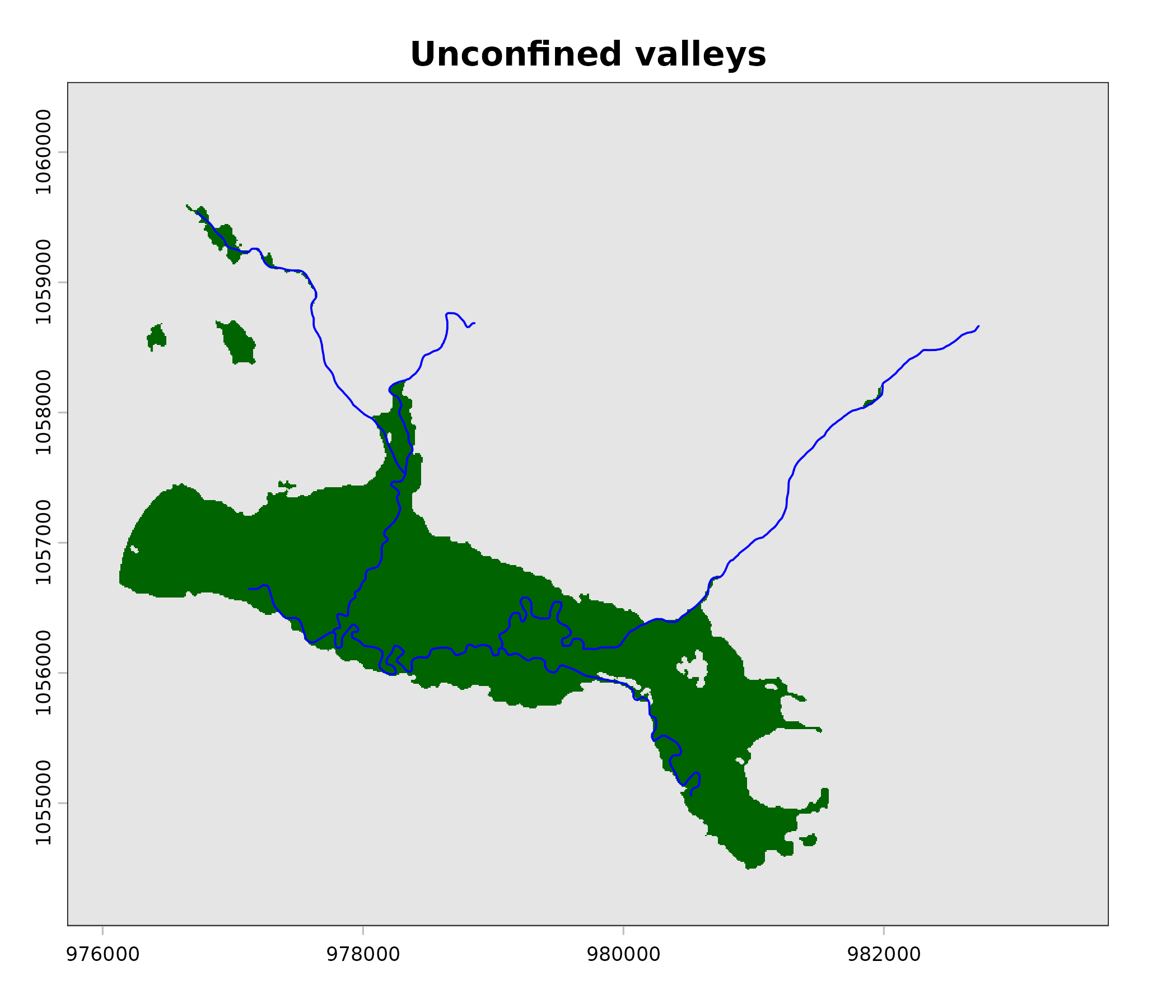
Unconfined valleys (green) with stream network.
Step 5: Post-processing
Connect to streams
Keep only valley patches that touch a stream cell — removes isolated flat areas disconnected from the network (Figure @ref(fig:plot-connected)).
connected <- fl_patch_conn(valleys, stream_r)
cat("Connected valley cells:",
    sum(values(connected) == 1, na.rm = TRUE), "\n")
#> Connected valley cells: 28488
plot(connected, col = c("grey90", "darkgreen"),
     main = "Connected valleys", legend = FALSE)
plot(st_geometry(streams), add = TRUE, col = "blue", lwd = 1.2)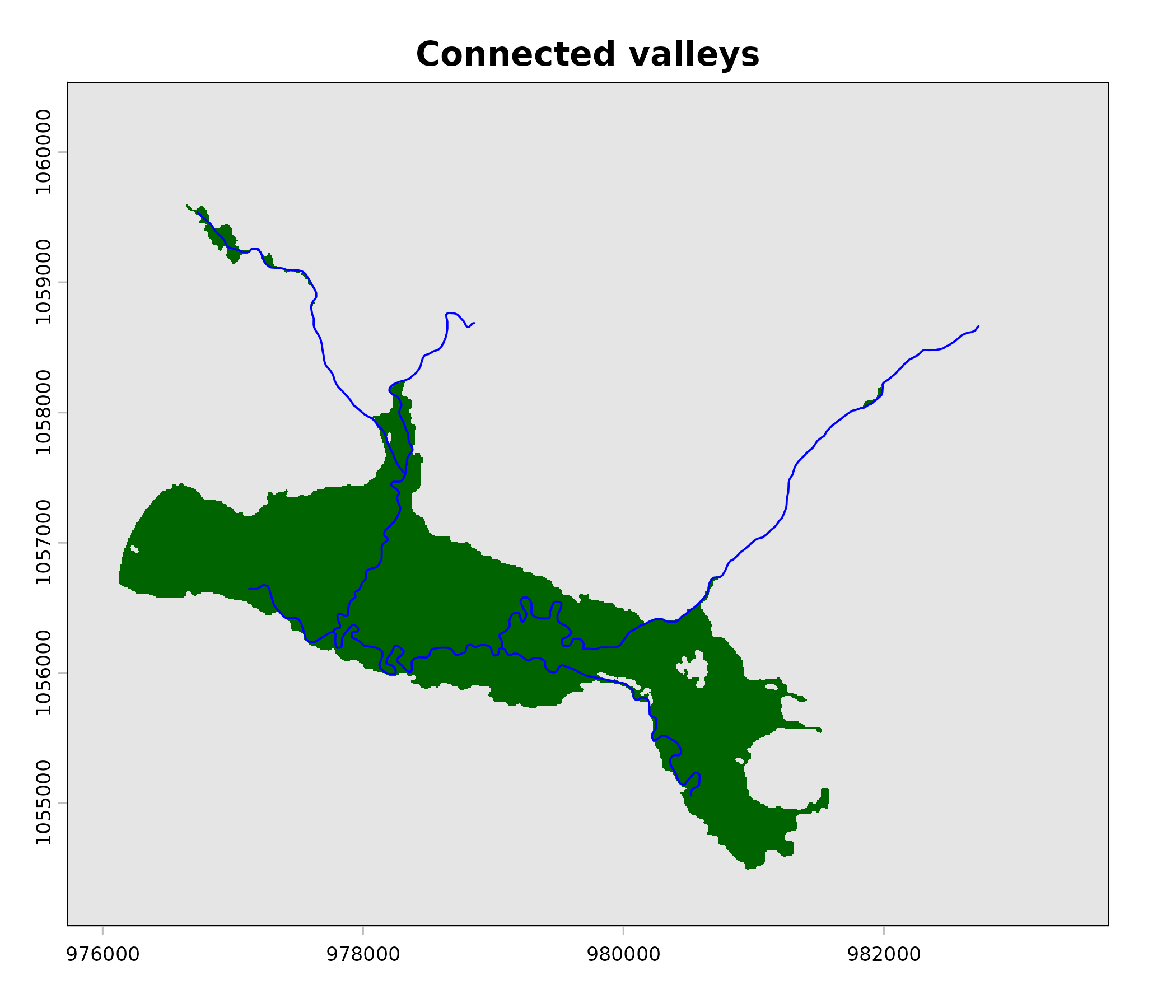
Valley patches connected to streams.
Trim with exclusion masks
fl_flood_trim() subtracts user-supplied masks. For
example, you could trim by urban areas, steep terrain, railways, or
waterbodies. Here we demonstrate by removing cells on slopes > 5% (a
stricter threshold).
steep_mask <- fl_mask(slope, threshold = 5, operator = ">")
trimmed <- fl_flood_trim(connected, steep_mask)
cat("After trimming steep cells:",
    sum(values(trimmed) == 1, na.rm = TRUE), "\n")
#> After trimming steep cells: 19468
Assemble multiple layers
fl_flood_assemble() unions multiple binary rasters. This
is useful when combining outputs from different flood models or data
sources.
# Example: union the connected valleys with a wider flood-only mask
flooded_mask <- flood[["flooded"]]
flooded_mask <- ifel(is.na(flooded_mask), 0L, flooded_mask)
assembled <- fl_flood_assemble(connected, flooded_mask)
cat("Assembled cells:", sum(values(assembled) == 1, na.rm = TRUE), "\n")
#> Assembled cells: 32661
Adding waterbodies and channel buffer
The VCA operates on terrain alone — lakes and wetlands appear as donut holes in the valley raster because the water surface reads differently than surrounding terrain. Similarly, at coarse DEM resolution the stream channel itself can be sub-pixel and excluded from the output.
fl_valley_confine() addresses both:
-
channel_buffer— auto-detected when streams have achannel_widthcolumn. Buffers each stream segment by half its channel width and adds to the output. This is a DEM correction, not a habitat buffer. Streams with NAchannel_widthare skipped for the buffer but still included in the VCA flood model via the bankfull regression. Users pulling lower-order streams may encounter NA widths — the channel width model (Thorley et al., 2021) does not yet cover most first-order streams. -
waterbodies— an optionalsfpolygon layer of lakes and wetlands. Rasterized as-is (no buffer) and added to the output via logical OR. No spatial filtering is applied — pre-filter to valley-bottom features before calling if headwater waterbodies are not wanted.
waterbodies <- st_read(
  system.file("testdata/waterbodies.gpkg", package = "flooded"),
  quiet = TRUE
)
cat("Waterbodies:", nrow(waterbodies), "features\n")
#> Waterbodies: 16 features
cat("Types:", paste(names(table(waterbodies$waterbody_type)),
                    table(waterbodies$waterbody_type), sep = "=", collapse = ", "), "\n")
#> Types: L=10, W=6
valleys_wb <- fl_valley_confine(
  dem, streams,
  area_field = "upstream_area_ha",
  slope = slope,
  precip = precip_r,
  waterbodies = waterbodies
)

n_wb <- sum(values(valleys_wb) == 1, na.rm = TRUE)
cell_area <- prod(res(dem))
cat("VCA only:          ", round(n_valley * cell_area / 1e4, 1), "ha\n")
#> VCA only:           287.3 ha
cat("VCA + features:    ", round(n_wb * cell_area / 1e4, 1), "ha\n")
#> VCA + features:     304.8 ha
cat("Features added:    ", round((n_wb - n_valley) * cell_area / 1e4, 1), "ha\n")
#> Features added:     17.5 ha
par(mfrow = c(2, 1), mar = c(2, 4, 2, 1))
plot(valleys, col = c("grey90", "darkgreen"),
     main = "VCA only", legend = FALSE)
plot(st_geometry(streams), add = TRUE, col = "blue", lwd = 1)

plot(valleys_wb, col = c("grey90", "darkgreen"),
     main = "VCA + waterbodies + channel buffer", legend = FALSE)
plot(st_geometry(streams), add = TRUE, col = "blue", lwd = 1)
if (nrow(waterbodies) > 0) {
  plot(st_geometry(waterbodies), add = TRUE, border = "darkorange",
       lwd = 1.2)
}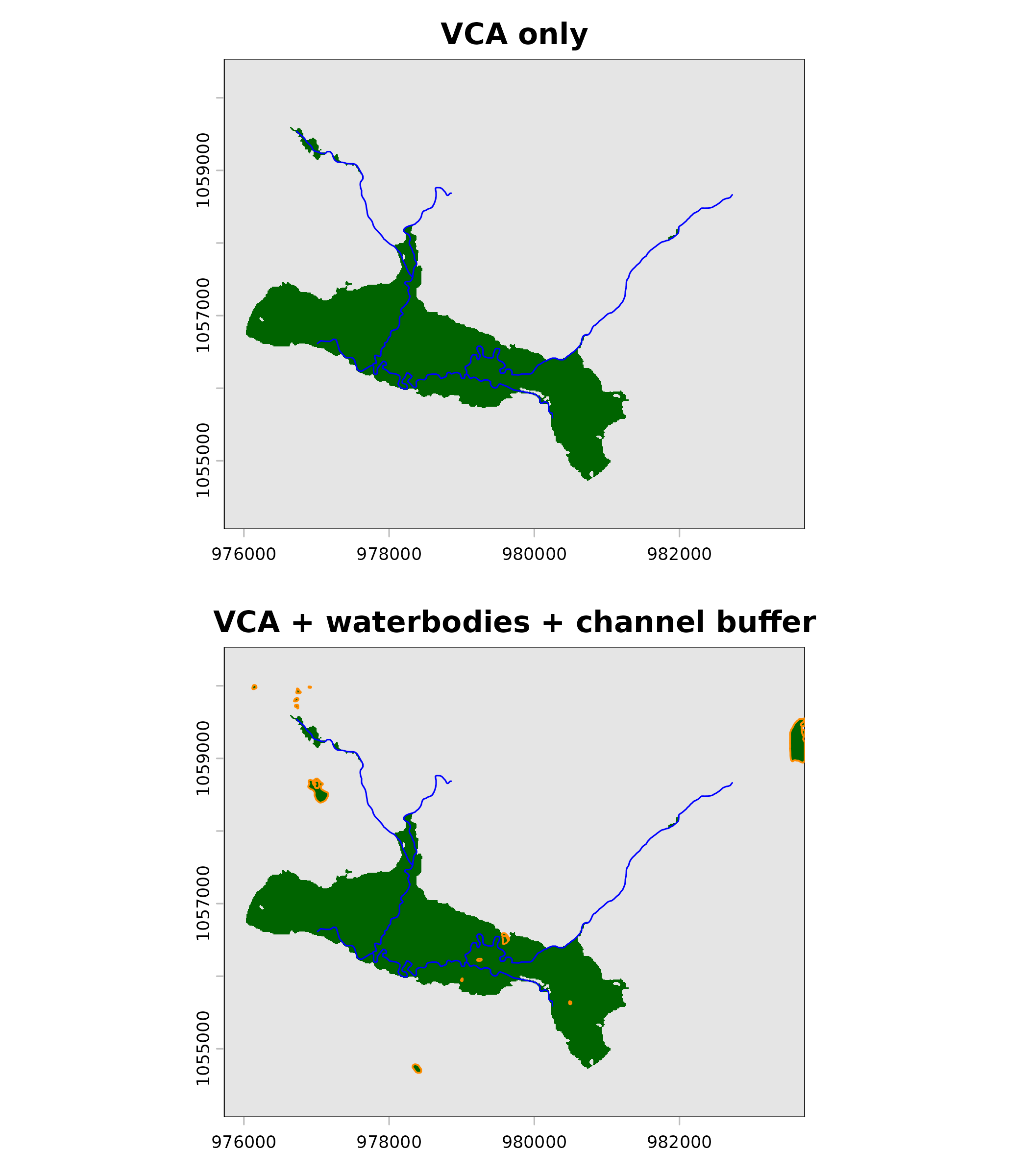
Valley delineation without (top) and with (bottom) waterbodies and channel buffer. Dark green = VCA valley floor, blue lines = streams, orange outlines = waterbody polygons (lakes and wetlands) added via logical OR. Waterbodies fill donut holes left by the terrain-based VCA where flat water surfaces read differently than surrounding floodplain.
Precipitation matters
The VCA bankfull regression includes a precipitation term
(precip ^ 0.355) that scales flood depth with local
climate. In BC, map_upstream (mean annual precipitation in
mm) is available as a stream attribute from fwapg (the Freshwater Atlas
Postgres layer). For other jurisdictions, any gridded precipitation
product will work — rasterize it to the DEM grid and pass it as the
precip argument.
Omitting precipitation (precip = NULL, the default)
underestimates flood depth by roughly 2.4x in wet climates (~500 mm
MAP), producing a noticeably narrower valley. Note that
precip = NULL is the way to drop the term — passing
precip = 1 means one millimetre, which is a depth
multiplier of 0.61 rather than 1 and gives a shallower result than
omitting precipitation altogether:
valleys_no_precip <- fl_valley_confine(
  dem, streams, area_field = "upstream_area_ha",
  precip = NULL
)

n_no <- sum(values(valleys_no_precip) == 1, na.rm = TRUE)
cat("Without precip:", n_no, "cells (",
    round(100 * n_no / ncell(dem), 1), "%)\n")
#> Without precip: 19838 cells ( 3.8 %)
cat("With precip:   ", n_valley, "cells (",
    round(100 * n_valley / ncell(dem), 1), "%)\n")
#> With precip:    28726 cells ( 5.5 %)
Flood factor scenarios
The flood_factor is a DEM compensation parameter — it
scales predicted bankfull depth to set the flood height above the
channel. Higher values compensate for coarser DEM vertical resolution.
The ecological interpretation is an overlay: Hall et al. (2007)
validated ff=3 against 213 field-measured floodplain widths on 10 m DEM;
Nagel et al. (2014) recommended ff=5–7 for mapping valley bottoms (wider
than functional floodplain).
fl_scenarios() provides three pre-defined scenarios.
fl_params() documents every tuning parameter with units,
defaults, and literature sources.
scenarios <- fl_scenarios()
scenarios[, c("scenario_id", "flood_factor", "description")]
#> # A tibble: 3 × 3
#>   scenario_id flood_factor description
#>   <chr>              <int> <chr>
#> 1 ff02                   2 Flood-prone width / active channel margin
#> 2 ff04                   4 Functional floodplain
#> 3 ff06                   6 Valley bottom extent
params <- fl_params()
params[, c("parameter", "unit", "default", "source")]
#> # A tibble: 6 × 4
#>   parameter       unit          default source
#>   <chr>           <chr>           <int> <chr>
#> 1 flood_factor    dimensionless       6 Nagel et al. 2014; Hall et al. 2007
#> 2 slope_threshold percent             9 Nagel et al. 2014
#> 3 max_width       metres           2000 Nagel et al. 2014 (modified)
#> 4 cost_threshold  dimensionless    2500 Nagel et al. 2014
#> 5 size_threshold  m2               5000 Nagel et al. 2014 (modified)
#> 6 hole_threshold  m2               2500 flooded-specific
Run all three scenarios on the test data to see how flood factor controls the mapped extent:
results <- list()
for (i in seq_len(nrow(scenarios))) {
  s <- scenarios[i, ]
  results[[s$scenario_id]] <- fl_valley_confine(
    dem, streams,
    area_field = "upstream_area_ha",
    slope = slope,
    precip = precip_r,
    flood_factor = s$flood_factor,
    slope_threshold = s$slope_threshold,
    max_width = s$max_width,
    cost_threshold = s$cost_threshold,
    size_threshold = s$size_threshold,
    hole_threshold = s$hole_threshold,
    waterbodies = waterbodies
  )
}

cell_area <- prod(res(dem))
for (id in names(results)) {
  n <- sum(values(results[[id]]) == 1, na.rm = TRUE)
  cat(sprintf("%-6s (ff=%s): %5.1f ha\n", id,
              scenarios$flood_factor[scenarios$scenario_id == id],
              n * cell_area / 1e4))
}
#> ff02   (ff=2): 203.7 ha
#> ff04   (ff=4): 249.8 ha
#> ff06   (ff=6): 304.8 ha
par(mfrow = c(3, 1), mar = c(2, 4, 2, 1))
titles <- c(
  ff02 = "ff=2: Active channel margin",
  ff04 = "ff=4: Functional floodplain",
  ff06 = "ff=6: Valley bottom"
)
for (id in names(results)) {
  plot(results[[id]], col = c("grey90", "darkgreen"),
       main = titles[id], legend = FALSE)
  plot(st_geometry(streams), add = TRUE, col = "blue", lwd = 1)
  if (nrow(waterbodies) > 0) {
    plot(st_geometry(waterbodies), add = TRUE,
         border = "darkorange", lwd = 1.2)
  }
}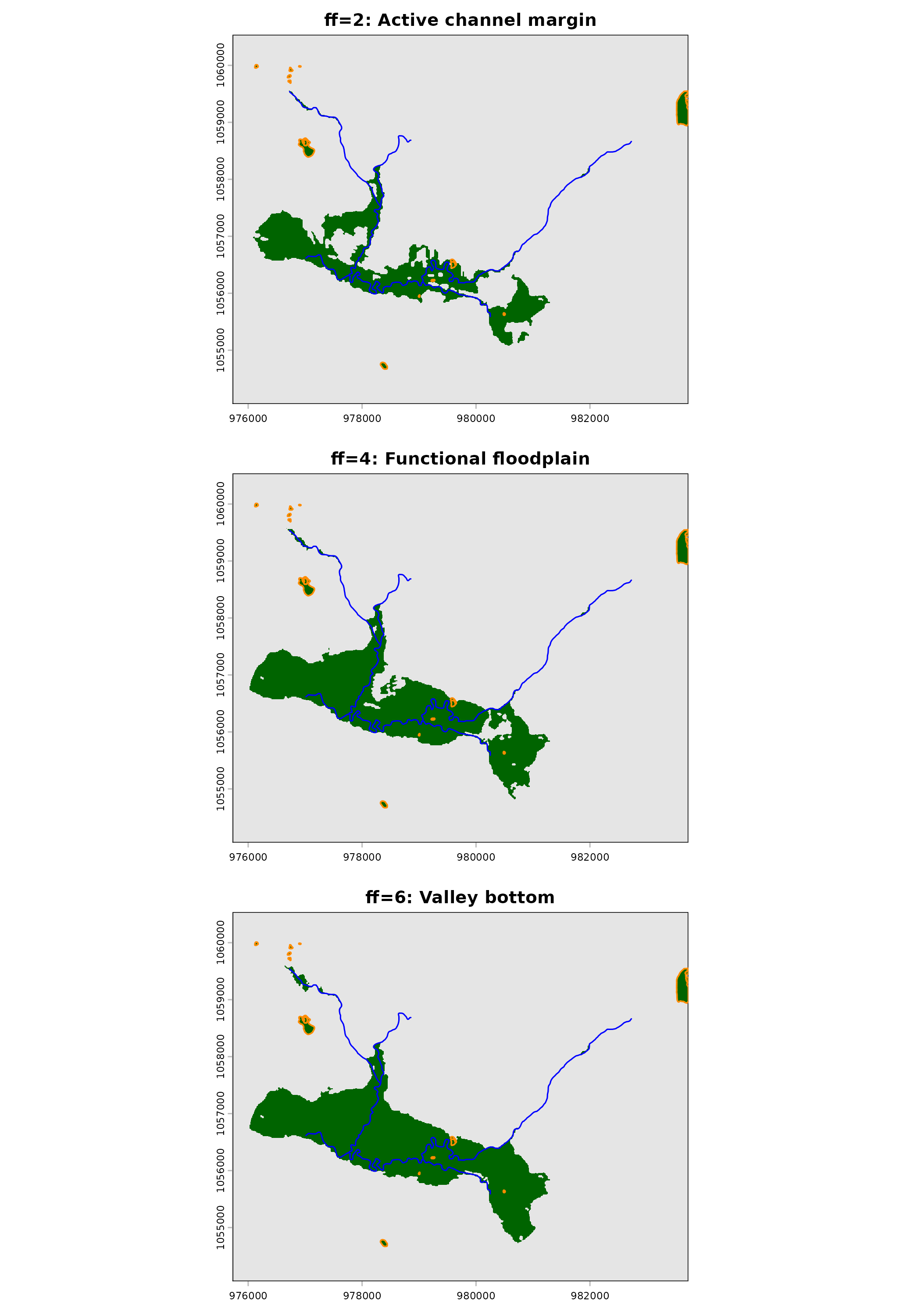
Valley delineation at three flood factor values. ff=2 (active channel margin) captures the zone of frequent inundation. ff=4 (functional floodplain) maps the historical flood extent. ff=6 (valley bottom) includes terraces and depositional surfaces beyond the active floodplain. Blue lines = streams, orange outlines = waterbody polygons.
Whose floodplain is it?
The delineation above answers “where is this network’s floodplain?”
It cannot answer “where is the Bulkley River’s floodplain?” — a
valley cell carries no memory of which stream made it one.
fl_valley_attribute() adds that memory after the fact: it
takes the finished delineation and works out which part of it belongs to
which watercourse.
by_stream <- fl_valley_attribute(
  valleys_wb,
  streams,
  group = "gnis_name",
  dem = dem
)
#> ℹ 1643 valley cells outside every group's thresholds - 1643 assigned to the nearest group.

by_stream[, "gnis_name"]
#> Simple feature collection with 5 features and 1 field
#> Geometry type: MULTIPOLYGON
#> Dimension:     XY
#> Bounding box:  xmin: 976087.5 ymin: 1054668 xmax: 983727.5 ymax: 1060008
#> Projected CRS: NAD83 / BC Albers
#>            gnis_name                       geometry
#> 1      Bulkley River MULTIPOLYGON (((978377.5 10...
#> 2      Cesford Creek MULTIPOLYGON (((978937.5 10...
#> 3    Richfield Creek MULTIPOLYGON (((978307.5 10...
#> 4 Robert Hatch Creek MULTIPOLYGON (((977057.5 10...
#> 5               <NA> MULTIPOLYGON (((980647.5 10...
A cell is attributed to a watercourse when it is a valley cell
and it sits within max_width / 2 of that
watercourse and its cost-distance from it is under
cost_threshold — the same two stream-dependent criteria the
VCA applies to the whole network. Nothing is re-delineated, so changing
the grouping key relabels the output without moving a boundary.
Near a confluence, ground legitimately belongs to more than one floodplain, so the rows overlap rather than partitioning the valley. On this tile the parts sum to roughly 2.2 times the whole:
areas <- data.frame(
  watercourse = ifelse(is.na(by_stream$gnis_name), "unnamed", by_stream$gnis_name),
  area_ha = round(as.numeric(sf::st_area(by_stream)) / 1e4, 1)
)
knitr::kable(
  areas[order(-areas$area_ha), ],
  row.names = FALSE,
  col.names = c("Watercourse", "Area (ha)"),
  caption = "Floodplain area attributable to each watercourse. Overlapping rows mean these do not sum to the total delineated area."
)| Watercourse | Area (ha) |
|---|---|
| Bulkley River | 265.2 |
| Richfield Creek | 130.3 |
| Cesford Creek | 122.4 |
| unnamed | 99.6 |
| Robert Hatch Creek | 55.9 |
The practical payoff is in the field. Filter to one watercourse and its floodplain terminates where that watercourse does, which is what makes “inside the Bulkley floodplain” and “upstream of it” answerable at a point:
plot(dem, main = "Floodplain by watercourse", col = grey.colors(100))
plot(st_geometry(by_stream[which(by_stream$gnis_name == "Bulkley River"), ]),
     add = TRUE, col = "#2166ac60", border = "#2166ac")
plot(st_geometry(by_stream[which(by_stream$gnis_name == "Richfield Creek"), ]),
     add = TRUE, col = "#d6604d60", border = "#d6604d")
plot(st_geometry(streams), add = TRUE, col = "steelblue", lwd = 0.8)
legend("topright", legend = c("Bulkley River", "Richfield Creek"),
       fill = c("#2166ac60", "#d6604d60"), border = c("#2166ac", "#d6604d"),
       bty = "n", cex = 0.8)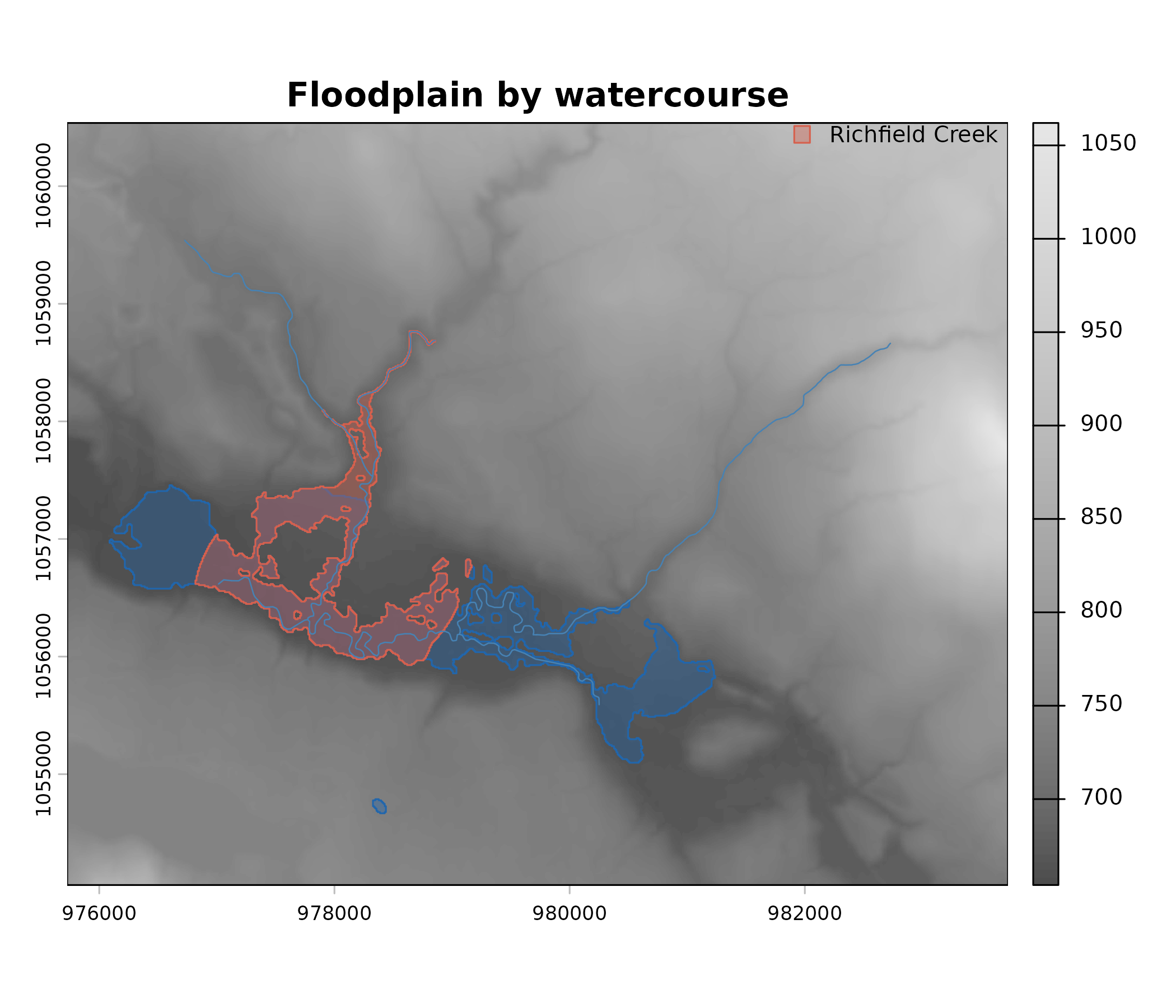
Floodplain attributed per watercourse. Blue is the Bulkley River mainstem, orange is Richfield Creek; the hatched overlap near the confluence belongs to both.
Why attribute a single delineation instead of running the VCA once per watercourse? Because a per-watercourse run is not that watercourse’s share of the whole-network run. The flood surface is interpolated from every seed cell, the distance and cost criteria loosen as seeds are added, and morphological cleanup couples patches — so dropping the tributaries changes the mainstem’s own floodplain. Attributing one delineation keeps the answer independent of whatever else happened to be in the run.
Morphological cleanup, the channel buffer, and waterbody polygons all add cells to the delineation after the masks are intersected, and those can fall outside every watercourse’s thresholds. By default they are assigned to the nearest watercourse so the attribution covers the delineation exactly; the count is reported and stored on the result:
attr(by_stream, "fl_fallback_cells")
#> [1] 1643
Performance
On the Parsnip River watershed group (a 3,749 x 3,761 cell grid at 30
m, 8,436 stream segments before flooded#87), one
fl_valley_confine() call took 83 to 122 s of wall time on
an Apple M1 Max with flooded 0.8.1 and terra 1.9.50, with other work on
the machine. Whether terra::terraOptions(threads = ) speeds
it up could not be separated from that load; see the Performance section
of ?fl_valley_confine.
Summary
Key tuning parameters from fl_params():
params <- fl_params()
knitr::kable(
  params[, c("parameter", "default", "unit", "effect")],
  col.names = c("Parameter", "Default", "Unit", "Effect")
)| Parameter | Default | Unit | Effect |
|---|---|---|---|
| flood_factor | 6 | dimensionless | Higher = deeper flood; more floodplain |
| slope_threshold | 9 | percent | Higher = more valley floor included |
| max_width | 2000 | metres | Analysis corridor width |
| cost_threshold | 2500 | dimensionless | Higher = valley extends further up hillslopes |
| size_threshold | 5000 | m2 | Minimum valley patch area |
| hole_threshold | 2500 | m2 | Maximum hole size to fill |
Additional arguments to fl_valley_confine() not in the
parameter legend:
| Parameter | Default | Effect |
|---|---|---|
precip |
NULL | MAP in mm, converted to cm/yr internally — critical for realistic flood depth |
waterbodies |
NULL | sf polygons of lakes/wetlands to fill donut holes |
channel_buffer |
auto | Buffer streams by channel_width (DEM correction) |