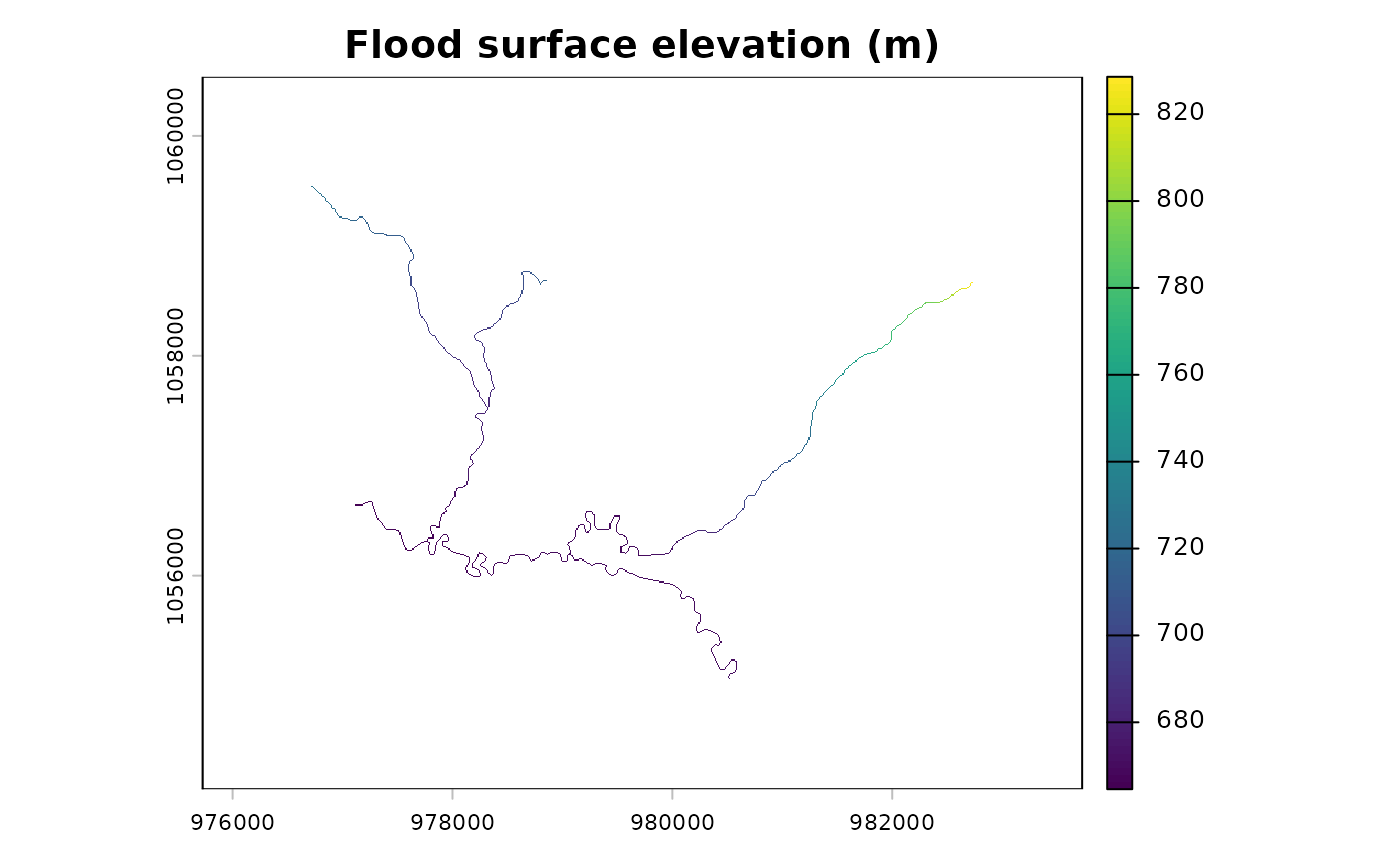
Estimates the bankfull flood surface elevation at each stream cell using
the VCA bankfull regression, then adds the DEM elevation. The result is
the water surface elevation that will be interpolated outward by
fl_flood_depth().
Arguments
- dem
A
SpatRasterof elevation.- streams
A
SpatRasterof rasterized streams (output offl_stream_rasterize()). Cell values must be upstream contributing area in hectares — they are the drainage-area term of the bankfull regression, not a generic channel-size proxy. Converted to km2 internally.- flood_factor
Numeric. Multiplier on bankfull depth to estimate flood depth. Default
6(VCA convention).- precip
A
SpatRasterof mean annual precipitation in millimetres, or a single numeric value in mm applied uniformly. Converted to cm/yr internally. DefaultNULL, which drops the precipitation term.
Details
Bankfull regressions follow the Valley Confinement Algorithm. Hall et al. (2007) and Nagel et al. (2014) both specify drainage area in km2 and mean annual precipitation in cm/yr, so the hectares and millimetres callers carry are converted before the coefficients are applied:
area_km2       = upstream_area_ha / 100
precip_cm      = precip_mm / 10

bankfull_width = (area_km2 ^ 0.280) * 0.196 * (precip_cm ^ 0.355)
bankfull_depth = bankfull_width ^ 0.607 * 0.145
flood_depth    = bankfull_depth * flood_factor
flood_surface  = DEM + flood_depth
When precip = NULL (default), the precipitation term drops out — the
multiplier is exactly 1 — and flood depth depends only on contributing
area. Supplying precipitation matters: on the bundled test data it raises
predicted depth by ~2.4x (2.36 averaged over stream cells).
The equation predicts a fitted index, not a surveyed channel. Hall's
regression has an R2 of 0.47, and its widths run well below independent
estimates such as fwapg's channel_width — 5.7 m against 31.3 m for the Bulkley.
flood_factor is what scales the index onto a mapped footprint.
Passing anything other than upstream area in hectares (channel width, for
instance) silently produces a plausible-looking but wrong flood surface;
see the units defect recorded in inst/notes/floodplain_interpretation.md.
Examples
dem <- terra::rast(system.file("testdata/dem.tif", package = "flooded"))
streams <- sf::st_read(
  system.file("testdata/streams.gpkg", package = "flooded"),
  quiet = TRUE
)
stream_r <- fl_stream_rasterize(streams, dem, field = "upstream_area_ha")
precip_r <- fl_stream_rasterize(streams, dem, field = "map_upstream")

# With precipitation — realistic flood surface
surface <- fl_flood_surface(dem, stream_r, flood_factor = 6, precip = precip_r)
terra::plot(surface, main = "Flood surface elevation (m)")