
Convenience wrapper that calls frs_break_find(), optionally
frs_break_validate(), then frs_break_apply() in sequence. To break at
point features instead, locate them with frs_feature_find() and pass
that table to frs_break_apply().
Usage
frs_break(
  conn,
  table,
  to = "working.breaks",
  attribute = NULL,
  threshold = NULL,
  interval = 100L,
  distance = 100L,
  overwrite = TRUE,
  evidence_table = NULL,
  where = NULL,
  count_threshold = 1L,
  segment_id = "linear_feature_id"
)
Arguments
- conn
A DBI::DBIConnection object (from
frs_db_conn()).- table
Character. Working schema table to find breaks on (from
frs_extract()).- to
Character. Destination table for break points. Default
"working.breaks".- attribute
Character. Column name for threshold-based breaks. Currently only
"gradient"is supported.- threshold
Numeric. Threshold value — sustained sections where gradient exceeds this produce a break point at the entry.
- interval
Integer. Not used (kept for compatibility). Default
100.- distance
Integer. Upstream window in metres for gradient computation at each vertex. Default
100.- overwrite
Logical. If
TRUE, droptobefore creating. DefaultTRUE.- evidence_table
Character or
NULL. If provided, validate breaks against upstream evidence before applying. Passed tofrs_break_validate().- where
Character or
NULL. SQL predicate to filter evidence (e.g."e.species_code IN ('CO','CH')"). Passed tofrs_break_validate().- count_threshold
Integer. Minimum upstream evidence count to remove a break. Default
1.- segment_id
Character. Column name used as segment identifier. Passed to
frs_break_apply(). Default"linear_feature_id".
See also
Other habitat:
frs_aggregate(),
frs_break_apply(),
frs_break_find(),
frs_break_validate(),
frs_categorize(),
frs_channel_width(),
frs_classify(),
frs_cluster(),
frs_col_generate(),
frs_col_join(),
frs_extract(),
frs_feature_find(),
frs_feature_index(),
frs_habitat(),
frs_habitat_access(),
frs_habitat_classify(),
frs_habitat_overlay(),
frs_habitat_partition(),
frs_habitat_predicates(),
frs_habitat_species(),
frs_near_river(),
frs_network_segment()
Examples
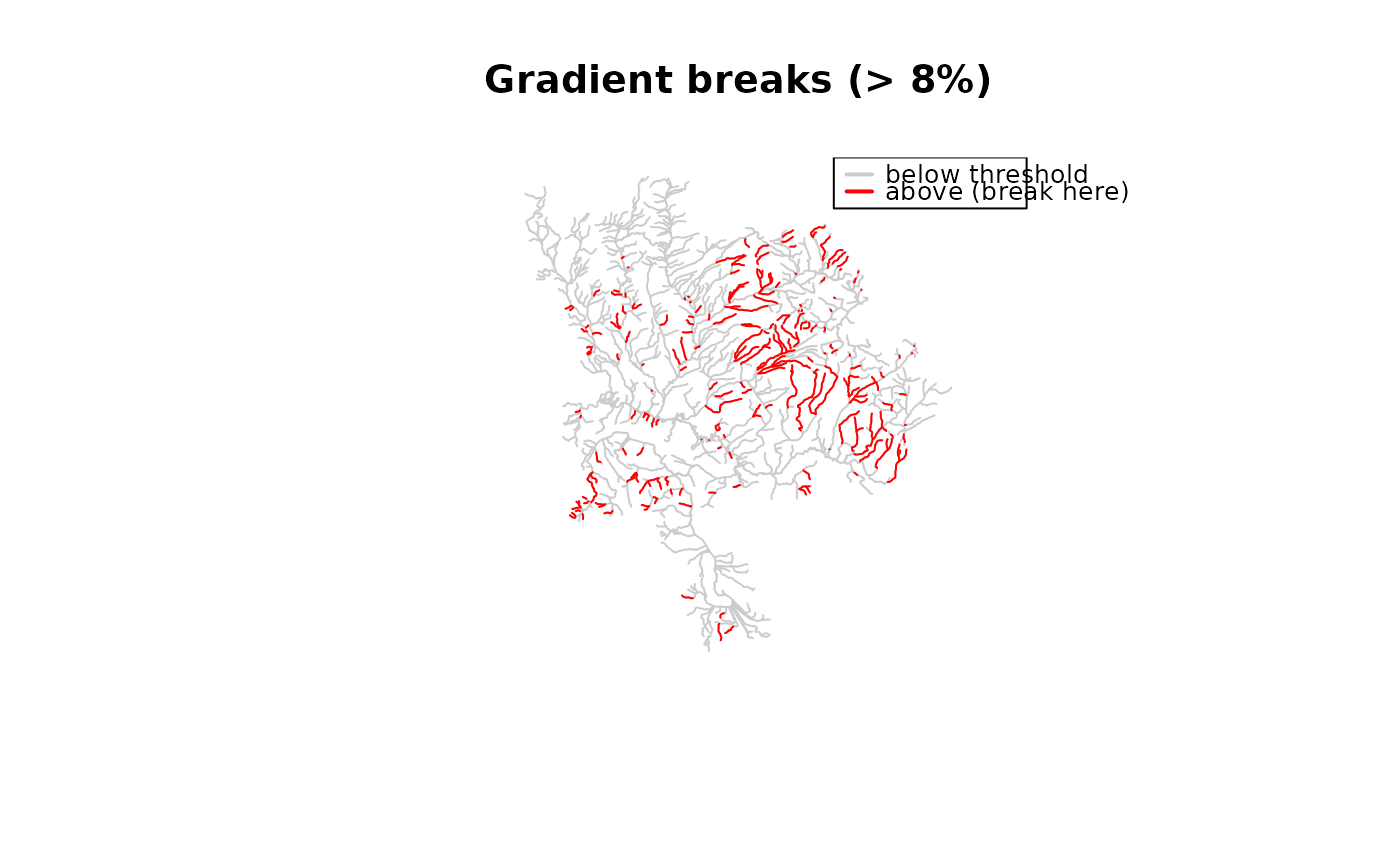
# --- Concept: what frs_break does (bundled data) ---
d <- readRDS(system.file("extdata", "byman_ailport.rds", package = "fresh"))
streams <- d$streams
# Steep segments are where breaks get placed
steep <- !is.na(streams$gradient) & streams$gradient > 0.08
plot(sf::st_geometry(streams), col = "grey80",
main = "Gradient breaks (> 8%)")
plot(sf::st_geometry(streams[steep, ]), col = "red", add = TRUE)
legend("topright",
legend = c("below threshold", "above (break here)"),
col = c("grey80", "red"), lwd = 2, cex = 0.8)
 if (FALSE) { # \dontrun{
# --- Live DB: copy-paste to see before/after ---
conn <- frs_db_conn()
aoi <- d$aoi # Byman-Ailport sf polygon from bundled data
# 1. Extract FWA base streams (unsegmented) to working schema
conn |> frs_extract(
from = "whse_basemapping.fwa_stream_networks_sp",
to = "working.demo_streams",
cols = c("linear_feature_id", "blue_line_key",
"downstream_route_measure", "upstream_route_measure",
"gradient", "geom"),
aoi = aoi,
overwrite = TRUE
)
# 2. Plot BEFORE — original segments
before <- frs_db_query(conn,
"SELECT gradient, geom FROM working.demo_streams")
n_before <- nrow(before)
plot(before["gradient"], main = paste("Before:", n_before, "segments"))
# 3. Convert to generated columns — gradient auto-recomputes after break
conn |> frs_col_generate("working.demo_streams")
# 4. Break at gradient > 8%
conn |> frs_break("working.demo_streams",
attribute = "gradient", threshold = 0.08)
# 5. Plot AFTER — more segments, gradient recomputed per sub-segment
after <- frs_db_query(conn,
"SELECT gradient, geom FROM working.demo_streams")
n_after <- nrow(after)
plot(after["gradient"],
main = paste("After:", n_after, "segments (+",
n_after - n_before, "from breaks)"))
# Clean up
DBI::dbExecute(conn, "DROP TABLE IF EXISTS working.demo_streams")
DBI::dbExecute(conn, "DROP TABLE IF EXISTS working.breaks")
DBI::dbDisconnect(conn)
} # }
if (FALSE) { # \dontrun{
# --- Live DB: copy-paste to see before/after ---
conn <- frs_db_conn()
aoi <- d$aoi # Byman-Ailport sf polygon from bundled data
# 1. Extract FWA base streams (unsegmented) to working schema
conn |> frs_extract(
from = "whse_basemapping.fwa_stream_networks_sp",
to = "working.demo_streams",
cols = c("linear_feature_id", "blue_line_key",
"downstream_route_measure", "upstream_route_measure",
"gradient", "geom"),
aoi = aoi,
overwrite = TRUE
)
# 2. Plot BEFORE — original segments
before <- frs_db_query(conn,
"SELECT gradient, geom FROM working.demo_streams")
n_before <- nrow(before)
plot(before["gradient"], main = paste("Before:", n_before, "segments"))
# 3. Convert to generated columns — gradient auto-recomputes after break
conn |> frs_col_generate("working.demo_streams")
# 4. Break at gradient > 8%
conn |> frs_break("working.demo_streams",
attribute = "gradient", threshold = 0.08)
# 5. Plot AFTER — more segments, gradient recomputed per sub-segment
after <- frs_db_query(conn,
"SELECT gradient, geom FROM working.demo_streams")
n_after <- nrow(after)
plot(after["gradient"],
main = paste("After:", n_after, "segments (+",
n_after - n_before, "from breaks)"))
# Clean up
DBI::dbExecute(conn, "DROP TABLE IF EXISTS working.demo_streams")
DBI::dbExecute(conn, "DROP TABLE IF EXISTS working.breaks")
DBI::dbDisconnect(conn)
} # }