
Detect where stream gradient exceeds a threshold for a sustained
distance (island detection). Produces break points at the entry of
each steep section, suitable for frs_break_apply().
Usage
frs_break_find(
  conn,
  table,
  to = "working.breaks",
  attribute = NULL,
  threshold = NULL,
  interval = 100L,
  distance = 100L,
  min_length = 0L,
  classes = NULL,
  blk_filter = TRUE,
  overwrite = TRUE
)
Arguments
- conn
A DBI::DBIConnection object (from
frs_db_conn()).- table
Character. Working schema table to find breaks on (from
frs_extract()).- to
Character. Destination table for break points. Default
"working.breaks".- attribute
Character. Column name for threshold-based breaks. Currently only
"gradient"is supported.- threshold
Numeric. Threshold value — sustained sections where gradient exceeds this produce a break point at the entry.
- interval
Integer. Not used (kept for compatibility). Default
100.- distance
Integer. Upstream window in metres for gradient computation at each vertex. Default
100.- min_length
Integer. Minimum island length in metres to keep. Default
0(keep all islands — a 30m waterfall at 20% gradient is a real barrier). Set to100to restore pre-0.12.2 behavior where short steep sections were filtered out.- classes
Named numeric vector or
NULL. Gradient class lower bounds for multi-class detection (matching bcfishpass v0.5.0). Names are class labels (used ingradient_classcolumn), values are lower gradient bounds. When provided,thresholdis ignored and all classes are detected in one pass. Example:c("5" = 0.05, "7" = 0.07, "15" = 0.15, "25" = 0.25).- blk_filter
Logical. If
TRUE(default), only sample main flow lines (blue_line_key = watershed_key). Matches bcfishpass.FALSEsamples all edge types including side channels.- overwrite
Logical. If
TRUE, droptobefore creating. DefaultTRUE.
Details
For locating point features on the network (crossings, falls,
observations), use frs_feature_find() instead.
See also
Other habitat:
frs_aggregate(),
frs_break(),
frs_break_apply(),
frs_break_validate(),
frs_categorize(),
frs_classify(),
frs_cluster(),
frs_col_generate(),
frs_col_join(),
frs_extract(),
frs_feature_find(),
frs_feature_index(),
frs_habitat(),
frs_habitat_access(),
frs_habitat_classify(),
frs_habitat_overlay(),
frs_habitat_partition(),
frs_habitat_predicates(),
frs_habitat_species(),
frs_network_segment()
Examples
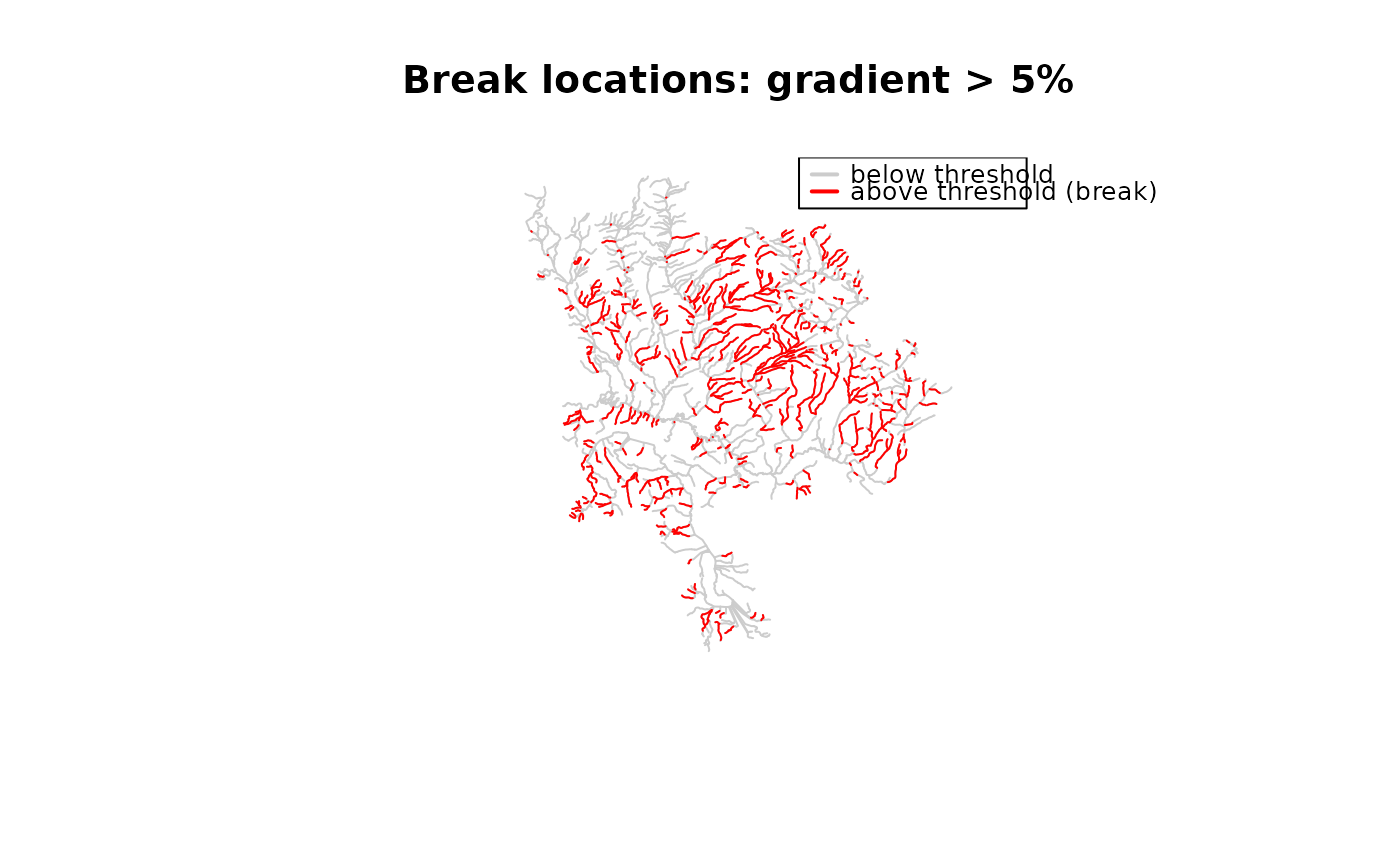
# --- Where breaks occur (bundled data) ---
# Break points are locations where a stream attribute exceeds a threshold.
# Here: segments with gradient > 5% (potential barriers to fish passage).
d <- readRDS(system.file("extdata", "byman_ailport.rds", package = "fresh"))
streams <- d$streams
# Which segments exceed 5% gradient?
is_steep <- streams$gradient > 0.05
message(sum(is_steep, na.rm = TRUE), " of ", nrow(streams),
" segments exceed 5% gradient")
#> 546 of 2167 segments exceed 5% gradient
# Plot: steep segments (red) are where breaks would be placed
plot(sf::st_geometry(streams), col = "grey80",
main = "Break locations: gradient > 5%")
plot(sf::st_geometry(streams[which(is_steep), ]), col = "red", add = TRUE)
legend("topright", legend = c("below threshold", "above threshold (break)"),
col = c("grey80", "red"), lwd = 2, cex = 0.8)
 if (FALSE) { # \dontrun{
# --- Live DB usage ---
conn <- frs_db_conn()
# Attribute mode: break where gradient exceeds 5%
conn |>
frs_extract("bcfishpass.streams_vw", "working.streams", aoi = "BULK") |>
frs_break_find("working.streams", attribute = "gradient", threshold = 0.05)
DBI::dbDisconnect(conn)
} # }
if (FALSE) { # \dontrun{
# --- Live DB usage ---
conn <- frs_db_conn()
# Attribute mode: break where gradient exceeds 5%
conn |>
frs_extract("bcfishpass.streams_vw", "working.streams", aoi = "BULK") |>
frs_break_find("working.streams", attribute = "gradient", threshold = 0.05)
DBI::dbDisconnect(conn)
} # }