Appendix - Floodplain Delineation
gpkg    <- "data/gis/necr.gpkg"
dem_tif <- "data/gis/necr_dem.tif"
val_tif <- "data/gis/necr_valleys.tif"

present <- sf::st_layers(gpkg)$name
load_layer <- function(name) {
  if (name %in% present) sf::st_read(gpkg, layer = name, quiet = TRUE) else NULL
}

aoi            <- load_layer("aoi")
streams        <- load_layer("streams")
waterbodies    <- load_layer("waterbodies")
floodplain     <- load_layer("floodplain")
railways       <- load_layer("railways")
roads          <- load_layer("roads")
reserves       <- load_layer("reserves")
parks          <- load_layer("parks")
named_streams  <- load_layer("named_streams")
municipalities <- load_layer("municipalities")
dem     <- terra::rast(dem_tif)
valleys <- terra::rast(val_tif)

dem        <- terra::mask(terra::crop(dem,     terra::vect(aoi)), terra::vect(aoi))
valleys    <- terra::mask(terra::crop(valleys, terra::vect(aoi)), terra::vect(aoi))
streams     <- suppressWarnings(sf::st_intersection(streams,     aoi))
waterbodies <- suppressWarnings(sf::st_intersection(waterbodies, aoi))
floodplain  <- suppressWarnings(sf::st_intersection(floodplain,  aoi))
if (!is.null(roads))          roads          <- suppressWarnings(sf::st_intersection(roads,          aoi))
if (!is.null(railways))       railways       <- suppressWarnings(sf::st_intersection(railways,       aoi))
if (!is.null(reserves))       reserves       <- suppressWarnings(sf::st_intersection(reserves,       aoi))
if (!is.null(parks))          parks          <- suppressWarnings(sf::st_intersection(parks,          aoi))
if (!is.null(named_streams))  named_streams  <- suppressWarnings(sf::st_intersection(named_streams,  aoi))
if (!is.null(municipalities)) municipalities <- suppressWarnings(sf::st_intersection(municipalities, aoi))
aoi_area_km2 <- as.numeric(sum(sf::st_area(aoi))) / 1e6
fp_area_ha <- as.numeric(sum(sf::st_area(floodplain))) / 1e4
fp_pct_aoi <- 100 * fp_area_ha / (aoi_area_km2 * 100)
streams_in_fp <- suppressWarnings(sf::st_intersection(streams, floodplain))
streams_km_total <- as.numeric(sum(sf::st_length(streams))) / 1e3
streams_km_in_fp <- as.numeric(sum(sf::st_length(streams_in_fp))) / 1e3
wb_in_fp <- suppressWarnings(sf::st_intersection(waterbodies, floodplain))
lakes_n <- sum(wb_in_fp$waterbody_type == "L", na.rm = TRUE)
wetlands_n <- sum(wb_in_fp$waterbody_type == "W", na.rm = TRUE)
lakes_ha <- as.numeric(sum(sf::st_area(wb_in_fp[wb_in_fp$waterbody_type == "L", ]))) / 1e4
wetlands_ha <- as.numeric(sum(sf::st_area(wb_in_fp[wb_in_fp$waterbody_type == "W", ]))) / 1e4This appendix details the floodplain delineation for the Nechako River Watershed Group. The rationale for mapping floodplain extent alongside the fish passage barrier inventory is described in the report background — in brief, the off-channel habitats that floodplains sustain are often as important to fish productivity as the mainstem passage that crossing remediations restore, and infrastructure corridors can compromise floodplain function in ways that structure replacement alone does not address.
Floodplain footprints were delineated using the flooded R package, which implements the Valley Confinement Algorithm of Nagel et al. (2014). The algorithm combines a digital elevation model with the stream network and a modelled bankfull flood surface to distinguish valley bottoms from confined canyon reaches. Bankfull depth — the flow depth at which a stream begins to spill onto its floodplain — is estimated from upstream watershed area and mean annual precipitation using the regional regression of Hall et al. (2007), calibrated against field-mapped floodplain sites in Pacific Northwest streams.
We mapped the functional floodplain: the area a river actively inundates and reworks during regular high-flow events. This sits between two other scales — the narrow active channel (the wetted perimeter at low flow) and the broader geologic valley bottom (which includes terraces untouched by water for centuries). The functional floodplain matters most for habitat planning because it is the ground where side channels form, seasonal flooding sustains wetlands, and riparian forests recruit. Inputs were the MRDEM-30 30 m DEM, the chinook accessible stream network (stream order ≥ 3) from bcfishpass, and BC Freshwater Atlas lakes and wetlands on that network. Waterbodies were included so the valley confinement model fills cells that gradient and cost-distance masks would otherwise exclude.
knitr::kable(
  data.frame(
    Metric = c(
      "Watershed group area (km²)",
      "Floodplain area (ha)",
      "Floodplain as % of watershed group",
      "Chinook accessible streams, order 3+ (km)",
      "Streams within floodplain (km)",
      "Lakes within floodplain (count)",
      "Lakes within floodplain (ha)",
      "Wetlands within floodplain (count)",
      "Wetlands within floodplain (ha)"
    ),
    Value = c(
      format(round(aoi_area_km2),     big.mark = ","),
      format(round(fp_area_ha),       big.mark = ","),
      sprintf("%.1f", fp_pct_aoi),
      format(round(streams_km_total), big.mark = ","),
      format(round(streams_km_in_fp), big.mark = ","),
      format(lakes_n,                 big.mark = ","),
      format(round(lakes_ha),         big.mark = ","),
      format(wetlands_n,              big.mark = ","),
      format(round(wetlands_ha),      big.mark = ",")
    ),
    stringsAsFactors = FALSE
  ),
  caption = "Nechako River Watershed Group — modelled functional floodplain and the off-channel habitat units within it.",
  col.names = c("Metric", "Value"),
  align = c("l", "r")
)| Metric | Value |
|---|---|
| Watershed group area (km²) | 4,148 |
| Floodplain area (ha) | 54,306 |
| Floodplain as % of watershed group | 13.1 |
| Chinook accessible streams, order 3+ (km) | 1,451 |
| Streams within floodplain (km) | 1,312 |
| Lakes within floodplain (count) | 439 |
| Lakes within floodplain (ha) | 8,331 |
| Wetlands within floodplain (count) | 702 |
| Wetlands within floodplain (ha) | 5,599 |
The Nechako River Watershed Group covers roughly 4,148 km². Modelled functional floodplain (Table 5.8) covers about 54,306 ha, or 13.1 % of the watershed group, attached to 1,312 km of the 1,451 km chinook accessible order-3+ network. Within that footprint sit 439 lakes and 702 mapped wetland polygons — the off-channel habitat units that lateral floodplain connectivity supports.
The watershed-wide footprint is shown in Figure 5.17; a detail view of the Murray Creek confluence area near Vanderhoof is shown in Figure 5.18.
hill <- terra::shade(
  terra::terrain(dem, "slope",  unit = "radians"),
  terra::terrain(dem, "aspect", unit = "radians")
)

terra::plot(hill, col = grey(0:100 / 100), legend = FALSE, axes = FALSE,
            mar = c(2, 2, 4, 2),
            main = "Nechako River Watershed Group\nfunctional floodplain, accessible order 3+")

terra::plot(valleys, col = c(NA, "#2c7a2c"), alpha = 0.55, add = TRUE, legend = FALSE)
plot(sf::st_geometry(waterbodies), col = "#a3cdb966", border = "#2171B5",
     lwd = 0.3, add = TRUE)
plot(sf::st_geometry(streams), col = "#1f77b4", lwd = 0.4, add = TRUE)

if (!is.null(roads)) {
  fsr <- roads[roads$transport_line_type_code %in% c("RRS", "RRD", "RRN"), ]
  if (nrow(fsr) > 0L) {
    plot(sf::st_geometry(fsr), col = "#88888888", lwd = 0.25, add = TRUE)
  }
}
if (!is.null(railways)) {
  plot(sf::st_geometry(railways), col = "black", lwd = 0.8, lty = "dashed", add = TRUE)
}
if (!is.null(parks)) {
  plot(sf::st_geometry(parks), col = "#639b5f55", border = "#33a02c",
       lwd = 0.7, add = TRUE)
}
if (!is.null(reserves)) {
  plot(sf::st_geometry(reserves), col = "#b2b2b288", border = "#232323",
       lwd = 0.6, add = TRUE)
  pts <- suppressWarnings(sf::st_centroid(sf::st_geometry(reserves),
                                          of_largest_polygon = TRUE))
  plot(pts, pch = 23, bg = "#222222", col = "white", cex = 0.9, add = TRUE)
}
if (!is.null(municipalities)) {
  plot(sf::st_geometry(municipalities), col = NA, border = "#cc0000",
       lwd = 0.8, add = TRUE)
  muni_pts <- suppressWarnings(sf::st_centroid(sf::st_geometry(municipalities),
                                               of_largest_polygon = TRUE))
  muni_coords <- sf::st_coordinates(muni_pts)
  text(muni_coords, labels = municipalities$admin_area_name,
       cex = 0.55, col = "#cc0000", font = 2, xpd = TRUE)
}

plot(sf::st_geometry(aoi), border = "black", lwd = 1.5, add = TRUE)

if (!is.null(reserves) && "english_name" %in% names(reserves) &&
    nrow(reserves) > 0L) {
  pts <- suppressWarnings(sf::st_centroid(sf::st_geometry(reserves),
                                          of_largest_polygon = TRUE))
  coords <- sf::st_coordinates(pts)
  ofs_y  <- par("cxy")[2] * 0.45 * 0.9
  halo_x <- par("cxy")[1] * 0.45 * 0.05
  halo_y <- par("cxy")[2] * 0.45 * 0.05
  ly <- coords[, 2] - ofs_y
  for (dx in c(-1, 1)) text(coords[, 1] + dx * halo_x, ly,
                            labels = reserves$english_name,
                            cex = 0.45, col = "white", font = 2, xpd = TRUE)
  for (dy in c(-1, 1)) text(coords[, 1], ly + dy * halo_y,
                            labels = reserves$english_name,
                            cex = 0.45, col = "white", font = 2, xpd = TRUE)
  text(coords[, 1], ly, labels = reserves$english_name,
       cex = 0.45, col = "#111111", font = 2, xpd = TRUE)
}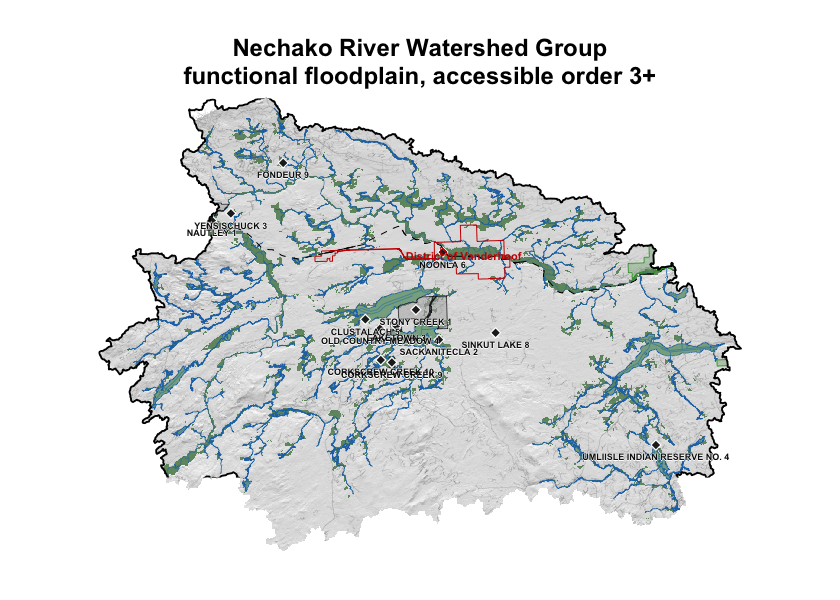
Figure 5.17: Nechako River Watershed Group functional floodplain (green) over hillshaded terrain. Chinook accessible order-3+ streams in blue; lakes and wetlands in light blue; parks light green; First Nations reserves light grey with diamond markers and labels; municipalities outlined in red; forest service / resource roads grey; railways black dashed; watershed boundary heavy black.
# Murray Creek confluence with Nechako River — Vanderhoof at bottom right.
murray <- named_streams[grepl("Murray", named_streams$gnis_name, ignore.case = TRUE), ]
if (nrow(murray) > 0L) {
  mb <- sf::st_bbox(murray)
  inset_bbox <- sf::st_bbox(c(
    xmin = unname(mb["xmin"] - (mb["xmax"] - mb["xmin"]) * 0.15),
    ymin = unname(mb["ymin"] - (mb["ymax"] - mb["ymin"]) * 0.6),
    xmax = unname(mb["xmax"] + (mb["xmax"] - mb["xmin"]) * 0.5),
    ymax = unname(mb["ymax"] + (mb["ymax"] - mb["ymin"]) * 0.15)
  ), crs = sf::st_crs(streams))
} else {
  e <- sf::st_bbox(aoi)
  cx <- (e["xmin"] + e["xmax"]) / 2
  cy <- (e["ymin"] + e["ymax"]) / 2
  span_x <- (e["xmax"] - e["xmin"]) * 0.3
  span_y <- (e["ymax"] - e["ymin"]) * 0.3
  inset_bbox <- sf::st_bbox(c(
    xmin = unname(cx - span_x), ymin = unname(cy - span_y),
    xmax = unname(cx + span_x), ymax = unname(cy + span_y)
  ), crs = sf::st_crs(streams))
}
inset_ext <- terra::ext(inset_bbox[c("xmin", "xmax", "ymin", "ymax")])

crop_sf <- function(x) {
  if (is.null(x) || nrow(x) == 0L) return(NULL)
  out <- suppressWarnings(sf::st_crop(x, inset_bbox))
  if (nrow(out) == 0L) NULL else out
}

dem_inset            <- terra::crop(dem, inset_ext)
valleys_inset        <- terra::crop(valleys, inset_ext)
streams_inset        <- crop_sf(streams)
wb_inset             <- crop_sf(waterbodies)
aoi_inset            <- crop_sf(aoi)
roads_inset          <- crop_sf(roads)
railways_inset       <- crop_sf(railways)
reserves_inset       <- crop_sf(reserves)
parks_inset          <- crop_sf(parks)
named_streams_inset  <- crop_sf(named_streams)
municipalities_inset <- crop_sf(municipalities)

hill_inset <- terra::shade(
  terra::terrain(dem_inset, "slope",  unit = "radians"),
  terra::terrain(dem_inset, "aspect", unit = "radians")
)

terra::plot(hill_inset, col = grey(0:100 / 100), legend = FALSE, axes = FALSE,
            mar = c(2, 2, 4, 2),
            main = "Nechako River Watershed Group\nMurray Creek confluence detail")

terra::plot(valleys_inset, col = c(NA, "#2c7a2c"), alpha = 0.55,
            add = TRUE, legend = FALSE)
if (!is.null(wb_inset)) {
  plot(sf::st_geometry(wb_inset), col = "#a3cdb988", border = "#2171B5",
       lwd = 0.4, add = TRUE)
}
plot(sf::st_geometry(streams_inset), col = "#1f77b4", lwd = 0.7, add = TRUE)

if (!is.null(roads_inset)) {
  plot(sf::st_geometry(roads_inset), col = "#666666aa", lwd = 0.4, add = TRUE)
}
if (!is.null(railways_inset)) {
  plot(sf::st_geometry(railways_inset), col = "black", lwd = 1.0, lty = "dashed",
       add = TRUE)
}
if (!is.null(parks_inset)) {
  plot(sf::st_geometry(parks_inset), col = "#639b5f55", border = "#33a02c",
       lwd = 0.8, add = TRUE)
}
if (!is.null(reserves_inset)) {
  plot(sf::st_geometry(reserves_inset), col = "#b2b2b2aa", border = "#232323",
       lwd = 0.7, add = TRUE)
}
if (!is.null(municipalities_inset)) {
  plot(sf::st_geometry(municipalities_inset), col = NA, border = "#cc0000",
       lwd = 1.0, add = TRUE)
  muni_pts <- suppressWarnings(sf::st_centroid(sf::st_geometry(municipalities_inset),
                                               of_largest_polygon = TRUE))
  muni_coords <- sf::st_coordinates(muni_pts)
  ofs_y <- par("cxy")[2] * 0.6 * 0.9
  halo_x <- par("cxy")[1] * 0.6 * 0.05
  halo_y <- par("cxy")[2] * 0.6 * 0.05
  ly <- muni_coords[, 2] - ofs_y
  for (dx in c(-1, 1)) text(muni_coords[, 1] + dx * halo_x, ly,
                            labels = municipalities_inset$admin_area_name,
                            cex = 0.6, col = "white", font = 2, xpd = TRUE)
  for (dy in c(-1, 1)) text(muni_coords[, 1], ly + dy * halo_y,
                            labels = municipalities_inset$admin_area_name,
                            cex = 0.6, col = "white", font = 2, xpd = TRUE)
  text(muni_coords[, 1], ly, labels = municipalities_inset$admin_area_name,
       cex = 0.6, col = "#cc0000", font = 2, xpd = TRUE)
}
if (!is.null(aoi_inset)) {
  plot(sf::st_geometry(aoi_inset), border = "black", lwd = 1.5, add = TRUE)
}

if (!is.null(named_streams_inset)) {
  dedup <- named_streams_inset[!duplicated(named_streams_inset$gnis_name), ]
  pts <- suppressWarnings(sf::st_centroid(sf::st_geometry(dedup)))
  text(sf::st_coordinates(pts), labels = dedup$gnis_name,
       cex = 0.5, font = 3, col = "#0d3a6c")
}

if (!is.null(reserves_inset) && "english_name" %in% names(reserves_inset) &&
    nrow(reserves_inset) > 0L) {
  pts <- suppressWarnings(sf::st_centroid(sf::st_geometry(reserves_inset),
                                          of_largest_polygon = TRUE))
  coords <- sf::st_coordinates(pts)
  plot(pts, pch = 23, bg = "#222222", col = "white", cex = 1.0, add = TRUE)
  ofs_y  <- par("cxy")[2] * 0.45 * 0.9
  halo_x <- par("cxy")[1] * 0.45 * 0.05
  halo_y <- par("cxy")[2] * 0.45 * 0.05
  ly <- coords[, 2] - ofs_y
  for (dx in c(-1, 1)) text(coords[, 1] + dx * halo_x, ly,
                            labels = reserves_inset$english_name,
                            cex = 0.45, col = "white", font = 2, xpd = TRUE)
  for (dy in c(-1, 1)) text(coords[, 1], ly + dy * halo_y,
                            labels = reserves_inset$english_name,
                            cex = 0.45, col = "white", font = 2, xpd = TRUE)
  text(coords[, 1], ly, labels = reserves_inset$english_name,
       cex = 0.45, col = "#111111", font = 2, xpd = TRUE)
}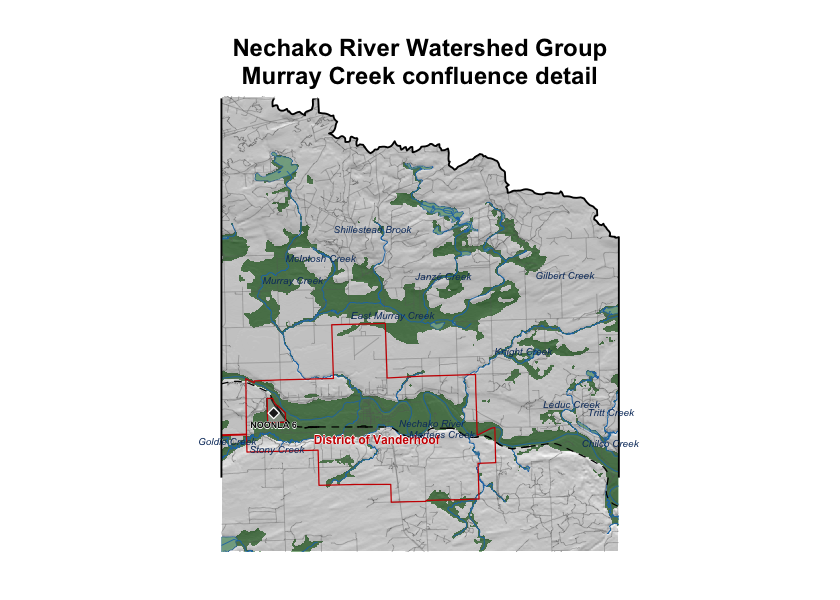
Figure 5.18: Detail view of the Murray Creek confluence with the Nechako River. Symbology as Figure 5.17; named streams labelled in italic blue; municipalities outlined and labelled in red.
The watershed-wide view shows floodplain tracking the trunk Nechako River through broad valley reaches and tributary confluences. The detail view near Vanderhoof resolves how road corridors and settlement intersect the floodplain footprint at reach scale — context that informs whether crossing remediation at a given site should account for restoring lateral connectivity beyond the structure itself. We plan to extend this mapping to additional watershed groups in coming years so that floodplain context can inform barrier prioritisation and restoration scoping across the region.